Monday, 17 October 2022

Folk Music of Assam


Folk Music of Assam, Indian Folk MusicFolk Music of Assam is equally rich like the state’s rich culture. Its richness can be very well noticed in its different types of folk music which reflects the life of the folk people. Since the origin of the mighty Brahmaputra River, Assamese music has been affluent. Nevertheless, the introduction of Indian Classical music and Religious music of Mahapurux Sankardeva and Madhavdeva has added precious stones to the coronet of Assamese folk music, which dates back to several centuries and evidences of practice of music are found during the 2nd century.

Folk Music of Assam is rich and encompasses different types of folk music. Some of the famous Folk Music of Assam is as follows;

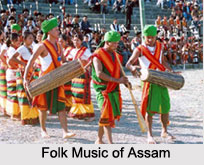
Bihu Geet: The festival of Bihu is the heart and soul of Assamese culture and Bihugeet are the songs sung during this festival. The carnival of life is expressed through Bihu songs. These songs are performed by youth, which is characterized by, flinging and flipping of hands, brisk stepping and swaying of hips.
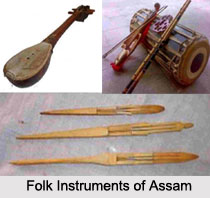
Folk Music of Assam, Indian Folk MusicKamrupiya Lokageet: Kamrupiya Lokageet is a popular form of folk music of Assam, which is basically sung in lower Assam. This music developed during the reign of Kamrupa Kingdom. These songs are based on various human emotions, especially of common people. It is known for its richness of musical style.

Goalporiya Lokageet: Goalporiya Lokgeet is a form of folk music of Assam, which is mainly sung in the Goalpara district of Assam. It is basically lyrical song of Goalpara based mainly on love.

For more, visit the link below:

Saturday, 15 October 2022

Indian Film Boards and Associations


Indian Film Boards and AssociationsIndian Film Boards and Associations provide the necessary ideal assistance and backing to the film industries of India, few of them acting as their regulatory bodies. The credible luminaries of Indian film fraternities have come together and steadily worked for the betterment of the industry, by collaborating and establishing these various associations. By setting up such organisations, they have proactively supported for the cause of growth and promotion of Indian Cinema, along with providing different benefits to the influential names in the industry. The following boards and organisations have been formed at the national level and all their activities are carried out at the national level.

Film and Television Institute of India (FTII)
One of Asia's premier film schools, the Film and Television Institute of India (FTII) is a member of CILECT (International Liaison Centre of Schools of Cinema and Television), an association of the world's leading schools of film and television. It is an autonomous institute under the Ministry of Information and Broadcasting of the Government of India. Television and film actor Gajendra Chauhan was appointed Chairman of the FTII in 2015.

Central Board of Film Certification (CBFC)
The Central Board of Film Certification (CBFC) certifies all films that get released and exhibited to public in India. Headquartered at Mumbai, it has 9 regional centres at Bangalore, Chennai, Cuttack, Delhi, Guwahati, Hyderabad, Kolkata, Thiruvananathapuram and Mumbai again. A Film Certification Appellate Tribunal (FCAT) has also been constituted under Section 5D of the Cinematograph Act, 1952 for hearing appeals against any order of the CBFC. While the work of certification of films is a central subject, the states have to enforce these censorship provisions and bring any violations to the notice of the CBFC. The organizational structure of the CBFC is based on the provisions of the Cinematograph Act and the Cinematograph (Certification) Rules 1983.

National Film Development Corporation of India (NFDC)
National Film Development Corporation of India (NFDC) is the central agency established to encourage the high quality cinema movement in the country. The primary goal of the NFDC is to plan, promote and organize an integrated and efficient development of the Indian film industry and foster excellence in cinema. Over the years NFDC has provided a wide range of services essential to the growth of Indian cinema. The NFDC (and its predecessor the Film Finance Corporation) have funded over 300 films. These films, in various Indian languages, have been widely acclaimed and have won many national and international awards.

For more, visit the link below:
Friday, 14 October 2022

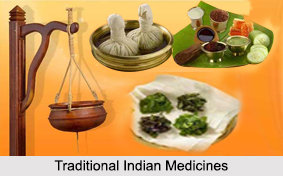
Traditional Indian Medicines


Traditional Indian MedicinesTraditional Indian Medicines are made from herbs or mixture of herbs either alone or combining it with minerals, metals and other ingredients. Traditional Indian Medicine reminds one of the ancient Indian health care systems popularly known as Ayurveda. Ayurveda is concerned with the protection of ‘Ayush’ which includes healthy living along with therapeutic measures that relate to physical, mental, social and spiritual harmony.

Concept of Traditional Indian Medicine
The central concept of traditional Indian medicine is the theory that the good health can be maintained when there is a balance between the Tridoshas; Vata, Pitta and Kapha. Vata is the air principle necessary to mobilize the function of the nervous system. Pitta is the fire principle which uses bile to direct digestion and hence metabolism into the venous system. Kapha is the water principle which relates to mucous, lubrication and the carrier of nutrients into the arterial system.

Origin of Traditional Indian Medicine
The origin of this traditional Indian medicine, Ayurveda is stated to be a divine revelation of the ancient Indian creator Lord Brahma. This knowledge was directly passed to Daksha Prajapati in the form of ‘Shloka’ sung by Lord Brahma and this was then passed through a successive chain and ultimately to Lord Indra, the protector of Dharma. The first human exponent of Ayurveda was Bharadvaja, who learned it directly from Lord Indra. Bharadvaja in turn taught Ayurveda to a group of assembled sages, who then passed down different aspects of this knowledge to their students. Ayurveda was first described in text form by Agnivesha, in his book the ‘Agnivesha Tantra’. The book was later renamed by Charaka and came to be known as the ‘Charaka Samhita’.

For more, visit the link below:
Thursday, 13 October 2022

Tourism In Gujarat


Tourism In GujaratGujarat, the western most state in India, presents its tourists with diverse places of interest. This state is noted for its temples which attract millions of devotees all the year round. There are also quite a few places of historical importance which are much visited by the tourists. Ahmedabad, the capital city of Gujarat offers a wide array of tourist destinations. Wild life and beaches in Gujarat are an integral part of its tourism. Village tourism can prove to be a pretty interesting experience for enthusiastic visitors. With this wide range of most spectacular attractions, along with a vibrant culture and rich heritage, Gujarat is one of the most favourite holiday spots for the tourists. The Tourism Corporation of Gujarat Limited offers an all-embracing travel services to visitors to the state.

Pilgrimage Tourism in Gujara
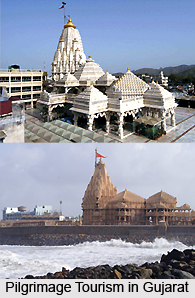
Pilgrimage tour in Gujarat has shown a phenomenal growth from its distant past. Today, the Gujarat tourism offers a wide array of tourist destination that attracts religious pilgrims from all over the world. Gujarat is dotted with temples and mosques hence this state is an important pilgrimage center for both Hindus and Muslims. Akshardham temple located in the Gandhinagar city of Gujarat is one of the renowned religious places of the state. Religious tourists from all across the country come here to offer their prayer. The Ambaji temple, in the Banaskantha district of Gujarat is dedicated to Ambe Mata - the Mother Goddess, and is a popular pilgrim place for Hindus. Ambaji temple is also regarded as one of the Shakti Peethas in India. Devotees in large numbers throng the Ambaji Temple during Purnima fairs held, on the full moon day, in the months of Kartika, Chaitra and Bhadrapad. The Somnath temple in Gujarat is also a major destination for pilgrims. The city of Dwarka in Gujarat, dedicated to Lord Krishna, is a place of great religious significance. Legend has it that Krishna had spent nearly hundred years of his life in Dwarka. The Tourism Corporation of Gujarat Limited, set up in 1975, provides comprehensive travel services to visitors to the state. During Janmashtami, this place is flooded with pilgrims from every corner of India. Ahmedabad, the capital city of Gujarat, has some of the most amazing mosques. The Sidi Sayed Mosque in Ahmedabad is the most predominant shrine for the Muslim devotees in Gujarat. It is a much visited religious site for people from all over the country. The Juma Masjid in Ahmedabad is another coveted place for the pilgrim tourists. During Fridays the mosque is flooded with devotees who come here for the prayer ceremony. There are also few churches and Jain temples in the state of Gujarat. Apart from the religious significance, these holy places are noteworthy for their splendid architecture.

To explore more of Gujarat, visit the link below:

Wednesday, 12 October 2022

Arjuna Awards in India


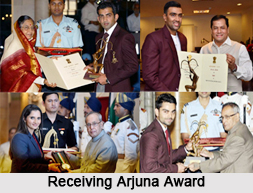
Arjuna Awards in India, Sports AwardsArjuna Awards in India are introduced for recognising the exceptional accomplishments of the players in National sports. Arjuna Awards were introduced by the Government of India in the year 1961. Arjuna Award includes a bronze statue of Arjuna, a scroll and a cash reward of Rs. 5, 00, 000. The Government of India has recently revised the scheme for the Arjuna Award. According to the guidelines, to be eligible for the Award, a sportsperson should not only have had good performance consistently for the previous four years at the international level with excellence for the year for which the Award is recommended, but should also have shown qualities of leadership, sportsmanship and a sense of discipline.

Arena of Arjuna Awards
+ In India, there are a lot of sports that have been considered as the mainstream or most popular sports. Amongst these sports Athletics,Hockey, Cricket, Football, Boxing, Chess, Basketball, Tennis, Table Tennis, Badminton, Swimming, Volleyball, Shooting, etc. are the leading. However, there are some other sports as well that might not be that much popular but that have been played in India for quite a very long period of time. Some of these are Equestrian, Rowing, Cycling, Gymnastics, Archery, Judo, Golf, Kabaddi, Carrom, Billiards and Snooker etc.

Eligibility to achieve Arjuna Awards
In recent times, Government of India has modified the scheme for the Arjuna Award. The revised guidelines states that a sportsperson will be considered eligible for receive the Arjuna Award if that player has shown sportsmanship, leadership, discipline qualities. Further, that sportsman should have had a good performance record constantly at the international level for the past three years.

Categories of Arjuna Awards
Since the year 2001, the Arjuna Award is awarded in cases of the categories including Sports for the Physically Challenged, Commonwealth Games/ Olympic Games/ World Championship Disciplines/ Asian Games/ World Cup and also in the category of Indigenous Games. During the middle of August 2011, as many as 19 Indian athletes had received the Arjuna Awards, and during 2012, 25 sportspersons were granted the Arjuna Awards.

For more, visit the link below:
Tuesday, 11 October 2022

Vishnu Purana


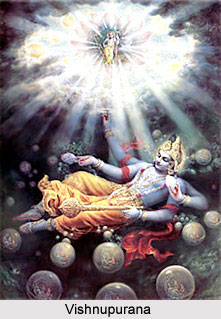
Vishnu PuranaVishnu Purana, also known as the Puranratna, or the gems of Puranas, is one among the eighteen major Indian Puranas. It is the sacred text of the Vaishnava branch of Hinduism. In this work Vishnu is praised and glorified as the highest being, as the one and only god, with whom Brahma and Lord Shiva are one, and as the creator and preserver of the world. Similar to the other Puranas, the Vishnu Purana also narrates the story of the creation of Cosmos to its destruction at the end. The text of Vishnu Purana opens with the introduction of the four Yugas at the beginning of the text. In addition to these, there are widespread sections on lineage of the celebrated kings, heroes and demigods of ancient India, including those from the epics of Ramayana and Mahabharata. It has been enumerated in the text of Vishnu Purana, if a man gives as a gift a book of Vishnu Purana on the full-moon day in the month of Asadha (July) with Jaladhenu he will attain the sacred Vishnupada.

Origin of Vishnu Purana
In the Vishnu Purana the reference of the Maurya Empire is found. Hence the scholars have surmised it to be composed in the first or second century AD.

Composition of Vishnu Purana
It is divided into six Adisas or Khandas or chapters. It deals with the events of Varahakalpa and contains 23,000 Shlokas. Its character is more that of a unified composition than of a mere compilation, which the case with most of the other Puranas is. It has been narrated by the narrator himself that Vyasa, adept in the composition of Puranas, composed this Puranasarirhita with akhyanas, upikhyanas, githas and kalpanirnayas. A Suta named Romaharsana was Vyasa's chief disciple. Vyasa in order to propagate his teachings among his disciples gave that Samhita to that Suta. Romaharsana had six disciples named Sumati, Agnivarcas, Mitrayus, Sarhsapiyana, Akrtavrana and Savarni. Of these, Akrtavrana, Savarni and Sarhsapiyana born in the Kasyapagotra have composed Puranasamhitas, which are based on the teachings of Vyasa described in Samhita. There is yet another Samhita composed by Romaharsana which became the basis of the sarirhitas of his three disciples. The narrator says that he composed the Vishnu Purana based on the above four Samhitas.

For more, visit the link below:
Monday, 10 October 2022

Indian Desserts


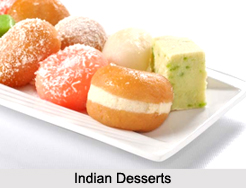
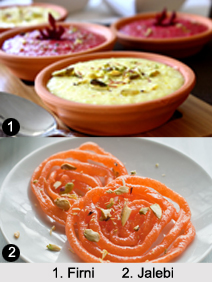
Indian DessertsIndian Desserts are a perfect delight in every season which not only satisfies the taste buds but also energizes the body with glucose shots. India has a wide range of very delectable, finger licking and luscious Indian desserts recipes. Indian sweet seems difficult to resist. It is said that there is no country has a wider range of exotic, luscious sweets than in India. A sumptuous meal is always incomplete without sweet dish like ‘Gulab Jamun’ or ‘Kulfi’ or ‘Gajar ka Halwa’. Desserts give a befitting end to any meal.

History of Indian Desserts
Historical facts lay bare that, desserts in India have an influence of various cultures those have come to India over the years through invasions or as a visitor. The word ‘Dessert’ has its etymological roots in the French term that has been derived from the word ‘desservir’ which means "to clear the table" or "to serve". The origin of sweets in India has been traced to at least 500 BC, where both raw sugar as well as refined sugar was being produced.Indian Desserts

Types of Indian Desserts
Indian Desserts can be divided into 2 broad categories one major category is the milk based dessert such as ‘Rabri’, ‘Peda’, ‘Barfi’ and so on. The second category of Indian dessert includes flour based sweets such as ‘Lal Mohan’, ‘Malpoa’, ‘Halwa’ and ‘Ladoo’.

For more, visit the link below:
Friday, 7 October 2022

Mudras of Universal Application

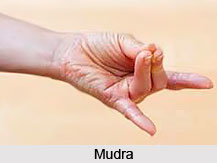
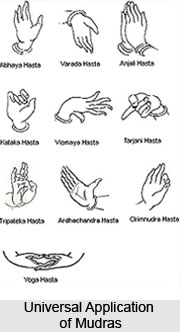
  In our daily life, we use all our body parts to give different gestures and postures. But the use of hands is the most frequent one. Here, are few mudras discussed below, which are given by the use of the hands.


Abhaya Hasta
Mudras of universal applicationThis mudra is denoted by exposing the right hand palm in front with fingers pointing upwards. This mudra indicates assurance and protection. The abhaya mudra can be seen in the images of Vishnu and Siva.

Varada Hasta
In this mudra, the palm of the left hand is exposed in front with fingers pointing downwards as if giving something. This mudra is commonly used by the deities to give a boon.

Mudras of universal applicationAnjali Hasta
In the Anjali hasta mudra, both the hands are clasped together. The palms are kept near the chest and touching it as if giving salutation. This mudra signifies the worship and can be seen usually in the images of devotees and subordinate deities.

Kataka Hasta
The Kataka hasta mudra is indicated by applying the tips of fingers loosely to the thumb to form a ring to hold flowers. This mudra is visible in the images of female deities to hold flowers for daily worship.

Vismaya Hasta
In the Vismaya Hasta, the forearm is bent at the elbow with palm facing the image. Then the fingers are kept pointing upwards. This particular mudra indicates the astonishment on the part of the deity.

Tarjani Hasta
The Tarjani hasta mudra denotes as if someone is warning or scolding the other or drawing attention as if preaching. In this mudra the index finger of a semi-flexed hand is pointed upwards.

Tripateka Hasta
In the Tripateka Hasta, the hand is raised above the level of the shoulder with the palm facing in front. The first two fingers are kept rising upwards and little separated to hold an insignia. This particular mudra can be seen in the images of Vishnu and Siva when carrying their emblems.

Damartt Hasta
In the damartt hasta mudra, the palm faces inwards and a drum is held either through a ribbon held between the index and middle finger or it is kept between the thumb and the three fingers lightly and in a playful manner. It is not a hard grip.

For more, visit the link below:
Thursday, 6 October 2022

Rituals of Durga Puja


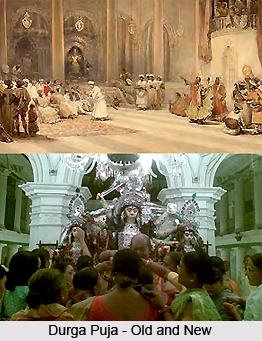
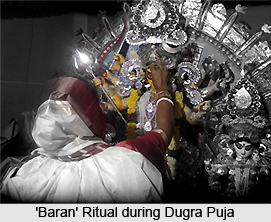
Rituals of Durga PujaRituals of Durga Puja start from the day of Mahalaya and continue till Dashami. The rituals include Bodhon, Amantron, mangal ghat, bathing of Nabapatrika and so on. Sacrifices are also included in the rituals. Earlier there was animal and human sacrifice. Since the rule of Vaishnava Kings there has been no such sacrifice. Vegetables are sacrificed instead. The sacrifice of pumpkin was one of the most common substitutes. Sacrifice is basically casting away of one's sins and faults.

Incantations
Mantra has the power to accomplish what they say in the context of the Puja. Chanting of Mantras in a Puja is very efficacious. The power of mantra is associated with Puja and kriya. One can take refuge in God as Mother.

One finds the following prayer to Mother Durga in the Mahanarayana Upanishad (2.2): I take refuge in Her, the Goddess Durga, who is fiery in lustre and radiant with ardency, who is the Power belonging to the Supreme, who manifests Himself manifold, who is the Power residing in actions and their fruits, rendering them efficacious (or the Power that is supplicated to by the devotees for the fruition of their work). O Thou Goddess skilled in saving, Thou takest us across difficulties excellently well- Our salutations to Thee.". She is duly worshipped in both aspects. One hymn praises Her benign Power, saying, "To Durga, the gracious and ever-benign, to the ever-auspicious One, the manifesto of all the worlds, I offer my respectful obeisance." With words of humility and reverence, another hymn praises both aspects: "Obeisance to Thee, O Divine Mother, Durga, the benignant and yet terrific roaring. Thou art power, the dark night of destruction." Both aspects, understood correctly, reveal Her benign redeeming grace. She destroys but to save. The vibrations give power. It is the sound that produces vibration. Mantra has the quality of a spell. People generally accept the action of the mantra when it is uttered by an ascetic. Mantras need to be pronounced correctly. Mantras contain the deity's name in a particular object in which it is invoked.

For more, visit the link below:
Saturday, 1 October 2022

Repertoire in Kathakali


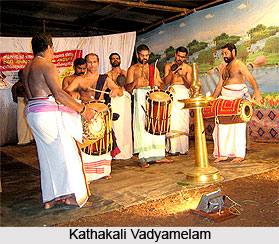
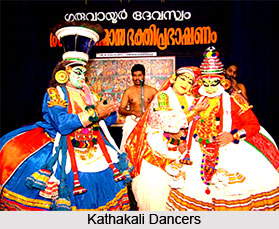
Repertoire in KathakaliRepertoire in Kathakali borrows heavily from both Mahabharata and Ramayana. Kathakali is generally performed in the evening. It begins with the beating of drums as that plays a key role in creating an atmosphere to perform. The play is performed outside with the light of a single oil-lamp. The beating of drums is done to get the attention of the audience. Dance is combined with dialogue to bring about a life in the myth and legends narrated. In the actual performance, there are three main types of characters: the Satvik which include gods, kings or heroes; the Rajasik, characters with specific vices, such as greed, lust, or vanity; and the Tamasik, the evil characters, such as demons. The basic moral is always the eternal warfare between good and evil.

The playing of the drums or commonly called melappadam is followed by a devotional song called the todayam. Here one or two characters invoke blessings of God. Todayam is performed behind a curtain held by two stage-hands. After that a piece is performed known as the purappadu. Here two characters appear, it is either the hero and his consort, or two other characters who are painted green, or even the Pandavas. The purappadu is a dance of invocation which has no mime. Several dance sequences are performed known as kalasams. Through these cadences the techniques of Kathakali are performed. After this, the play that is chosen for that evening starts.

Repertoire in KathakaliThere is the slow revelation of the character from behind the curtain before any major character appears. As the curtain gets lowered the character gradually appears. A powerful character when appearing for the first time stands close behind the curtain. The character executes many dance sequences which is accompanied by drums and cymbals and seen by the audience partially. The suspense is maintained. Then the curtain disappears and he appears in his full beauty. The play with curtain is commonly known as tiranokku.

For more, visit the link below: