Showing posts with label yogalife. Show all posts

Tuesday, 21 March 2023

Bandhas, Type of Pranayama


Bandhas, Type of PranayamaTypes of Bandhas
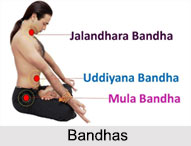
There are three major bandhas in vogue. Jalandhara Bandha is for throat, Uddiyana Bandha is for abdomen and Mula Bandha is for perineum and anus. Apart from these three main bandhas, there is another Bandha known as the ‘Maha Bandha’. It is an advanced yogic practice that involves practicing three major bandhas together: Mula Bandha, Uddiyana Bandha and Jalandhara Bandha.

These sensitive areas are stimulated during Pranayama by practicing these bandhas particularly during Kumbhaka. Then the Pranic energy passes upwards through Sushumna, which is to be experienced. Thus it may be said that the mudras will awaken the kundalini power while bandhas will help this serpent power to rise up along the chakras to bring about a specific effect.

Meaning of the word ‘Bandha’ is to bind, to lock, or to tie. The particular neuromuscular junction is contracted to increase positive pressure and to generate visceroreceptive or proprioceptive impulse that would travel upward through ascending path in the spinal cord. Secondly, there is a specific type of sensation at the contracted area. One has to remain attentive in order to maintain the contraction for a few seconds. One has to develop awareness of these impulses and the sensitivity to experience them.

For more, visit the link below:

Friday, 7 October 2022

Mudras of Universal Application

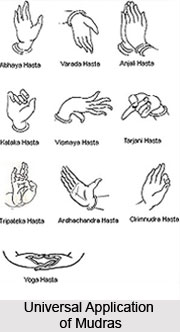
  In our daily life, we use all our body parts to give different gestures and postures. But the use of hands is the most frequent one. Here, are few mudras discussed below, which are given by the use of the hands.


Abhaya Hasta
Mudras of universal applicationThis mudra is denoted by exposing the right hand palm in front with fingers pointing upwards. This mudra indicates assurance and protection. The abhaya mudra can be seen in the images of Vishnu and Siva.

Varada Hasta
In this mudra, the palm of the left hand is exposed in front with fingers pointing downwards as if giving something. This mudra is commonly used by the deities to give a boon.

Mudras of universal applicationAnjali Hasta
In the Anjali hasta mudra, both the hands are clasped together. The palms are kept near the chest and touching it as if giving salutation. This mudra signifies the worship and can be seen usually in the images of devotees and subordinate deities.

Kataka Hasta
The Kataka hasta mudra is indicated by applying the tips of fingers loosely to the thumb to form a ring to hold flowers. This mudra is visible in the images of female deities to hold flowers for daily worship.

Vismaya Hasta
In the Vismaya Hasta, the forearm is bent at the elbow with palm facing the image. Then the fingers are kept pointing upwards. This particular mudra indicates the astonishment on the part of the deity.

Tarjani Hasta
The Tarjani hasta mudra denotes as if someone is warning or scolding the other or drawing attention as if preaching. In this mudra the index finger of a semi-flexed hand is pointed upwards.

Tripateka Hasta
In the Tripateka Hasta, the hand is raised above the level of the shoulder with the palm facing in front. The first two fingers are kept rising upwards and little separated to hold an insignia. This particular mudra can be seen in the images of Vishnu and Siva when carrying their emblems.

Damartt Hasta
In the damartt hasta mudra, the palm faces inwards and a drum is held either through a ribbon held between the index and middle finger or it is kept between the thumb and the three fingers lightly and in a playful manner. It is not a hard grip.

For more, visit the link below:

Tuesday, 6 September 2022

Kurmasana, Cultural Asana


Kurmasana, Cultural AsanaKurmasana is an advanced yoga posture that putatively prepares the aspirant for Pratyahara, a higher stage in Yoga practice. The asana is highly beneficial to the spine and the abdominal organs. Kurmasana is a seated yoga asana in which the body folds at the waist and the arms slip under the legs. It is recommended to stay in the pose for 30 to 40 seconds and for roughly 5 to 10 breaths. This pose is designed to create inner awareness and relaxation. As a result, Kurmasana is touted as beneficial for relieving stress and improving concentration.

Its name comes from the Sanskrit ‘Kurma’ which means ‘turtle’ or ‘tortoise’, and asana which means ‘posture’. It is so called because the asana resembles the shape of a tortoise in the full pose. Kurmasana may also be known as ‘Tortoise Pose’.

KurmasanaPractice of Kurmasana
In this posture the human body resembles the tortoise. A sequential process for the practice of Kurmasana follows:

• Sit with legs wide apart. Place the hands on the thighs.
• Inhaling, slightly bend the knees.
• Exhaling fully, bend the upper body forward from the hips. With palms facing down slide the arms under the knees from inside the legs.
• Slowly bend the upper body further forward until the chin and the chest touch the floor.
• Stretch the arms backwards as far as possible. The legs should be bent as little as possible.
• Breathing normally hold this position.
• Inhaling return to the starting position.

For more, visit the link below:

Tuesday, 17 May 2022

Tantra Yoga


Tantra Yoga, Types of YogaTantra Yoga holds a special place for the Hindus as it is a potent power for spiritual regeneration. It enlightens the one who is in darkness. It is a unique approach which studies the phenomenon of the entire universe from the perspective of the individual. A lot of sciences including astronomy, astrology, numerology, physiognomy, physics, chemistry, Ayurveda, psychology, mathematics and geometry are included within the realm of Tantra Yoga. Tantra Yoga does not limit itself to a particular branch of study rather it incorporates in it diverse elements which are linked together with a unifying rule of the Dharma. Rather the essence of Tantra Yoga is to understand the Dharma in the absolute sense.

Aims of Tantra Yoga
Tantra Yoga aims to bring in consciousness in all the three states of human life; that is, in the conscious state, the waking state and in the dream state. In order to attain this consciousness, the human mind needs to seek immense spiritualism and deep knowledge. Tantra Yoga teaches the methodology and the ways which discards intolerance, ignorance, selfishness and the animal instinct that is present in human beings. Tantra Yoga thus concentrates on a single point that helps individuals to emancipate the consciousness from limitation.

Role of Shakti in Tantra Yoga
Tantra Yoga, Types of YogaUniverse is made of two opposing forces, while Lord Shiva being the static principal, Shakti is the dynamic force. Shakti stands for creativity, energy and power. The external part of everything is the creative aspect and inside every dynamic aspect lies the static part. The role of Shakti has neither any beginning nor any end. Although energy is restless yet it moves in an orderly cycle following alternate periods of rest and motion. The phenomenon of energy undergoes a lot of changes. It gets distorted and gets reorganized during its period of rest. Thus it can be said that there is a constant process of creation, preservation, destruction, reorganization and recreation in this world. According to the Tantra Yoga, Shakti is the Universal Mother who has the power to create, destroy and sustain. As a result the essence of Tantra Yoga lies in worshipping Shakti as an aspect of the Divine.

Thursday, 31 March 2022

Tantra Kundalini


Tantra KundaliniIn human beings, Shakti, the female aspect is called "Kundalini". This is the vital energy that rests at the base of the spinal cord. The Yoga Upanishads describe Kundalini as lying "coiled" at the base of the spine, represented as either a goddess or sleeping serpent waiting to be awakened. The object of Tantric practice of Kundalini Yoga is to awaken the cosmic energy and make it ascend through the psychic centers, the charkas that lie along the axis of the spine as consciousness potentials. The female Shakti then again unites above the crown of the head with Shiva, the pure consciousness. This union aims at Kundalini Yoga. Thus duality turns into unity and fusion with the absolute takes place. By this union the Sadhaka or the worshipper attains liberation, which is considered as the highest experience: a union of human life with the Universe. Once Kundalini Shakti has ascended to above the crown of the head and merged with Shiva, it is made to reverse its course and return to rest at the base of the spine.

Concept of Kundalini
According to the Tantric philosophy, the entire universe is the manifestation of pure consciousness. In manifesting the universe, this pure consciousness seems to become divided into 2 aspects, each of which cannot exist without the other. Each requires the other in order to manifest its total nature. Tantra KundaliniThe aspects are Shiva and Shakti. Shiva, the masculine part retains a static quality and remains identified as long as the consciousness is not manifested. Shiva has the power to be but not the power to change the world. The other aspect of the power is Shakti, which is feminine, dynamic, energetic and creative. Shakti is the Great Mother of Universe, from which all the other creatures are born.

According to the Tantra, the human being is the miniature of the Universe. All that is found in the cosmos can be found within the individual and the principle that applies in case of universe also applies in the case of individual being.

For more, visit the link below:

Monday, 6 December 2021

Mudras in Therapeutic Use


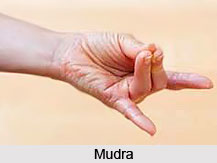
Mudras in Therapeutic UseMudras or hand gestures are used extensively to communicate in dance and other art forms. The science of Mudras is also based on the retention and maintenance of the natural balance in our lives. A healthy existence is always desired and Mudra in therapeutic use defines a feeling of 'wellness'. Thus Mudras have a beneficial effect on the mind and the body of a human being. However, Mudras, similar as Yoga must be practiced sincerely and after attaining full knowledge of them. Mudras are natural process of healing from any ailment or disease. Tradition says that the body, mind, and soul are inherent to every fingertip, every finger joint in each individual finger, and naturally also in the entire hand itself.

Mudras are easy to practise as they are free from negative elements. According to the science of Mudra, the five fingers of the hand correspond to the five natural elements. The thumb is associated with 'Agni' or fire, the index finger with 'Vayu' or air, the middle finger with 'Akash' or ether or space, the ring finger with 'Prithvi' or earth and the little finger with 'Jal' or water. A great influence on every area of the body is rendered through the fingers and hands. It is believed that the physical level is associated with material energy.

A reference of the basic qualities of Mudras is found in the ancient health systems. It is on the concept that a balance of the five elements in the body is maintained by the tips of the fingers. Each fingertip possesses energy corresponding to these five elements and by connecting various fingers to each other in different gestures help in balancing these elements in the body.

The mudra therapy is considered to be five thousand years old. Much knowledge of the Mudras in therapeutic use is rooted in ancient texts however this knowledge is often twined with religion. Mudra therapy is a complementary therapy and can be practised side by side with any regular therapy. The therapeutic use of Mudras can be classified with popular therapies such as Acupressure, Naturopathy, Pranic healing and Reiki. According to traditional healing process there are seventy to eighty Mudras used for therapies.

A wide variety of Mudras in therapeutic use are found. Mudras such as Pran mudra, the Vayu mudra, the Shunya mudra, the Shankh mudra, the Prithvi mudra and the Varun Mudra are used for therapies. Each of these mudras can be practised to relive conditions ranging from a simple cold to chronic disorders. Although researches say that the healing process is not instant but a strong believe of getting well can be equally effective.

For more, visit the link below:

Tuesday, 20 July 2021

Surya Yoga, Types of Yoga


Surya Yoga, Types of YogaSurya Yoga, also known as ‘Surya Namaskar’ is a type of yoga which is the salutation to the Sun. Surya is the fountain source of strength and vitality, light and effulgence and so. It naturally rules the heart, spine and constitutions of human body. A person’s life, health and well-being are truly dependent upon the Sun.

Concept of Surya Yoga
Surya is an essential concept in yoga because, since ancient times, yogis have worshipped the sun through mantras, movements and salutations. Surya Jowel, known as ‘Surya Swami’, is the founder of the Surya Yoga. Surya Yoga or Surya Namaskar is a combination of two Sanskrit words Surya and Yoga, where ‘Surya’ means Sun and ‘Yoga’ means ‘to yoke’. Together which literally means to amalgamate with the sun – become one.

Healing through Sunlight
Sunlight has great therapeutic value. The importance of Sun was realised very early by the ancient civilizations. It was given the status of a God and worshipped from time immemorial. The Sun generates ‘Vital force’ or ‘Prana Shakti’ that contains 5 sub-vital airs known as ‘Panch Prana’ which is inherent in every limb, muscle, etc.

Benefits of Surya Yoga
Surya Yoga is an energetic, dynamic and rejuvenating style of yoga based on a unique series of Sun Salutations. The omnipotent Surya’s presence can change, arrange, reduce, remove imbalances and organise the chemical, bio-chemical, bio-electrical and bio-magnetic powers in living beings by practising Surya Yoga. Surya Yoga helps in revitalise energy and negates illnesses of the mind and body. It is a blend of yoga, nada (sound), rishi gyan and Gautama Buddha stage (silence).

For more, visit the link below:

Wednesday, 7 July 2021

Supta Baddha Konasana


Supta Baddha KonasanaSupta Baddha Konasana is a cultural yoga asana that tones the muscles of the legs and abdomen. It is performed in a reclining posture and relaxes the mind and body.

Meaning of Supta Baddha Konasana
Supta means "sleeping or reclining" (here the meaning is strictly reclining), Baddha means "Bound", and the literal meaning of Konasana is "angle". Supta Baddha konasana is classic restorative posture that can be modified to meet any level of resistance in the hips and groins.

Practice of Supta Baddha Konasana
The procedure should be started by acquiring "Baddha Konasana" posture.
* While in the above-mentioned posture, Exhale and lower back torso toward the floor while leaning on the hands.
* Once leaning back on the forearms, use the hands to spread the back of the pelvis and release the lower back and upper buttocks through the tailbone.
* Bring the torso all the way to the floor, supporting the head and neck on a blanket roll or bolster if needed.
* While gripping the topmost thighs, rotate the inner thighs externally, pressing the outer thighs away from the sides of the torso.
* Next slide the hands along the outer thighs from the hips toward the knees and widen the outer knees away from the hips.
* Slide the hands down along the inner thighs, from the knees to the groins. Imagine that the inner groins are sinking into the pelvis. * Push the hip points together, so that while the back pelvis widens, the front pelvis narrows.
* Lay the arms on the floor, angled at about 45 degrees from the sides of the torso, palms up. The natural tendency in this pose is to push the knees toward the floor in the belief that this will increase the stretch of the inner thighs and groins. But especially if the groin is tight, pushing the knees down will have just the opposite of the intended effect: The groin will harden, as will the belly and lower back. Instead, imagine that the knees are floating up toward the ceiling and continue settling the groin deep into the pelvis. As the groin drops toward the floor, so will the knees.
* While practicing this posture in the beginning, stay in this pose for one minute. Gradually extend the stay anywhere from five to 10 minutes.
* To come out, use the hands to press the thighs together, then roll over onto one side and push away from the floor with head trailing the torso.

Benefits of Supta Baddha Konasana
* The posture stimulates abdominal organs like the ovaries and prostate gland, bladder, and kidneys.
* It stimulates the heart and improves general circulation.
* Stretches the inner thighs, groins and knees.
* Helps in relieving stress, mild depression, menstruation and menopause.

For more, visit the link below:

Saturday, 29 May 2021

Kaivalya Pada, Patanjali Yoga Sutra


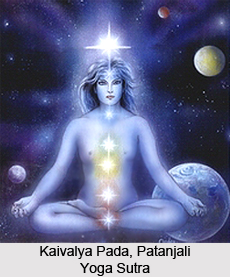
Kaivalya Pada, Patanjali Yoga SutraKaivalya Pada is the fourth and the final chapter of Patanjali Yoga Sutra. The three components of Indian philosophy have been laid down systematically in the unique way of Patanjali. The components of Kaivalya Pada are 'Bhakti Marga', 'Karma Marga', and 'Jnana Marga'. In Kaivalya Pada, the path of renunciation or the 'Vairagya Marga' is elaborately explained.

Kaivalya means exclusiveness, or eternal emancipation. Kaivalya Pada describes an absolute, indivisible state of existence of the 'Yogi'. The yogi is free of thoughts, mind, intellect and ego and also freed from the intricacies of the 'gunas' of nature like, 'sattva', 'rajas' and 'tamas'. The chapter of Kaivalya Pada is both impressive and exhaustive. One of its main themes is that the content of consciousness is pure, absolute and divine, provided it remains unblemished by action; be it white ('sattvic') grey ('rajasic') or black ('tamasic'). The absolute nature of consciousness is to be realised by propitious birth, spiritual fervour and meditation.

Kaivalya Pada opens with the contention that prodigious yogic powers may be inborn, acquired by merit accumulated through practice in former lives. They may also be attained through use of herbs ('ausadhi'), incantation ('Mantra'), devoted discipline ('tapas'), meditation ('dhyana') and total absorption ('Samadhi'). In these five types of yogis, nature's energy, which later becomes known as 'Kundalini', flows with ever-increasing abundance, preparing them to receive the infinite light of the soul. This is why tapas and Samadhi are held to be the best of the five; they provide a firm foundation for stable growth, which prevents the yogi from misusing the energy built up through his practices. For ensuring safety the yogis employ method and restrain so as to use nature's energy ('Shakti'), intelligently to gain wisdom.

In other chapters of Patanjali Yoga Sutra, it is pointed out that nature is eternal and its qualities or gunas are ever-changing. Kaivalya Pada further says that this blending of the gunas creates diversity in the mind so that it sees objects in different ways. The object is the same and the mind, too, is the same. But the same mind has many qualities of mood and behaviour. This fragmentation is the cause of 'Avidya'. The mind divided by the gunas moulds and re-moulds man. The study of subject and object helps the student to perceive with prejudice, and facilitates him to be aware of the objects exist independently, irrespective of his cognition of them.

The last word used in 'Vibhuti Pada' is Kaivalyam, which denotes detachment from the material world. There are almost thirty-four 'Sutras' under this section that guides the Yogi step by step, about what comes after Samadhi. After reaching this stage, the individual gains an amazing feeling of being united with the universe. There are no sorrows or happiness and there is only peace and contentment for the one who has successfully attained Kaivalyam. However, it is clearly mentioned in Kaivalya Pada that this should not deter the Yogi from living his life normally. A person continues to do all their material duties however without keeping any high expectations or with the greed for anything materialistic.

For more, visit the link below:
Thursday, 29 October 2020

Meditative Asanas, Yoga


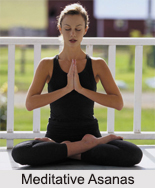
Meditative Asanas, YogaMeditative Asanas are the postures one assumes in order to sit or stand comfortably for extended durations, enabling one to concentrate and meditate without interference from muscle proprioceptors. The idea behind Meditative Asanas is merely to position oneself in such a way so that one’s limbs cease to send stimuli to the mind, allowing the practitioner to concentrate on meditation.

Meditative Asanas have been consistently mentioned in various Indian Text on Yoga over the ages, including the Puranas and the Vedas, and have formed the core around which a comprehensive physical culture of asana practice was developed.

Types of Meditative Asanas
Asanas classified as meditative are considered highly important in the canonical Yoga texts. There are 12 meditative postures listed in various Hatha Yoga manuals, and variations on the same have been devised over the years, of which 16 are known, resulting in a total of 28 Meditative Asanas. Only 19 of these, however, can be considered real Meditative Asanas, since the others are corrective or cultural.

Postures of Meditative Asanas
All the meditative Asanas are similar, and invariably involve keeping the neck and body erect to let the blood flow freely along the spine and to avoid pressure on the visceral organs. The legs are rooted to the ground to maintain a steady posture. Meditative Asanas are also performed with either of two gazes; the nasal gaze and the frontal gaze (focusing on the nose or directly in front) and also involve the three Bandhas: the chin lock, abdominal compression and anal contraction. Some hand and finger symbolisms known as ‘Mudras’, are also performed in some meditative Asanas.

For more visit the link below: