Showing posts with label Yoga philosophy and science of Patanjali. Show all posts

Tuesday, 18 July 2023

Tantrism: Unveiling the Enigmatic Current of Hinduism


Tantrism, a mysterious current within the religion of Hinduism, stands apart for its distinct purpose: the pursuit of spiritual power and the ultimate realization of Truth. While it is often associated with the worship of Shakti, the divine feminine energy, Tantrism goes beyond and combines mystical elements with sacred writings, creating a unique movement within Hinduism.


Origins and Philosophical Departure

Tantrism traces its origins back to ancient India as a counterforce to the prevailing Vedic traditions. It emerged in contrast to the ascetic and ritualistic practices of Vedic Brahmanism, emphasizing direct divine experiences and harnessing spiritual energy through rituals, meditations, and yogic practices. Tantrism sought to bridge the gap between the transcendental and the immanent, embracing both the spiritual and the worldly aspects of existence. 

The Worship of Shakti

A defining characteristic of Tantrism is its focal point on the worship of Shakti, the primordial cosmic energy that animates the universe. Shakti, viewed as the creative and transformative force, is venerated through the worship of goddesses, allowing practitioners to tap into this divine power. Within Tantric philosophy, the feminine aspect of the divine holds immense reverence, representing the dynamic interplay between masculine and feminine energies within each individual and the cosmos. 

Practices and Rituals

Tantrism incorporates a diverse range of practices and rituals, often encompassing intricate symbolism and esoteric techniques. Essential components of Tantric rituals include mantra recitation, meditation, visualization, and the utilization of yantras (geometric diagrams). These practices aim to awaken dormant spiritual energies, known as Kundalini, and direct them towards self-realization and liberation. Indian Religion

 Sacred Texts: The Tantras

Sacred texts, known as Tantras, serve as authoritative sources of knowledge in Tantric traditions. These texts provide teachings, rituals, and philosophical insights that guide practitioners on their spiritual journey. Encompassing various aspects of life, such as cosmology, metaphysics, yoga, and devotion, the Tantras offer a holistic approach to spirituality. They emphasize the integration of all facets of human experience, providing a comprehensive roadmap for spiritual seekers. 

Influence and Expansion

While Tantrism is primarily associated with Hinduism, its influence transcends religious boundaries. It has left a lasting impact on diverse traditions, including Buddhism, Jainism, and Sikhism. Within these contexts, Tantrism has been adapted and integrated into their respective religious frameworks, infusing new dimensions into their practices and philosophies. 

Misconceptions and the True Essence

The enigmatic nature of Tantrism has spawned misunderstandings and misconceptions over time. Sensationalism and distortion of its core teachings have arisen due to the esoteric nature of its practices and the misuse of certain rituals. However, at its essence, Tantrism represents a spiritual path seeking to transcend dualities and realize the underlying unity of existence. It encourages practitioners to embrace both the light and the shadow within themselves, finding liberation through the integration of all aspects of their being. 

Tantrism, an intriguing current within Hinduism, weaves a rich tapestry of practices, rituals, and philosophical insights. As a spiritual path focused on the pursuit of spiritual power and Truth, Tantrism challenges conventional notions of spirituality. Embracing both the mundane and the divine, it offers a holistic approach to spiritual exploration and empowerment. Despite the misconceptions surrounding it, Tantrism continues to be a profound and transformative tradition that invites seekers to delve into the mysteries of existence and awaken to their highest potential.

Thursday, 10 June 2021

Kundalini Chakras, Yoga


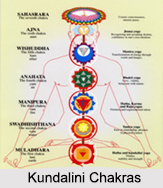
Kundalini Chakras, YogaKundalini Chakras are the 7 Chakras, according to Kundalini meditation are awakened. The Chakras are arranged vertically along the spine and abundant energy pathways or channels are present, called Nadis that intersect at these Chakras. The Chakras are sometimes referred to as lotuses, since they open and close like a flower, and in the yogic system they are represented with varied number of petals, ranging from 4 at the base Chakra to 1000 at the crown. They can be stimulating and awakened by yogic practices like asanasbreathing and meditation. When motivated, they create latent forces, which awaken the power to triumph over disease, decay and finally, according to the ancient yogis, death as well.

Concept of Chakra in Kundalini
The word Chakra is a Sanskrit word, meaning "wheel" or "disc". In the ancient yoga systems of India, the word ‘Chakra’ described a spinning vortex of energy in the subtle body.

Seven Kundalini Chakras
The lotus is used as a symbol for purity in regard to the Chakras, because despite of living in mud it is not soiled by the mud but rises above it. Thus the lotus justifies the theory of Maya Shakti. Each petal of the lotus is a separate Bija Mantra for that particular Chakra. The 7 kundalini chakras are as follows;

  • Mooladhara Chakra (base of spine): memory, time and space;
  • Svadhishthana Chakra (below navel): reason;
  • Manipura Chakra (solar plexus): willpower;
  • Anahata Chakra (heart center): direct cognition;
  • Vishuddha Chakra (throat): divine love;
  • Ajna Chakra (third eye): divine sight;
  • Sahasrara Chakra (crown of head): illumination, Godliness.

  • For more, visit the link below:

    Saturday, 29 May 2021

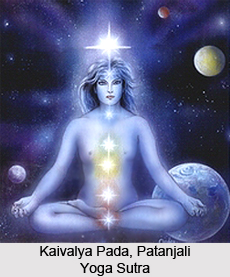
    Kaivalya Pada, Patanjali Yoga Sutra


    Kaivalya Pada, Patanjali Yoga SutraKaivalya Pada is the fourth and the final chapter of Patanjali Yoga Sutra. The three components of Indian philosophy have been laid down systematically in the unique way of Patanjali. The components of Kaivalya Pada are 'Bhakti Marga', 'Karma Marga', and 'Jnana Marga'. In Kaivalya Pada, the path of renunciation or the 'Vairagya Marga' is elaborately explained.

    Kaivalya means exclusiveness, or eternal emancipation. Kaivalya Pada describes an absolute, indivisible state of existence of the 'Yogi'. The yogi is free of thoughts, mind, intellect and ego and also freed from the intricacies of the 'gunas' of nature like, 'sattva', 'rajas' and 'tamas'. The chapter of Kaivalya Pada is both impressive and exhaustive. One of its main themes is that the content of consciousness is pure, absolute and divine, provided it remains unblemished by action; be it white ('sattvic') grey ('rajasic') or black ('tamasic'). The absolute nature of consciousness is to be realised by propitious birth, spiritual fervour and meditation.

    Kaivalya Pada opens with the contention that prodigious yogic powers may be inborn, acquired by merit accumulated through practice in former lives. They may also be attained through use of herbs ('ausadhi'), incantation ('Mantra'), devoted discipline ('tapas'), meditation ('dhyana') and total absorption ('Samadhi'). In these five types of yogis, nature's energy, which later becomes known as 'Kundalini', flows with ever-increasing abundance, preparing them to receive the infinite light of the soul. This is why tapas and Samadhi are held to be the best of the five; they provide a firm foundation for stable growth, which prevents the yogi from misusing the energy built up through his practices. For ensuring safety the yogis employ method and restrain so as to use nature's energy ('Shakti'), intelligently to gain wisdom.

    In other chapters of Patanjali Yoga Sutra, it is pointed out that nature is eternal and its qualities or gunas are ever-changing. Kaivalya Pada further says that this blending of the gunas creates diversity in the mind so that it sees objects in different ways. The object is the same and the mind, too, is the same. But the same mind has many qualities of mood and behaviour. This fragmentation is the cause of 'Avidya'. The mind divided by the gunas moulds and re-moulds man. The study of subject and object helps the student to perceive with prejudice, and facilitates him to be aware of the objects exist independently, irrespective of his cognition of them.

    The last word used in 'Vibhuti Pada' is Kaivalyam, which denotes detachment from the material world. There are almost thirty-four 'Sutras' under this section that guides the Yogi step by step, about what comes after Samadhi. After reaching this stage, the individual gains an amazing feeling of being united with the universe. There are no sorrows or happiness and there is only peace and contentment for the one who has successfully attained Kaivalyam. However, it is clearly mentioned in Kaivalya Pada that this should not deter the Yogi from living his life normally. A person continues to do all their material duties however without keeping any high expectations or with the greed for anything materialistic.

    For more, visit the link below:

    Friday, 25 September 2020

    Patanjali Yoga Sutras


    Patanjali Yoga SutraPatanjali Yoga Sutras is the ancient treasure narrating how to keep the body healthy. This yoga sutra is now one of the most acclaimed elements of everyday life. Yoga is an art, a science and a philosophy that touches the life of man at every level, bodily, intellectually and spiritually.

    All yoga as practiced today is based on Patanjali Yoga Sutras, a collection of aphorisms offered more than 2000 years ago by the Indian sagePatanjali. Patanjali Yoga Sutras by Maharshi Patanjali is the foundational text for Yoga. Historically, it is believed that Maharshi Patanjali may have lived in around 500 BC to 2000 BC and has compiled mainly three subjects of Patanjali Yoga Sutras namely, grammarmedicine and yoga. Patanjali's three works together deal with man's development as a whole in thought, speech and action.

    Patanjali Yoga SutrasDivisions of Patanjali Yoga Sutras
    Patanjali Yoga Sutra consists of 196 sutras which are divided into four chapters or padas. Each sutra consists of Sanskrit words that are written in one or two lines. The 196 sutras are precise, reflective and pious in approach. Each of the sutras contains a wealth of ideas and wisdom towards full knowledge of his real nature. The Patanjali Yoga Sutra state, through proper practice one can radiate grace, disposition and compassion. The four chapters or padas of the yoga sutras correspond to the four stages of life. The ultimate achievement of following the path of Patanjali Yoga Sutra is to experience the effortless, indivisible state of the prophet. The four chapters of Patanjanli Yoga Sutras include, Samadhi Pada, Sadhana Pada, Vibhuti Pada and Kaivalya Pada.

    Thursday, 3 September 2020

    Indian Yogic Philosophy


    Indian Yogic Philosophy on spirituality is intricately much deeper and rich than anywhere else. The strong roots have not only been preserved by the Indian culture and traditions since thousands of years, but have also spread to the western nations. It is based on this ideology that conception of Hatha Yoga has taken place. Since Hatha yoga has developed post-Vedic, it is important to place yoga within the context of Indian philosophy. To know Hatha, one has to understand at least some of the theoretical themes that reveal the practical endeavour of yoga. This elaborate theme is embedded in Indian philosophy or Darshanas. To understand the relation with Hatha Yoga, particular attention is required for the classical Yoga Darshana of Patanjali and its relevance to Hatha Yoga.


    The Six Astika Darshanas
    Vedic Samhitas may be seen as the roots of the Indian philosophical tradition. The BrahmanasAranyakas and Upanishads may arise from that root which then followed the multiple philosophical ‘schools’ in the post-Vedic era. The authority of these schools is derived from their adherence to the Vedic scriptures. Although, they all are secondary to the Vedas and Upanishads themselves, each major ‘school’ is presented not in the form of a long and rigorously argued treatise but as a series of terse statements, known as ‘Sutras’. Sutras are the coded medium to convey knowledge in different ways. The traditions of interpretation, which are based upon these texts, are known as Darshanas. Sutras, like shruti are believed to be verbal expressions of truth or realization.

    For more click the link below:

    Friday, 10 July 2020

    Yoga Asanas


    Yoga Asana traditionally means a 'sitting condition' or 'position' of the body, which contributes to the steadiness of the body and mind and a sense of well-being. In a nutshell, the yoga asanas can be defined as postural patterns. Asanas are also based on the natural postures of various 
    animalsbirds or even symbols like the treelotus, bow and plough, etc. Yoga asanas include various types of sittingstanding, stretching and inverted postures all aimed to improve flexibility, balance, strength and posture. These Yoga asanas target various muscle groups in the body. Some yoga asanas are highly ancient and have been mentioned in several ancient yoga texts.

    History of Yoga Asanas
    Though it was Maharishi Patanjali, who for the first time mentions yoga asanas, the history of these postural patterns goes back even earlier than the days of Patanjali. There are references in the VedasBrahmanasAranyakas and the earlier Upanishads about these practices. Besides, Lord Shiva and the Buddha are often portrayed sitting in the Padmasana; thus, indicating that yoga asanas were practised in ancient India as well.

    Types of Yoga Asanas
    Yoga asanas can be classified by considering their features and effects, into three major groups, and one minor group that contains only two asanas. Of the major three, the classification into cultural asanas and meditative asanas is a contemporary innovation.

    Monday, 3 July 2017

    Patanjali Yoga Sutra


    Patanjali Yoga Sutras is the ancient treasure narrating how to keep the body healthy. This yoga sutra is now one of the most acclaimed elements of everyday life. 
    "Yoga teaches us to cure what need not be endured and endure what cannot be cured".- Yoga is an art, a science and a philosophy that touches the life of man at every level, bodily, intellectually and spiritually. 

    All yoga as practiced today is based on Yoga Sutras, a collection of aphorisms offered more than 2000 years ago by the Indian sage, Patanjali. Yoga Sutras by Maharshi Patanjali are known as the Patanjali Yoga Sutra and is the foundational text for Yoga. Historically, it is believed that Maharshi Patanjali may have lived in around 500 BC to 2000 BC and Patanjali has compiled mainly three subjects of Patanjali Yoga Sutras namely, grammar, medicine and yoga. Patanjali's three works together deal with man's development as a whole in thought, speech and action. 


    Patanjali Yoga Sutra explains that the soul is pure and divine provided it is unblemished by action. Man may make or ruin his progress through good actions or bad action. Yogic action leads to religious life and non-yogic actions bind one to the world. With yogic practices the sadhaka is freed from the reactions of his actions and engrossed in Kaivalya. The Patanjali yoga sutra state, through proper practice one can radiate goodwill, friendliness and compassion. The four chapters or padas of the yoga sutras correspond to the four stages of life. The ultimate achievement of following the path of Patanjali yoga sutra is to experience the effortless, indivisible state of the prophet. To know more read: