Showing posts with label yoga. Show all posts

Monday, 18 May 2026

Khanda Manda Yoga: The Extreme Path of Spiritual Transformation

 Yoga encompasses a wide range of physical, mental, and spiritual practices aimed at achieving self-realization and liberation. Among its many traditions, Khanda Manda Yoga stands out as one of the most severe and mysterious forms of spiritual discipline. Associated with intense austerity and complete surrender to divine will, this practice symbolizes the destruction of ego and the rebirth of consciousness. Though often viewed through a symbolic and philosophical lens, Khanda Manda Yoga remains a striking illustration of the extreme paths undertaken in certain spiritual traditions.


The Meaning and Nature of Khanda Manda Yoga

Khanda Manda Yoga is considered one of the most difficult forms of Yoga. Traditional descriptions state that the Yogi cuts off his own arms and legs with a sharp cleaver and throws them into a roaring fire. After twelve hours, these limbs are believed to emerge from the flames and rejoin the body, symbolizing a form of spiritual rebirth. While such descriptions are often interpreted metaphorically, they reflect the intense philosophy behind the practice. 

The concept emphasizes that natural spiritual potential becomes meaningful only through disciplined cultivation. In this context, all spiritual practices are regarded as sadhanas, or paths of disciplined effort. However, Khanda Manda Yoga belongs to the category of severe sadhanas that aim to completely dismantle ordinary human identity and rebuild it on a higher spiritual foundation. 

Philosophy of Khandana and Mandana

According to the philosophy of Khanda Manda Yoga, there are two methods of practicing khandana and mandana: external action and internal discipline. Khandana refers to the destruction or cutting away of attachments, desires, and limitations, while mandana represents reconstruction and renewal. 

The tradition explains that desire can be overcome either through complete satiation or through total mastery and control. Mere suppression is considered ineffective because suppressed desires remain dormant only temporarily. Much like a tightly coiled spring, they return with greater force once restraint weakens. Therefore, Khanda Manda Yoga advocates a deeper transformation of consciousness rather than superficial control over impulses. 

Meditation on Death and Ego Dissolution

One of the most intense aspects of this sadhana involves meditation on burning corpses. The purpose of such contemplation is to force consciousness beyond the limitations of personality and ego. In this philosophy, the strongest attachments are the hardest to remove, and only severe penances can dissolve them completely. 

Khanda Manda Yoga seeks to destroy every layer of conditioned identity and rebuild the individual from the ground of consciousness upward. Yogis who undertake this path do not fear bodily loss because they believe a new spiritual personality will emerge through rebirth. The practice is ultimately viewed as a complete surrender to the Will of God. 

Khanda Manda Yoga represents an uncompromising path of spiritual transformation rooted in the principles of sacrifice, detachment, and inner rebirth. Though extreme in both symbolism and discipline, it illustrates the profound emphasis placed on transcending ego within certain yogic and Aghora traditions. As an example of Aghora’s approach to personality development, Khanda Manda Yoga continues to fascinate those interested in the deeper and more challenging dimensions of spiritual practice.

Monday, 9 March 2026

Meditation: A Path to Mental Clarity and Inner Balance

 Meditation is an ancient practice that focuses on training the mind to achieve clarity, calmness, and heightened awareness. Originating from spiritual traditions across the world, meditation has evolved into a widely accepted method for improving mental and physical well-being. In modern times, it is practiced not only for spiritual growth but also for stress management, emotional balance, and overall health. By encouraging individuals to focus their attention and regulate their thoughts, meditation promotes a state of relaxation and inner harmony.


Historical Background of Meditation

The roots of meditation can be traced back thousands of years, particularly within ancient Eastern traditions. Practices associated with meditation were integral to spiritual systems in India, China, and other parts of Asia. Early scriptures and philosophical teachings emphasized meditation as a means to achieve self-realization and spiritual enlightenment. Over time, the practice spread across cultures and religious traditions, including Buddhism, Hinduism, and later Western philosophical movements. Today, meditation is widely practiced in both secular and spiritual contexts, making it accessible to people from diverse backgrounds.


Types of Meditation

Meditation is not a single practice but a broad category encompassing various techniques designed to cultivate mindfulness and concentration. One of the most common forms is mindfulness meditation, which involves observing thoughts and sensations without judgment. Another widely practiced method is focused meditation, where attention is directed toward a specific object, sound, or breathing pattern. Transcendental meditation emphasizes the repetition of a mantra to promote deep relaxation and mental clarity. Additionally, loving-kindness meditation aims to develop compassion and positive emotions toward oneself and others. Each technique serves the same fundamental purpose of calming the mind and increasing awareness.


Health Benefits of Meditation

Numerous studies have demonstrated that meditation offers significant health benefits. Regular practice helps reduce stress and anxiety by lowering the levels of stress hormones in the body. It also improves concentration and cognitive functioning, enabling individuals to maintain focus in daily activities. Meditation has been linked to better emotional regulation, helping individuals manage negative emotions more effectively. Furthermore, it supports physical health by lowering blood pressure, improving sleep quality, and strengthening the immune system. As a result, meditation is often recommended as part of a holistic approach to well-being.


Meditation in Daily Life

Incorporating meditation into daily life does not require extensive time or complex preparation. Even a few minutes of quiet reflection each day can produce noticeable benefits. Many individuals begin by setting aside a specific time in the morning or evening to sit in a calm environment and focus on their breathing. Over time, meditation becomes easier and more natural as the mind learns to settle into a state of stillness. Consistency and patience are essential, as the benefits of meditation gradually develop through regular practice.


Meditation, like yoga, serves as a powerful tool for cultivating mental clarity, emotional balance, and physical well-being. Rooted in ancient traditions yet relevant in modern society, it continues to offer practical benefits for individuals seeking peace and self-awareness. By dedicating time to meditation, individuals can develop a deeper connection with their inner selves while fostering a healthier and more balanced life.

Tuesday, 18 July 2023

Tantrism: Unveiling the Enigmatic Current of Hinduism


Tantrism, a mysterious current within the religion of Hinduism, stands apart for its distinct purpose: the pursuit of spiritual power and the ultimate realization of Truth. While it is often associated with the worship of Shakti, the divine feminine energy, Tantrism goes beyond and combines mystical elements with sacred writings, creating a unique movement within Hinduism.


Origins and Philosophical Departure

Tantrism traces its origins back to ancient India as a counterforce to the prevailing Vedic traditions. It emerged in contrast to the ascetic and ritualistic practices of Vedic Brahmanism, emphasizing direct divine experiences and harnessing spiritual energy through rituals, meditations, and yogic practices. Tantrism sought to bridge the gap between the transcendental and the immanent, embracing both the spiritual and the worldly aspects of existence. 

The Worship of Shakti

A defining characteristic of Tantrism is its focal point on the worship of Shakti, the primordial cosmic energy that animates the universe. Shakti, viewed as the creative and transformative force, is venerated through the worship of goddesses, allowing practitioners to tap into this divine power. Within Tantric philosophy, the feminine aspect of the divine holds immense reverence, representing the dynamic interplay between masculine and feminine energies within each individual and the cosmos. 

Practices and Rituals

Tantrism incorporates a diverse range of practices and rituals, often encompassing intricate symbolism and esoteric techniques. Essential components of Tantric rituals include mantra recitation, meditation, visualization, and the utilization of yantras (geometric diagrams). These practices aim to awaken dormant spiritual energies, known as Kundalini, and direct them towards self-realization and liberation. Indian Religion

 Sacred Texts: The Tantras

Sacred texts, known as Tantras, serve as authoritative sources of knowledge in Tantric traditions. These texts provide teachings, rituals, and philosophical insights that guide practitioners on their spiritual journey. Encompassing various aspects of life, such as cosmology, metaphysics, yoga, and devotion, the Tantras offer a holistic approach to spirituality. They emphasize the integration of all facets of human experience, providing a comprehensive roadmap for spiritual seekers. 

Influence and Expansion

While Tantrism is primarily associated with Hinduism, its influence transcends religious boundaries. It has left a lasting impact on diverse traditions, including Buddhism, Jainism, and Sikhism. Within these contexts, Tantrism has been adapted and integrated into their respective religious frameworks, infusing new dimensions into their practices and philosophies. 

Misconceptions and the True Essence

The enigmatic nature of Tantrism has spawned misunderstandings and misconceptions over time. Sensationalism and distortion of its core teachings have arisen due to the esoteric nature of its practices and the misuse of certain rituals. However, at its essence, Tantrism represents a spiritual path seeking to transcend dualities and realize the underlying unity of existence. It encourages practitioners to embrace both the light and the shadow within themselves, finding liberation through the integration of all aspects of their being. 

Tantrism, an intriguing current within Hinduism, weaves a rich tapestry of practices, rituals, and philosophical insights. As a spiritual path focused on the pursuit of spiritual power and Truth, Tantrism challenges conventional notions of spirituality. Embracing both the mundane and the divine, it offers a holistic approach to spiritual exploration and empowerment. Despite the misconceptions surrounding it, Tantrism continues to be a profound and transformative tradition that invites seekers to delve into the mysteries of existence and awaken to their highest potential.

Wednesday, 22 March 2023

Features of Tantrism


Tantrism is the search for spiritual power and ultimate release by means of the repetition of sacred syllables, phrases, symbolic drawings, and other secret rites. Features of Tantrism have certain steps following which a yogi is able to realize the Absolute Truth.


Spirit of Heterodoxy
One of the main features of Tantrism is that it is a departure from tradition, especially the Vedic. The term ‘Tantrika’ was used as a mark of distinction from ‘Vaidika’. Tantra advocated certain peculiar and heterodox guidelines. The cult of the body, including sex -yogic practices along with esoteric geometric patterns, gestures and incantations are nothing but instruments to attain spiritual transcendence.

Spirit of Revolt
Tantrism as a movement of the masses is a reaction against the social ills and excesses of the established religions. It professed equality of all encouraged free social interaction among all castes and unrestricted access to ritual worship for all, in blatant opposition to the existing Brahmanic traditions.

Ritualism
Tantrism is essentially ritualistic with rites and rituals of varying complexity occupying a fundamental position in all Tantras whether Hindu, Buddhist or Jain. It echoes the strong trend that probably affected all religions to substitute tangible and popular ritual for the earlier abstract meditations.

Tuesday, 21 March 2023

Bandhas, Type of Pranayama


Bandhas, Type of PranayamaTypes of Bandhas
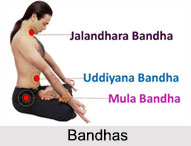
There are three major bandhas in vogue. Jalandhara Bandha is for throat, Uddiyana Bandha is for abdomen and Mula Bandha is for perineum and anus. Apart from these three main bandhas, there is another Bandha known as the ‘Maha Bandha’. It is an advanced yogic practice that involves practicing three major bandhas together: Mula Bandha, Uddiyana Bandha and Jalandhara Bandha.

These sensitive areas are stimulated during Pranayama by practicing these bandhas particularly during Kumbhaka. Then the Pranic energy passes upwards through Sushumna, which is to be experienced. Thus it may be said that the mudras will awaken the kundalini power while bandhas will help this serpent power to rise up along the chakras to bring about a specific effect.

Meaning of the word ‘Bandha’ is to bind, to lock, or to tie. The particular neuromuscular junction is contracted to increase positive pressure and to generate visceroreceptive or proprioceptive impulse that would travel upward through ascending path in the spinal cord. Secondly, there is a specific type of sensation at the contracted area. One has to remain attentive in order to maintain the contraction for a few seconds. One has to develop awareness of these impulses and the sensitivity to experience them.

For more, visit the link below:

Monday, 6 February 2023

Meditative Asanas, Yoga


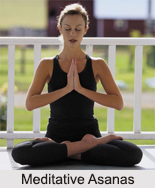
Meditative Asanas, YogaMeditative Asanas are the postures one assumes in order to sit or stand comfortably for extended durations, enabling one to concentrate and meditate without interference from muscle proprioceptors. The idea behind Meditative Asanas is merely to position oneself in such a way so that one’s limbs cease to send stimuli to the mind, allowing the practitioner to concentrate on meditation.

Meditative Asanas have been consistently mentioned in various Indian Text on Yoga over the ages, including the Puranas and the Vedas, and have formed the core around which a comprehensive physical culture of asana practice was developed.

Types of Meditative Asanas
Asanas classified as meditative are considered highly important in the canonical Yoga texts. There are 12 meditative postures listed in various Hatha Yoga manuals, and variations on the same have been devised over the years, of which 16 are known, resulting in a total of 28 Meditative Asanas. Only 19 of these, however, can be considered real Meditative Asanas, since the others are corrective or cultural.

Meditative Asanas, YogaSwastikasana
  • Vajrasana
  • Samasana
  • Bhadrasana
  • Padmasana
  • Siddhasana
  • Virasana
  • Goraksasana
  • Hathasiddhasana
  • Sukhasana
  • Guptasana
  • Muktasana
  • Tristhitasana
  • Pavana Muktasana
  • Vrisasana
  • Sthitaprarthanasana
  • Ksemasana
  • Sthirasana
  • Dhirasana
  • For more, visit the link below

    Saturday, 21 January 2023

    Sankirtan Yoga


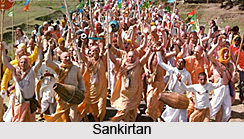
    Sankirtan YogaSankirtan yoga refers to taking the name of God. It is one of the nine modes of Bhakti. According to the Puranas, the glory of the Supreme Being lies in his Name. Hence, the easiest way to attain the lord is by remembering him. Swami Sivananda, the founder of Divine Life Society, defines Sankirtan as the Swarupa (indispensable nature), Dhwani (sound) and the essence of Vedas. In fact, both the Vedas and Sankirtan originate from the same source. In Sankirtan people sit together and remember God by singing his name harmoniously. But the most important thing is the bhava (thought or feeling). If the person is taking the Lord’s name with utmost devotion, then He will answer the devotee’s call.

    Sankirtan is further considered to be a science that has the power to lift the mind and spirits to its farthest extent. Sankirtan Yoga is the easiest and best way to realize God. In modern times, when it has become increasingly difficult for people to practice austerities, practicing Brahmacharya or Raja Yoga, singing His name is quite easy. Any common man can practice it as it does not require deep intelligence to comprehend Jnana Yoga or Sadhana.

    According to belief there is Shakti in God’s name. It has the power to eradicate all the 'mala' or impurities of mind. In fact there are three types of obstacles in the path to attain God: Mala, Vikshepa and Avarana. In order to get rid of this, selfless service, intellectual seeking and upasana are recommended. However, Sankirtan Yoga can achieve all these single-handedly because nothing is more powerful than His name. Even if it is the veil of Maya that deludes man, taking the name of God will help man to severe the worldly ties. Thus, Sankirtan enables one to realise the Brahman.

    For more, visit the link below:

    Monday, 9 January 2023

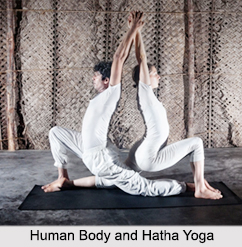
    Human Body and Hatha Yoga


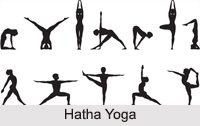
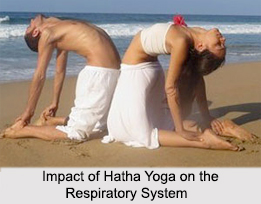
    Human Body and Hatha YogaHuman Body and Hath Yoga are deeply connected. Hatha Yoga is designed to gain in-depth understanding of the body and to unleash its power and strength to obtain higher selves. To a Hath Yogi, the body is not a mere mass of living matter, but a mystic bridge between the spiritual and the physical being. Hatha Yoga is often regarded as physical or bodily yoga. This implies that bodily perfection is viewed as a consequence of meditative discipline, although the relation between the two should perhaps be better understood as one of mutual enhancement. According to Yoga Sutra, the goal of Hatha Yoga results in beauty, gracefulness, strength and robustness.

    Hatha Yoga does not seek mere transcendental experiences. Its objective is to transform the human body to make it a worthy vehicle for Self-realization. According to a yogic philosophy, the body, mind and senses constitute instruments or tools for the respective processes of experiencing the world and realizing ones true nature. Physical upliftment assists the spiritual one and vice versa.

    Impact of Hatha Yoga on Body Cells
    Human Body and Hatha YogaHatha Yoga teaches that the physical body is built up of small cells, each cell containing within it a miniature life which controls its action. These lives on the other hand have small bits of intelligence which allow the cells to do their work in a proper manner. The small cells of human body are under the control of the central system and readily obey their orders consciously or unconsciously. The process of digestion, assimilation, etc shows the intelligence of the cells either separately or collectively in groups. Each atom of a living body according to the Yogi is a living being which has its own independent life. Cells in human body are the ones which carry on the work of continual regeneration. It has been said that in order to perform all the different actions the cells need a supply of Prana. The cells are able to get the supply of Prana from the nourishment they derive from the food which they have.

    In order to supply adequate Prana to the cells it is necessary that the body is kept in a proper condition and the yogis believe that Hatha Yoga is a way to keep the body in a healthy condition.

    For more, visit the link below:

    Friday, 16 December 2022

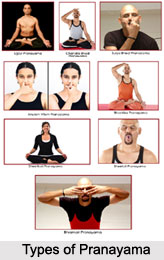
    Types of Pranayama


    Types of Pranayama, YogaPranayama is the Yogic science of breathing. It is one such part of Yoga which helps one in mental and spiritual healing process. Oxygen is the most vital nutrient for the integrity of the brain, nerves, glands and internal organs.

    Steps to Perform Pranayama
    The Pranayama process involves a series of regulated breathing exercises that is used to purify the Pranic Nadis by controlling, regulating, and channelizing the Prana or the life force in the body. Pranayama techniques are best practiced while sitting on the floor on a folded blanket. It must be performed in empty stomach. Early morning is the best time to practice Pranayama, preferably before sunrise when the pollution is at its lowest level. One must dedicate at least 30-40 minutes to complete the entire pranayama series.

    Major Types of Pranayama
    Different types of Pranayama have different effects on the health. The correct choice of Pranayama depends on many factors such as body constitution, season, purpose and many more. Some major types of pranayama yoga are as follows:

    Nadi Sodhana: Pranava mudra is made by bending the index and middle finger towards the palm and slowly inhaling through the left nostril and exhaling through the right nostril and vice versa.

    Shitali Pranayama: Shitali involves the inhalation of air through the tongue and then very slowly expelling the air using both the nostrils.

    Shitkari Pranayama: In this yoga, one has to breath in air externally, both right and left nostrils will be used emphatically.

    Ujjayi Pranayama: Ujjayi Pranayama is a diaphragmatic breathing technique- first filling the lower belly, activating the first and second ‘chakras’, rising to the lower rib cage to activate the third and fourth ‘chakras’ and finally up to the upper chest and throat.

    Kapalabhati Pranayama: Kapalabhati is a breathing exercise where various breathing techniques are moulded to soothe the Yoga practitioners.

    Chandranga Bhastrika: It is practised through left nostril, and it influences Ida nadi. It is relatively coolaning in nature. Hence it will not increase Pitta, but increases Vata and slightly Kapha.

    For more, visit the link below:

    Thursday, 1 December 2022

    Astanga Yoga


    Astanga YogaAstanga Yoga is a system of Yoga that was taught by the sage Vamana Rishi in the Yoga Korunta, which is an ancient manuscript "said to contain lists of many different groupings of asanas, as well as highly original teachings on Vinyasa, Drishti, Bandhas, Mudras and Philosophy". This text was imparted to Sri T. Krishnamacharya in the early 1900's by his Guru Rama Mohan Brahmachari, and was later passed down to Pattabhi Jois during the duration of his studies with Krishnamacharya, beginning in 1927. Since 1948, Pattabhi Jois has been teaching Ashtanga Yoga from his yoga shala, the Astanga Yoga Research Institute.

    Astanga Yoga literally means the "eight-limbed yoga," as outlined by the sage Patanjali in the Yoga Sutras. According to Patanjali, the path of internal purification for revealing the Universal Self consists of the following eight spiritual practices:

    1.Yamas (Principles or moral code)
    Yama means restraints There are five yamas viz. Ahimsa, Satya, Asteya, Brahmacharaya and Aparigraha.
    Ahimsa : Ahimsa is the foundation upon which the rest of the Yamas and Niyamas are based. One must have Ahimsa in one's thoughts, speech and actions.
    Satya : Truth must always co-relate with the facts as they are. Truth that causes pain or injury is not positive. Truth should be spoken in harmony with nature.
    Asteya : One must not take away from another. It would deprive others from the fruits of their work or from what is rightfully theirs. Thus stealing cause injury as well.
    Brahmacharya : Control of sex organs / instincts increases one's energy. From this energy one can gain miraculous powers, or more important - can gain knowledge.
    Aparigraha : Non - conveotusness is the lack of desire to possess not only material objects, but persons, places, feelings and so forth. The One who has no interest or desire to possess the past, present or future, will find knowledge of these three : time states coming to him naturally.

    2. Niyamas (Self-Purification and study)
    Niyam means observances . There are five niayamas viz. Saucha, Santosh, Tapa, Swa - adhyay and Ishwar Pranidhan
    Saucha : Physical and mental cleanliness.
    Santosh : Contentment with what one has.
    Tapa : By fortitude the removal of impurities and mastering of the body and the senses follow.
    Swadhyaya : Through self study, communication can be established with the desired spiritual entity.

    Ishwar Pranidhan : " Our intelligence is no match to the divine wisdom". Keeping this in mind always, one should surrender to the will of God with complete faith after having done one's duties very well.

    For more, visit the link below:

    Friday, 18 November 2022

    Trataka, Yoga


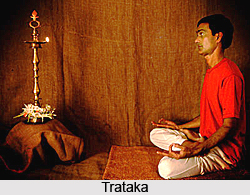
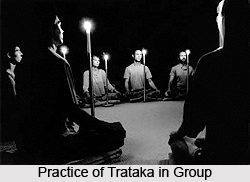
    Trataka, YogaTrataka is used in yoga for enhancing concentration. In this practice, the practitioner gazes at the smallest object comfortably with steady eyes until tears roll down. Moreover, trataka cures eye diseases and prevents laziness and it is one of the six cleansing processes (Kriyas) of hatha yoga. It is performed with the eyes.

    Traditionally, there are three types of trataka available for the practice. They are Antar trataka, Madhya trataka and Bahya trataka.

    Antar Trataka
    In this trataka, one has to experience as if he is gazing in between the two eyebrows (Bhrumadhya drishti) or heart, navel or any other such internal organ with closed eyes.

    Madhya Trataka
    In Madhya trataka, the practitioner still gazes on bhrumadhya or nasagra (tip of nose) or any near object made of metal or stone or even on Aum written on paper, or single dot in black colour, with open eyes.

    Bahya Trataka
    In this trataka, one has to fix the gaze on the distant object like Moon, rising Sun or illumined planet.

    Technique of Trataka
    Trataka is done preferably in padmasana (lotus posture) or ardha-padmasana on the ground. It can also be done in sukhasana (comfortable sitting posture) but with the straight back or spinal column. A lamp is placed in the level of the eyes at about one meter distance. Now with the relaxed mind one should gaze at the bright portion of the flame, without blinking, till tears appear in the eyes and roll down on the cheeks. This is the endpoint of trataka. After this, eyes should be closed gently. The practitioner then should sit quietly for 3-5 minutes and then open his eyes slowly. If required, one may repeat the technique once again. It is recommended that after this the practitioner should wash his face and eyes with water.

    The duration of trataka from the beginning till the appearance of tears varies from person to person. It also depends on the state of mind of the individual. The duration of trataka is less if the practitioner is relaxed and if the practitioner is tensed or disturbed, he may take more time to finish. Generally, in normal individuals trataka is finished within 3-5 minutes. Some individuals have been observed to take even more than 12 minutes.

    Physiology of Trataka
    It has been found that soon after trataka is over, the parasympathetic predominance is established as indicated by lowering of heart rate and respiration rate as well as an increase in amplitude of plethysmogram (vasodilatation). That means a peripheral blood circulation is increased after trataka. Emotional balance or stability is restored and a degree of relaxation is increased as indicated by the production of well-modulated train of alpha frequency after trataka.

    Trataka, YogaTrataka acts as a catharsis, bringing out repressed or suppressed wishes or desires and eliminating them from the subconscious level. This is the process of purification. After this, the practitioner experiences psycho-physiological relaxation and a feeling of calmness and lightness. One pointed concentration is improved, and attention fluctuations are reduced. It has been found that the neurotic tendencies such as anger, short temper, suspicion, irritation and resentment are reduced after trataka practice is done for one month. Anxiety is also reduced. In this way, trataka is a very important practice to remove impurities or blockages in the neural network and to prepare the individual for meditation.

    For more, visit the link below: