Showing posts with label mythology. Show all posts

Wednesday, 29 July 2026

Kausika: The Lesser-Known Son of Vasudeva in Mahabharata

 Kausika, also spelled Kaushika, is a relatively obscure figure in Hindu mythology who is mentioned in the genealogical traditions associated with the Yadava dynasty. Although he does not play a prominent role in the narrative of the Mahabharata, his name appears in ancient Hindu texts as a member of Lord Krishna's extended family. Kausika is recognized as a half-brother of Lord Krishna and occupies a modest yet noteworthy place in the lineage of Vasudeva, one of the most important figures in the Yadu clan.


Parentage and Family Background

According to the Vishnu Purana, Kausika is the only son born to Vasudeva and his wife Vaishali. Vasudeva, a distinguished Yadu prince, is best known as the father of Lord Krishna and Lord Balarama. While Krishna was born to Devaki and Balarama to Rohini, Vasudeva had several wives, and Kausika was born through Vaishali. This makes him a half-brother of both Krishna and Balarama. 

The Vishnu Purana records Kausika among the many children of Vasudeva, preserving his place within the extensive Yadava genealogy. Although little is revealed about his personal life or achievements, his inclusion demonstrates the importance ancient Hindu literature placed on documenting royal family lineages. 

Kausika in the Mahabharata

In the Mahabharata, Kausika is portrayed as a minor character rather than an active participant in the epic's central events. Unlike Krishna, who serves as the guide and charioteer of Arjuna, or Balarama, who appears at significant moments throughout the narrative, Kausika does not receive an individual storyline or perform any notable heroic deeds. 

His mention primarily serves a genealogical purpose, identifying him as one of Vasudeva's sons and reinforcing the extensive family network of the Yadavas. As a result, Kausika remains a peripheral figure whose significance lies more in his lineage than in his actions. 

Significance in Hindu Genealogy

Ancient Hindu texts often devoted considerable attention to preserving dynastic records alongside religious narratives. Kausika's presence in the Vishnu Purana reflects this tradition of carefully recording the descendants of important royal families. His inclusion contributes to a more complete understanding of Vasudeva's household and the broader Yadava lineage from which Lord Krishna emerged. 

Although Kausika is overshadowed by his celebrated half-brothers, his mention illustrates the richness and complexity of the genealogical traditions found in Hindu scriptures. Such references help scholars and readers reconstruct the family connections that underpin many of the epic and Puranic narratives. 

Legacy

Kausika remains one of the lesser-known members of Krishna's family, with only brief references in the Mahabharata and the Vishnu Purana. Nevertheless, these mentions establish him as the only son of Vasudeva and Vaishali and affirm his place within the Yadava dynasty. While he does not influence the major events of Hindu mythology, Kausika's inclusion in ancient genealogical records reflects the comprehensive nature of India's epic and Puranic traditions, where even minor members of significant royal lineages were preserved for posterity.

Wednesday, 22 July 2026

Mahodara in the Ramayana: The Powerful Rakshasa Commander of Lanka

 Mahodara was one of the most prominent Rakshasa warriors in the Ramayana, serving as a trusted minister and one of the foremost army chiefs under the demon king Ravaṇa. Renowned for his immense strength, courage, and military skill, Mahodara played a significant role during the epic Battle of Lanka. Although he is not as widely remembered as Indrajit or Kumbhakarna, various versions of the Ramayana portray him as an influential figure in Ravaṇa's court and an important member of the Rakshasa leadership.


Parentage and Family Lineage

According to the Ramayana, Mahodara was one of the sons of the sage Visravas and his wife Puṣpotkata. Visravas was a celebrated sage, scholar, and ascetic who attained extraordinary spiritual power through years of rigorous penance (tapasya). His wisdom and spiritual accomplishments made him one of the most respected sages of his time. 

Puṣpotkata, also known as Nikasha in certain traditions, was a Gandharva princess and one of Visravas's wives. Through this distinguished parentage, Mahodara inherited a lineage that combined spiritual heritage with the powerful Rakshasa dynasty. His ancestry linked him to some of the most notable figures in the Ramayana, reinforcing his importance within the kingdom of Lanka. 

Role in Ravaṇa's Court

Mahodara occupied a prominent position in the court of Ravaṇa, the principal antagonist of the Ramayana. He served not only as a high-ranking military commander but also as one of Ravaṇa's trusted ministers. His responsibilities extended beyond the battlefield, as he advised the king on matters concerning warfare and the administration of the kingdom. 

Several versions of the Ramayana also identify Mahodara as one of the ministers of Sumali, the maternal grandfather of Ravaṇa. This association further establishes Mahodara as a respected member of the influential Rakshasa lineage that played a central role in the rise of Ravaṇa's power. 

Mahodara in the Battle of Lanka

Mahodara gained particular prominence during the great Battle of Lanka, the climactic conflict between the forces of Rāma and Ravaṇa. As one of Ravaṇa's foremost army chiefs, he commanded Rakshasa forces with exceptional skill and determination. His reputation for physical strength and military prowess made him one of the leading defenders of Lanka against the invading Vanara army led by Rāma, Lakshmana, Hanuman, and Sugriva. 

Throughout the battle, Mahodara remained loyal to Ravaṇa despite the mounting losses suffered by the Rakshasa army. Like many of Lanka's great warriors, he fought valiantly in defense of his king and kingdom, demonstrating the courage and dedication expected of one of Ravaṇa's principal commanders. 

Legacy

Although Mahodara is not among the most celebrated characters of the Ramayana, he remains an important figure in the epic's narrative. His role as both a minister and military commander highlights the organized structure of Ravaṇa's administration and the formidable strength of the Rakshasa forces. His distinguished ancestry, close association with Ravaṇa, and participation in the Battle of Lanka have ensured his place in the rich tradition of the Ramayana, where he is remembered as one of Lanka's most capable and loyal warriors.

Saturday, 29 June 2024

Mythological Forests in India


India's rich tapestry of mythology and history is interwoven with the presence of sacred forests that have played significant roles in epic narratives and religious texts. These mythological forests are not only significant in ancient scriptures but also hold cultural and spiritual importance. Among the most notable are Dandakaranya, Kamyaka Forest, Dvaita Forest, Baikunthapur, and Naimisha Forest. 

Dandakaranya

Dandakaranya, often referred to as the Dandak Forest, is one of the most famous forests in Indian mythology. It is extensively mentioned in the Ramayana, where it served as the exile ground for Lord Rama, his wife Sita, and his brother Lakshmana. Located in the central part of India, Dandakaranya stretched over a vast region that included parts of present-day Chhattisgarh, Odisha, Telangana, and Andhra Pradesh. This forest was notorious for being infested with demons (Rakshasas), who frequently troubled the sages and ascetics living there. Lord Rama's journey through Dandakaranya was marked by several significant events, including the abduction of Sita by Ravana. 

Kamyaka Forest

Kamyaka Forest holds a significant place in the Mahabharata. This forest was the refuge for the Pandavas during their exile. Situated near the banks of the Sarasvati River, Kamyaka Forest provided a serene yet challenging environment for the Pandavas. It was in this forest that they encountered many sages and divine beings who offered them guidance and support. The Kamyaka Forest is also where the Pandavas received the Akshayapatra, a magical vessel that provided an endless supply of food, from the Sun god. 

Dvaita Forest

Another forest of great importance in the Mahabharata is the Dvaita Forest. Located near the banks of the Sarasvati River, like the Kamyaka Forest, the Dvaita Forest was a place where the Pandavas spent part of their exile. The forest is remembered for its tranquility and natural beauty. It served as a backdrop for many significant events and encounters, including meetings with various sages and gods. The Dvaita Forest also highlights the importance of nature and seclusion in spiritual growth and penance. 

Baikunthapur

Baikunthapur, while not as widely known as Dandakaranya or the forests mentioned in the Mahabharata, holds its own unique significance. Located in the northeastern region of India, in West Bengal, Baikunthapur is often associated with Lord Krishna and his divine play (Lila). This forest is believed to be a place of great spiritual energy and is visited by devotees seeking peace and enlightenment. The forest's association with Krishna adds to its mystique and importance in the cultural and religious landscape of India. 

Naimisha Forest

Naimisha Forest, also known as Naimisharanya, is one of the most revered forests in Hindu mythology. It is believed to be the site where many sages performed penances and held grand yagnas (sacrificial rituals). Located near the Gomti River in present-day Uttar Pradesh, Naimisha Forest is considered a sacred space where the Vedas were divided into four parts by Sage Vedavyasa. The forest is also mentioned in the Puranas and other ancient texts as a center of learning and spirituality. Pilgrims visit Naimisharanya to seek blessings and gain spiritual merit. 

The mythological forests of India, such as Dandakaranya, Kamyaka Forest, Dvaita Forest, Baikunthapur, and Naimisha Forest, are integral to the country's rich cultural and spiritual heritage. These forests are not just geographical locations but are imbued with stories of divine interactions, epic journeys, and profound spiritual significance. They continue to inspire devotion and reverence among people, reflecting the deep connection between nature and spirituality in Indian tradition.

Friday, 8 September 2023

Kaushalya, Wife of Dasharatha


In the annals of Indian mythology, the name Kaushalya stands as a symbol of virtue, resilience, and devotion. As the first wife of King Dasharatha, she played a pivotal role in the epic Ramayana, showcasing a life marked by challenges and blessings.


Kaushalya, the daughter of King Suvarna, was born into a noble family in the kingdom of Kosala. From a young age, she exhibited qualities of grace, wisdom, and unwavering devotion to her dharma (duty). Her virtues did not go unnoticed, and it was no surprise when King Dasharatha of Ayodhya, known for his valor and righteousness, sought her hand in marriage. 

Their union was not just a coming together of two individuals, but a union of two kingdoms and the fates of countless subjects. Kaushalya, in accepting Dasharatha as her husband, embraced a life destined for both joy and sorrow.

Challenges and Struggles

The path of Kaushalya's life was marred by challenges, the most significant of which was her inability to bear a child. This was a source of great anguish and heartache for her, as the duty of a queen was to provide an heir to the throne. Her barrenness weighed heavily on her heart, and she endured years of pain and sorrow.

Despite her personal struggles, Kaushalya remained steadfast in her devotion to her husband. She never once wavered in her support for Dasharatha, even in the face of mounting pressure from the court and the populace. Her inner strength and resilience during these trying times were a testament to her unwavering commitment to her dharma as a wife and queen.

Motherhood and Blessings

Kaushalya's life took a momentous turn when, through divine intervention, she was blessed with a son named Rama. This was a moment of immense joy and relief for both her and King Dasharatha. Rama, born to Kaushalya, was not just a son; he was destined to be a beacon of righteousness and a symbol of dharma for all of humanity.

Kaushalya's role as a mother was marked by love, wisdom, and selflessness. She raised Rama with the utmost care and imparted the values of honor, duty, and humility to him. Her motherly blessings and guidance played a pivotal role in shaping Rama into the noble prince and later, the revered king that he became. Dasaratha 

The Ultimate Sacrifice

As the Ramayana unfolds, Kaushalya's devotion to her family and her sense of duty are put to the ultimate test. When Dasharatha, under duress, is compelled to send Rama into exile, Kaushalya's heart is shattered. Yet, she does not falter. She stands by her husband's decision, even though it causes her immeasurable pain.

Kaushalya's character shines in her unwavering support for her husband's choice and her unselfish concern for Rama's welfare. Her sacrifice and her ability to put the needs of her family and kingdom above her own desires exemplify the ideals of a devoted wife and queen.


Tuesday, 5 September 2023

Brahmins: Guardians of Ancient Indian Tradition


The Brahmins, an influential and revered caste in the Indian social hierarchy, hold a unique place in the country's cultural and historical landscape. For centuries, they have played a pivotal role in shaping and preserving India's rich cultural and spiritual heritage. This article delves into the origin, cultural significance, and enduring legacy of the Brahmins in India.


The term "Brahmin" finds its roots in the ancient Indian scriptures known as the Vedas. According to these sacred texts, Brahmins were born from the mouth of Lord Brahma, the creator of the universe, symbolizing their high spiritual and intellectual status. This divine origin conferred upon them the duty of preserving and disseminating sacred knowledge and rituals.

Brahmins have been instrumental in preserving and passing down the profound wisdom contained in the Vedas, Upanishads, and other ancient texts. Their role as scholars and teachers has ensured the continuity of knowledge related to philosophy, religion, astrology, and various other disciplines. This preservation of knowledge has contributed significantly to the development of Indian thought and philosophy.

Brahmins are essential participants in Hindu religious ceremonies and rituals. They serve as priests in temples, officiating ceremonies and performing sacred rites. Their presence is considered crucial for ensuring the spiritual efficacy of these rituals, which are an integral part of Hinduism.  Varna System in Ancient India

Brahmins have historically held positions of leadership and authority in Indian society. They have guided and advised rulers, politicians, and communities, playing a significant role in shaping the moral and ethical fabric of society. Their ethical and spiritual insights have often been sought after in times of crisis.

Brahmins have been at the forefront of education in India. They established and ran traditional schools, known as Gurukuls, where they imparted knowledge to students from various backgrounds. Their commitment to education has contributed to India's rich intellectual heritage.

Brahmins have made substantial contributions to Indian art, literature, and culture. Many renowned poets, writers, musicians, and artists in India's history have been Brahmins. Their cultural contributions have left an indelible mark on Indian art forms, such as classical music and dance.

In contemporary India, the role of Brahmins is evolving as society becomes more inclusive and diverse. However, their traditional responsibilities continue to be essential in maintaining the spiritual and intellectual fabric of the nation. The Brahmins, as guardians of ancient Indian tradition and knowledge, remain a vital part of India's cultural tapestry, carrying forward the wisdom of the ages for future generations to cherish and learn from.

Friday, 4 August 2023

Shakuntala: Unraveling the Cultural Significance of an Indian Mythological Icon


Indian mythology, with its plethora of captivating characters, offers profound insights into human nature, virtues, and complexities. Among these mythical beings, Shakuntala holds a special place as an emblem of love, purity, and resilience. Poet Kalidasa's magnum opus, "Abhijnanasakuntalam" (The Recognition of Shakuntala), further elevates her tale, endowing it with depth and cultural significance that transcends time. Shakuntala


The Mysterious Origins

The story of Shakuntala begins with an air of mystery surrounding her birth. Believed to be the daughter of the sage Vishwamitra and the heavenly nymph Menaka, Shakuntala's divine heritage imbues her with unparalleled beauty and virtue. Raised by the sage Kanva in a hermitage, she embodies the essence of ascetic values, making her an ethereal and enigmatic figure. Indian Mythology


The Fateful Encounter with King Dushyanta

One fateful day, King Dushyanta, while hunting in the vicinity, stumbles upon the entrancing Shakuntala. Her beauty and grace captivate him instantly, leading to a profound and mutual attraction. However, Shakuntala, grounded in her ascetic upbringing, hesitates to reciprocate immediately, creating an intriguing dynamic between love and virtue.


The Symbolic Bond: Love and the Ring

Despite the divine connection they share, fate intervenes, and the couple's love story faces numerous trials. Symbolizing their unbreakable bond, Dushyanta gifts Shakuntala a ring, signifying their commitment to each other. This simple yet powerful token serves as a reminder of their love and becomes pivotal in the tale's later developments.


The Curse and Ordeal

Shakuntala's story takes a tragic turn when she incurs the curse of the sage Durvasa. This curse causes King Dushyanta to forget her existence entirely, leading to a heart-wrenching separation. Thus, Shakuntala's ordeal exemplifies the harsh whims of destiny and the interplay of divine will and human agency.


Kalidasa's Literary Brilliance

Kalidasa, the renowned poet and playwright, immortalized Shakuntala's tale through his literary brilliance in "Abhijnanasakuntalam." The play delves into human emotions, evoking empathy and admiration for Shakuntala's unwavering devotion and resilience. It explores the themes of recognition and recollection, underscoring the power of memory in shaping our lives and relationships.


Shakuntala: A Symbol of Female Strength

In Kalidasa's rendition, Shakuntala emerges as an exemplar of female strength and virtue. Far from being a passive victim, she embodies resilience, patience, and unwavering loyalty. Her portrayal as a devoted mother adds layers of tenderness and nurturing love to her character, solidifying her status as an icon of Indian womanhood.


Transcending Time and Space

"Abhijnanasakuntalam" has transcended the boundaries of time and space, finding resonance in multiple art forms. Adapted and translated across cultures, it continues to captivate audiences worldwide. Shakuntala's story exemplifies the universal appeal of human emotions and the intricacies of love, making it a timeless exploration of the human condition.


Shakuntala in Contemporary Culture

Beyond the realms of classical literature, Shakuntala's cultural significance persists in modern times. Contemporary adaptations in music, dance, and theater pay homage to her enduring allure. Her iconic status in Indian mythology serves as a source of inspiration for artists, writers, and creators, keeping her legacy alive and relevant.


Shakuntala, the Indian mythological character, transcends time and space to become a symbol of love, purity, and resilience. Kalidasa's masterful rendition of her tale in "Abhijnanasakuntalam" elevates her to a pedestal of cultural significance. Her journey of love, separation, and ultimate recognition resonates with audiences across generations, making her an eternal icon in the tapestry of Indian mythology and culture.


Monday, 22 May 2023

Sattriya- Indian Classical Dance from Assam


The significance of Sattriya extends beyond its artistic allure. It plays a vital role in preserving Assamese cultural identity and fostering a sense of community. Sattras, the monastic institutions where the dance form originated, continue to be centers of learning and practice, passing down the knowledge and techniques from one generation to the next. The dedication and discipline required to master Sattriya instill a deep sense of devotion and reverence in the dancers, connecting them to their roots and spiritual heritage.


Originating in the vaishnavite monasteries of Assam, Sattriya is a classical Indian dance form that has a rich and intriguing history. It was founded in the 15th century by the revered saint and social reformer, Srimanta Sankardeva, who sought to spread the teachings of Lord Krishna through various artistic expressions. Sankardeva incorporated dance movements into his devotional songs, known as Borgeets, giving birth to Sattriya. The dance form evolved within the Sattras, the monastic institutions of Assam, where it was nurtured and preserved by dedicated practitioners. 

Sattriya dancers, also known as Sattriya bhokots, play a central role in bringing this enchanting dance form to life. Traditionally, Sattriya was exclusively performed by male dancers, but today, women have also taken up this art form and contribute to its vibrant legacy. The dancers undergo rigorous training and dedicate themselves to mastering the intricate footwork, graceful movements, and expressive facial expressions that are hallmarks of Sattriya. With years of practice and devotion, they are able to convey narratives from Hindu mythology and Vaishnavite literature, captivating audiences with their artistry. 

The costumes and attire worn by Sattriya dancers are not just decorative elements but also significant symbols. They reflect the cultural heritage and traditions of Assam, and each piece of attire holds its own meaning and significance. The meticulous attention to detail in the costume showcases the reverence and respect that Sattriya dancers have for their art form and the traditions it represents. The combination of vibrant colors, intricate designs, and graceful movements creates a visual spectacle that captivates audiences and transports them into the realm of divine beauty. 

In recent years, Sattriya has gained international recognition, captivating audiences around the world with its unique blend of grace and vigor. Festivals and cultural events provide platforms for Sattriya dancers to showcase their talent, allowing diverse audiences to experience the mesmerizing beauty of this classical art form. Collaborations with other dance styles and musicians have further expanded the artistic horizons of Sattriya, infusing it with new dimensions while maintaining its core essence. 

The future of Sattriya shines brightly, with ongoing efforts to promote its visibility and ensure its longevity. Educational institutions and dedicated academies offer training programs and workshops, nurturing a new generation of Sattriya artists and scholars. Cultural exchange programs and international collaborations enhance its global reach, fostering cross-cultural understanding and appreciation. 

As we delve into the intricate world of Sattriya, we witness the devotion, skill, and passion that infuse every movement. It reminds us of the power of art to transcend language barriers and connect us to our shared humanity. Sattriya dances, with their captivating storytelling and soul-stirring music, transport us to a realm where the divine and the mortal intertwine, evoking emotions, and leaving an indelible impression on our hearts and minds.

For more, visit the link below:

https://www.indianetzone.com/58/sattriya.htm


Thursday, 27 April 2023

River Yamuna


The River Yamuna, also known as Jamuna, is one of the most important and sacred rivers in India. Originating from the Himalayas, ths river travels through several north Indian states before merging into another Himalayan river. The river is revered for its cultural, religious, and economical importance.


The Yamuna river originates from the Yamunotri glacier in the Himalayas, situated in the Uttarkashi district of Uttarakhand, India. This glacier is one of the major sources of the river, and it is fed by several other smaller streams along its course. The river flows through the rugged terrain of the Himalayas before entering the plains at Dak Pathar in the Dehradun district of Uttarakhand. 

As the river moves downstream, it passes through several states, including Himachal Pradesh and Haryana, where it is joined by several tributaries, including the Chambal, Betwa, and Ken rivers. The Yamuna then flows through the national capital of Delhi, where it is a major source of drinking water for the city. However, due to increasing pollution and industrialization, the river has become highly polluted, and steps are being taken to clean up its waters. 

The river then flows through the state of Uttar Pradesh, where it is joined by several more tributaries, including the Hindon and the Sengar rivers. The Yamuna is also an important source of irrigation water for the farmers in the region, and several dams and canals have been built along its course to harness its waters for agricultural purposes. 

The Yamuna river spans a length of approximately 1,376 km before finally merging with the River Ganges at Allahabad. The confluence of these two rivers is considered to be one of the holiest sites in Hinduism, and it is known as the Sangam. 

Apart from its ecological and economic importance, the River Yamuna is also of great cultural and religious significance. According to Hindu mythology, the river is considered to be the daughter of the Sun god, Surya, and the sister of the god of death, Yama. The river is worshipped as a goddess, and several temples and shrines have been built along its banks. 

One of the most famous temples on the banks of the Yamuna is the Yamuna Temple in Yamunotri, which is one of the four holy shrines of the Char Dham Yatra. The river is also associated with the life and teachings of Lord Krishna, who is said to have spent his childhood on the banks of the Yamuna in the city of Mathura. 

The River Yamuna is also home to a diverse range of flora and fauna. The river is home to several species of fish, including the mahseer, catfish, and rohu, and several migratory birds, including the bar-headed goose and the common pochard, can be seen along its banks. However, due to pollution and habitat destruction, many of these species are now facing extinction. 

The Yamuna river is also a major source of irrigation water for the farmers in the region, and several dams and canals have been built along its course to harness its waters for agricultural purposes. It also serves as a vital source of drinking water for the cities and towns that it passes through. In addition, the river provides employment opportunities for those involved in fishing and boating.

For more, visit the link below:

https://www.indianetzone.com/2/yamuna_river.htm

Wednesday, 26 April 2023

River Beas


Beas River is one of the most significant rivers in India. It originates from the Beas Kund, a holy place in the Himalayas, near the Rohtang Pass in Himachal Pradesh. The river flows through the states of Himachal Pradesh and Punjab before merging with the Sutlej River in Punjab. The Beas River is approximately 470 km long, and its basin area covers over 20,000 square kilometers. 


The Beas River has immense historical, cultural, and ecological importance. It was known as Hyphasis during Alexander the Great's invasion of India, and his troops reached the river before they refused to go any further, marking the easternmost limit of his conquests. The river finds mention in Indian epics like Mahabharata. According to the legend, the Pandavas bathed in the Beas River during their exile. 

The Beas River has been significant for agriculture since ancient times, and its fertile banks have been used for farming for centuries. The river basin is promoting agriculture by helping various crops sustain such as rice, wheat, maize, and sugarcane. The river is also an essential source for irrigation, hydroelectric projects, and drinking water. 

The Beas River has a significant cultural significance. It is a holy river for the Hindus, who believe that bathing in its waters will cleanse their sins. Many Hindu pilgrims travel to the river to perform religious ceremonies and rituals. The river is also significant for the Sikhs, as Guru Gobind Singh, the tenth Sikh Guru, spent a considerable amount of time on its banks during his travels. 

The Beas River basin is rich in biodiversity, and it is home to various flora and fauna species. The river supports a wide variety of fish species, including trout, mahseer, and catfish. The river basin is also home to many bird species, including the Indian pitta, the white wagtail, and the black-necked stork. 

Despite its significance, the Beas River faces several environmental challenges. The river's water quality is poor due to industrial pollution, untreated sewage, and agricultural runoff. This pollution has resulted in a decline in fish populations and increased health risks for people who rely on the river for their drinking water. 

In conclusion, the Beas River is a significant river in India, with immense historical, cultural, and ecological importance. It forms a crucial source for agriculture, religious practices, and economy of the region. However, the river faces several environmental challenges which need immediate attention to preserve its ecology so it can continue to be a vital resource for people of the region it flows through.

 For more, visit the link below:

https://www.indianetzone.com/6/beas_river.htm


Monday, 15 February 2021

Indian Mythology


Indian MythologyIndian Mythology encompasses a wide field of myths and legends concerning Indian religion. India is a country of diverse religious practices and socio-cultural habits which incorporates a saga of a nation with a vivid religious background. Indian Mythology takes into consideration all those myths related to HinduBuddhistJain and some other scriptures. Indian Mythology is among the richest elements of Indian cultureVedas in India are important in shaping not only the culture but also the mythology of India. Through generations either by word of mouth or carefully stored scriptures, stories of Indian Mythology have been passed down. Indian Mythology is inseparable from Indian religion; the myths are religious accounts of Gods and Goddesses for many millions of people. The oral transmission of the stories could be trusted due to the strong religious aspects.

Indian Mythology in Indian Epic Poetry
Indian epic poetry is a rich reserve of epic poetry written in India and the deep seated inter relation of Indian epic poetry with Indian mythology cannot be denied. Indian mythology cannot be accounted without Hindi epic poetries. Memorable among them is Tulsidas’s ‘Ramcharitamanas’ based on Ramayana.

Indian MythologyVedic Mythology
Indian Mythology is incomplete without the mention of Vedic mythology. The Vedic tradition refers to the Vedic rituals, religious concepts that were essential in the development and evolution of Hinduism. The Vedic culture was constructed on the ruins of the Indus Valley Civilization. Indian mythology accounts for the existence of four Vedas namely Rig VedaYajur VedaSama Veda and Atharva Veda. Vedic mythology germinated from the Vedas, also known as Vedam, which are again a component of the Hindu Shruti. VayuVarunaIndraSuryaAgniYamaKuberaSomaMitraKama, Gayatri, AditiUshasSaraswati and Rudra are the Vedic Gods.

Indian Mythology in Different Religions
Indian Mythology comprises a whole lot of myths and legends associated with different religions. They are discussed below:

Indian MythologyHindu Mythology
Hindu Mythology has its origins in the Vedas and they date back to the era around 7200 BC. Hindu Mythology refers to the Indian literature which is replete with deities, divine incarnations, legends with a huge lot of philosophical discourses and moral and ethical connotations. Divine incarnation is another feature of Hindu mythology.

Religious cosmology also forms a part of the Hindu mythology, these are the ways in which evolution of the universe and its history is explained. Hindu mythology has the concept of fourteen worlds (not planets) – seven higher worlds (heavens) and seven lower ones (hells). Different deities play their part in ruling these worlds.


In Hindu cosmology, the concept of "Lokas" holds a significant place, representing various planes of existence that comprise the vast and intricate structure of the universe. These Lokas, also referred to as worlds or realms, are believed to exist on different levels of reality, each with its own distinctive attributes and inhabitants. Understanding the framework of these Lokas provides a glimpse into the intricacies of Hindu cosmology and the spiritual dimensions it encompasses.


Friday, 17 July 2020

Vedic Literature


Vedic Literature, Vedic Civilisation in IndiaVedic literature glorifies Vedic India. ‘Vedas’, a Sanskrit phrase, implies knowledge. It is the traditional faith that Vedas are ‘apuruseya’ (not composed by human beings), which was known to be a direct revelation of God, hence named shruti. Scholars believed that Vedic Literature originates long before the literary tradition started in India. However the oldest text, Rig-Veda has been traced back to the 11th century. The Vedic literature consists of the Vedas, UpanishadsVedangas, Sutras, Upavedas, Shastras and Puranas.

The Vedic period lasted for a millennium encompassing the late bronze & Iron Age. As far as the researches are concerned, the Vedic Literatures are composed in 1500 B.C, over a period of years. Vedic Literature saw its crest after the composition of the mantra texts, frequently called Samhita texts. With the composition of the mantra texts, shakas were established all over northern India. Usually Shakas are the theological schools that were focused on the learning of the Vedic Mantras.

The Vedas can be classified into categories of texts, traditionally the Samhitas or mantras, Brahmans, Aryanyak and Upanishads. The Vedas, as often termed as the Sutra literature can also be classified into Shrautasutras and Grahyasutras.

The Vedic Samhitas or the Mantras are mainly the metric texts and there are four Vedic samhitas- Rig VedaSama VedaYajur Veda and Atharva Veda. Sometimes the term ‘Vedas’ is used to signify those Samhitas. The Samhitas are the oldest stratum of Vedic texts. As ‘Vedic Concordance’ of Bloomfield, an eminent scholar records, Vedas have 89000 padas, of which 72000 are in Samhitas.

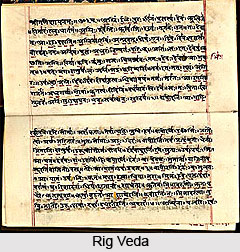
Vedic Literature, Vedic Civilisation in IndiaThe Rig Veda: This oldest existing Indian text is an anthology of 1028 hymns and 10,600 verses devoted to the Rig Vedic deities, compiled in 10 mandalas or books. According to the different opinions forwarded by the historians, saints composed Rig Veda for a period of 500 years in the Sapta – Sindhu, present day Punjab region of Indian Subcontinent. The Indian Rig Veda is closely synonymous with the Iranian and Andronovo culture.

The Sama Veda: The name ‘Sama’ derived from the word ‘saman’ means the ‘song of praise’. The Sama Veda is the ‘Veda of chants’ or ‘Knowledge of melodies’. Sama Veda is a compilation of 1875 verses, some of which are the repetitive imitations of the Rig Veda. It serves as a song book for the priests who take part in public worship. A priest singing in the rituals is commonly called ‘udgati’ or ‘cantor’. A fixed style was followed by the priests while enchanting. Two major shakas are associated with this Veda- Ranayianiya and Jainimiya.

The Yajur Veda: It consists of cryptic prose mantras, some parts are borrowed from the Rig Veda. Each of the mantras in the Yajur Veda are associated with specific sacrificial rites, not merely Soma offering. Two major recessions of the Yajur Veda are "White" & "Black". The "White" discusses only those verses required for the sacrifices but do not explain the implication of those verses but the "black" Yajurveda contain specific explanations of the work to be performed.

The Atharva Veda: depicts the "Knowledge of the Atharvans" or the "Agnisara". As it has been pointed by Apte, the scholarly historian, "atharvan" is a priest who worships fire and Soma. It is a collection of 760 hymns and about one-sixth hymns are the imitation of Rig Veda. The Atharva Veda has least connection with the sacrifices and rituals but involves the incantations required for prevention of demons and disasters.

Vedic Literature, Vedic Civilisation in IndiaThe Brahmanas are the prose literature, codified in a procedural fashion, which depicts the sacrificial rituals, their meanings and a complete commentary on the usage, implication and their significant effect of those rituals. Brahmanas are considered to be the heart of Indian Philosophy, describing the concepts of Karma and Samsara and the significance of the four stages of the life of a Hindu Brahmin, namely- BrahmacharyaGrihasthya and Vanprastha and Sanyas. It also provides a perception of the spirituality and supernaturalism of the Vedanta philosophy. Each of the Brahmans are associated with one of the Samhitas and according to that one of the shakas or schools. The Brahmans may also include the Aryanaka or the Upanishads.

For more visit the page:

Tuesday, 11 February 2020

Mythological Forests in India

3566e4252decff2509ed67b033b3b2f0Mythological Forests in India are mentioned in the Indian epics like Ramayana, Mahabharata and Puranas.

1463135583
Mythological Forests in India are not the forests of imaginations. These forests were once existed in Indian subcontinent, which included the modern Indian main land, Pakistan, Afghanistan, Bangladesh, Myanmar, Sumatra, Java, Laos, Thailand and Srilanka.

dandakaranya-forest-copy1_DandakaranyaDandakaranya
Dandakaranya is a physiographic region of India. This forest spans over the central and eastern parts of India. In modern India, it covers the Indian states like Chattisgarh, Madhya Pradesh and some parts of Jharkhand and Odisha.
index
Kamyaka Forest
Kamyaka forest is mentioned in the Indian epic Mahabharata.

indextourism-in-baikunthapur-500x500Baikunthapur
Baikunthapur forest region has its ancient origin- from the time of Lord Krishna. This forest region is extended from the south of the foothills of Himalayan Mountain range in India, between the Mahananda River to the west and Tista River to the east.

Read More :- Mythological Forests in India

Thursday, 6 February 2020

Tridev, Hindu Mythology

Origin-of-Lord-Shiva-and-Vishnu-Relationship-between-lord-shiva-and-lord-vishnuTridev, the trinity of Brahma, Vishnu and Maheshwara forms the psychological, physical and spiritual troika of humanbody

guru dattatreya wallpaper hdThe divine trio of Brahma, Vishnu and Maheshwara were born as the unique child of Dattatreya ( three children ,yet not born and were exquisite concept).

om-sign-of-light-blue-red-small-3The Hinduism is emblematized by the symbol "OM" or "AUM" which encompasses the aspect, trinity. The representation of "AUM" connotes Brahma(A), Vishnu (U) and Maheshwara (M).
imagesb22f3e6776d19494541a0aecc9d9f1ef0bf79485r1-745-512v2_uhq
Brahma, the absolute and the creator was born in a lotus out of the navel of the sleeping Vishnu. The speech originates from the mind corresponds to Brahma and is also representative of Vak Swarupa and Brihat Swarupa. Brahma is also the primordial sound and is named as Shabda Brahmamayi.

Untitledlord_vishnu_sitting_on_garuda-otherVishnu, the preserver, the second God of the tridev and the consort of Devi Laksmi, is portrayed as blue or black skinned and has four arms which bear Sankha , Chakra, Gada and Padma ."Atma" or the mind emerges from mind and as referred to in the dictum "Vishwam Vishnumayam" is also admitted as Vishnu Swarupa.

Shiva-worshipped-as-lingam
Untitled1cb46aaab229678132e5853571cb2549The third of the tridev is Maheshwara or Lord Shiva, the better half of Mother Parvati, is presented as white with dark blue throat and three eyes and is known to be the destroyer and also the creator.

By the divine dance "tandava", Maheshwara destroys the senile and decayed and out of his power creates regeneration. Lord Shiva as a symbol of creation is worshipped as "Linga".

indexLord-Vishnu-and-Goddess-Lakshmi-StoryBrahma's tongue is the abode of Saraswati , the goddess of knowledge and wisdom.

Goddess Lakhsmi , the consort to Lord Vishnu, stands for the compassion aspect of Vishnu.

unnamedGoddess Parvati is inseparable from Lord Shiva or Lord Shiva presents the image of "Ardhanarishwar"( the half male and the half female form).

Read More :- Tridev, Hindu Mythology