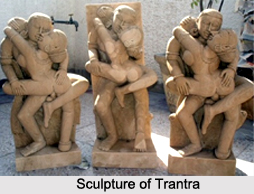
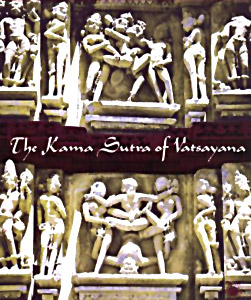
 Kama Sutra by ancient Sanskrit scholar Vatsayana is a stupendous text, redefining the art of corporeal love and eroticism, containing seven parts or sections, which are further sub-divided into thirty-six chapters.
Divisions of Kama Sutra
The first part or section of Kama Sutra is treated as an introductory to the extensive text, named as Introductory to Kama Sutra. Chapter 1 to this extensive treatise on the art of love is named as 'Salutation to Dharma, Artha and Kama'. The initial chapter speaks evidently that the text of Kama Sutra was originally penned by several other litterateurs, like, Swayambhu Manu, Brihaspati and Nandi, corresponding to Dharma, Artha and Kama. The master creations had in the subsequent ages, undergone further makeovers in separate poetic hands. Hence, it had become mandatory for a judicious author who could compile these colossal unobtainable volumes, into a unified one. Thus was Vatsayana introduced into the state of affairs, who lend his genius brain to shorten Kama Sutra into seven parts, making the treatise decipherable. Chapter 1 to Kama Sutra elucidates about the four basic goals of life, in the meantime speaking about other various aspects of the subsequent chapters.
Chapter 2
Chapter 2 of Kama Sutra is titled as 'On The Acquisition of Dharma, Artha and Kama'. This chapter mainly lays accentuation on the observance of the three worldly attainments of Virtue, Wealth and Love, i.e., on the acquisition of Dharma, Artha and Kama. Vatsayana goes on to additionally state that there lies a pre-ordained time for acquisition of each of these domains of humanity. Childhood, one's youth and old age must be exploited in accomplishing these canonical goals of life. However, attention must be rested on the fact that none of these Dharma, Artha and Kama learning should overlap in any of the life's fundamental stages.
Chapter 3
Chapter 3 to the Introductory of Kama Sutra is titled as 'On The Arts and Sciences to be Studied'. The present chapter instructs every human, especially women to study, comprehend and finally assimilate Kama Sutra within one's bodily system. There rests a very gross notion that the art of love can be mastered under any circumstances, which is indeed untrue. According to Vatsayana, one need must learn the art and science of Kama Sutra, though she is an unmarried maiden. The law and rule of Kama Sutra is not known to any unknowledgeable being, who base their knowledge merely upon apprehension. Women, who are already versed in the science of Kama itself, Kama Shastra, must make it customary to apprehend the sixty-four arts of Kama Sutra from somebody senior and married.
Chapter 4
Chapter 4 of the Introductory of Kama Sutra is named as 'The Life of a Citizen'. The said chapter deals basically with the household life of a man and his daily chores. The man of the household, having acquired the necessary wealth and education in his life, now sheds his attention upon his married phase. Vatsayana describes in a comprehensive manner where precisely the man should have his home, how many rooms would it contain and lastly, a phenomenal and meticulous portrayal of the inner and outer rooms.
To learn more, visit the link below: