Showing posts with label zodiac. Show all posts

Thursday, 16 April 2026

Decoding Chain Markings in Palmistry: Interpretations and Life Implications

 Palmistry, the ancient practice of interpreting the lines and markings on the hand, assigns significant meaning to various patterns that appear on the palm. Among these, chain signs—small, linked, island-like formations along a line—are considered particularly important. These markings are believed to reflect fluctuations in life energy, emotional states, and personal experiences. Their placement and clarity can influence how they are interpreted, offering insights into an individual’s life journey.


What Are Chain Signs?

Chain signs appear as a series of interconnected loops or islands that resemble the links of a chain. Instead of a clear, straight line, the line appears fragmented or wavering. These formations can occur on major lines such as the Life Line, Heart Line, or Head Line, as well as on minor lines.

In palmistry, a well-defined, unbroken line is typically associated with stability and clarity, whereas a chained line suggests interruptions, sensitivities, or periods of uncertainty. The degree of chaining—whether heavy, faint, or partial—also plays a crucial role in interpretation. 

Chain Signs on the Life Line

When chain signs appear on the Life Line, they are often associated with fluctuations in physical vitality and emotional grounding. A heavily chained Life Line may indicate a person who experiences recurring periods of low energy, stress, or health-related concerns. It can also reflect a life marked by frequent changes or instability. 

If the chain pattern is prominent at the beginning of the line, it may suggest a challenging or unsettled early life. Conversely, if the chaining appears toward the end, it can point to difficulties or transitions in later years. A chain that begins faintly and becomes clearer may indicate gradual improvement in health and stability over time. 

Chain Signs on the Heart Line

On the Heart Line, chain formations are often linked to emotional sensitivity and complexity in relationships. Individuals with a chained Heart Line may be deeply empathetic but prone to emotional ups and downs. These markings can also suggest difficulties in maintaining consistent emotional balance or experiencing repeated disappointments in relationships. 

However, such signs are not entirely negative. They may also indicate a rich emotional depth and a capacity for profound connections, albeit with a tendency toward overthinking or vulnerability. 

Chain Signs on the Head Line

When chain signs appear on the Head Line, they are generally associated with mental strain, indecision, or scattered thinking. A chained Head Line may suggest a person who struggles with concentration or experiences frequent mental fatigue. 

This marking can also point to a highly imaginative mind that tends to wander, making it difficult to maintain focus. In some interpretations, it reflects a tendency to overanalyze situations, leading to confusion or anxiety. 

Variations and Interpretative Nuances

The interpretation of chain signs is not fixed and must be considered alongside other markings on the palm. A lightly chained line may simply indicate temporary challenges, whereas a deeply etched chain suggests more persistent patterns. Additionally, the presence of supportive signs—such as strong secondary lines—can mitigate the negative implications of chaining. 

Chain signs in palmistry are complex indicators that highlight periods of fluctuation, sensitivity, and transformation. While they are often associated with challenges, they also reveal depth of experience and adaptability. A balanced interpretation requires examining the entire hand, ensuring that these markings are understood within the broader context of an individual’s life path.

Thursday, 9 April 2026

Understanding the Line of Education in Palmistry and What It Reveals

 Palmistry, an ancient practice rooted in the study of hand lines and mounts, has long been used to interpret personality traits, life patterns, and potential abilities. Among the various lines examined by palmists, the Line of Education holds particular significance as it is believed to reveal insights into an individual’s intellectual development, learning capacity, and academic journey. Although not always distinctly visible on every palm, this line is often analyzed alongside other markings to understand a person's inclination toward knowledge and education.


Understanding the Line of Education

In palmistry, the Line of Education is generally considered a minor line rather than a primary one like the Life Line, Head Line, or Heart Line. It is usually observed near the Mount of Mercury, located below the little finger, or sometimes emerging from or intersecting with the Head Line. Palmists believe this line reflects the individual’s pursuit of knowledge, intellectual curiosity, and potential success in academic or scholarly endeavors. 

The clarity, length, and depth of the line are thought to influence the interpretation. A well-defined and straight Line of Education is often associated with strong learning abilities, focus, and academic achievement. Conversely, a faint or broken line may indicate interruptions in education or challenges in maintaining academic consistency. 

Variations and Their Interpretations

The Line of Education can appear in different forms, each carrying its own symbolic interpretation in palmistry. 

A long and clear line is commonly interpreted as a sign of dedication to studies and a capacity for sustained intellectual effort. Individuals with such markings are often believed to excel in higher education or research-oriented fields. 

A short line, on the other hand, may suggest that formal education plays a limited role in the person's life. However, palmists often emphasize that this does not necessarily indicate a lack of intelligence. Instead, it may imply that the individual gains knowledge through practical experiences rather than traditional academic pathways. 

If the line appears broken or fragmented, it may symbolize disruptions in educational pursuits. These interruptions could stem from external circumstances such as financial constraints, family responsibilities, or personal challenges that affect academic progress. 

Relationship with Other Palm Lines

The Line of Education is rarely interpreted in isolation. Palmists typically analyze it alongside other significant lines to form a broader understanding of a person’s intellectual profile. 

The Head Line plays a crucial role in this interpretation. A strong and well-formed Head Line combined with a visible Line of Education is believed to indicate a balanced combination of intelligence, concentration, and academic ambition. 

Similarly, markings on the Mount of Mercury can influence the reading. A prominent mount with a distinct Line of Education may suggest strong communication skills, analytical thinking, and potential success in professions related to science, teaching, writing, or business. 

Symbolic Importance in Palmistry

In traditional palmistry, the Line of Education symbolizes more than just formal schooling. It is often associated with the broader pursuit of knowledge, intellectual discipline, and the desire for self-improvement. Palmists view it as an indicator of how an individual engages with learning throughout life, whether through academic institutions, professional training, or personal study. 

However, it is important to note that palmistry is considered a cultural and interpretive practice rather than a scientifically proven method. The Line of Education is therefore understood as a symbolic feature used within the framework of traditional palm reading. 

The Line of Education occupies a distinctive place in palmistry as a marker believed to reflect intellectual inclination and educational experiences. While its interpretations vary depending on its appearance and relationship with other lines on the palm, it is commonly associated with learning potential and scholarly pursuits. Although palmistry remains a traditional system of interpretation, the concept of the Line of Education continues to intrigue those interested in understanding the symbolic meanings embedded in the human hand.

Friday, 3 April 2026

Understanding the Trident Sign in Palmistry and Its Significance

 Palmistry, also known as chiromancy, is the ancient practice of interpreting the lines, shapes, and markings on the human hand to understand an individual’s personality and potential life events. Among the many symbols that may appear on the palm, the trident sign is considered particularly significant. This mark resembles a three-pronged fork or the shape of a trident and is generally viewed as a symbol of positive energy, success, and expansion in palmistry.


Understanding the Trident Sign

A trident sign appears when a line on the palm splits into three distinct branches at one end, forming a pattern that resembles a trident. This formation may appear at the termination or along the course of a major line such as the life line, heart line, head line, or fate line. In traditional palmistry interpretations, the trident is regarded as a fortunate symbol that enhances the qualities of the line on which it appears. 

Palmists often interpret the trident as an indicator of growth, opportunity, and prosperity. Unlike simple forks or breaks in the lines, the trident formation suggests that positive energy flows in multiple directions. This is believed to amplify the beneficial effects associated with the line where the symbol is located. 

Trident on the Sun Line

One of the most favorable placements of the trident sign is on the Sun line, also known as the Apollo line. When a trident appears at the end of the Sun line, it is commonly interpreted as a sign of great success, fame, or recognition. Individuals with this marking are often believed to achieve prosperity through their talents, creativity, or public reputation. 

This sign is frequently associated with artistic ability, leadership in creative fields, and financial rewards resulting from personal achievements. The trident on the Sun line is therefore considered a powerful indicator of professional accomplishment and social prestige. 

Trident on the Fate Line

When the trident appears on the fate line, it is interpreted as a sign of career advancement and multiple opportunities in professional life. The three branches symbolize different paths that may lead to success. Individuals with this mark are believed to possess strong determination and the ability to manage diverse responsibilities effectively. 

Palmists often associate this sign with people who experience growth through career changes, business ventures, or leadership roles. It may also suggest financial stability and recognition gained through sustained effort. 

Trident on the Life Line

A trident appearing at the end of the life line is often interpreted as a symbol of vitality and expansion later in life. It may indicate that the individual will experience improved circumstances, comfort, and stability as they grow older. In some interpretations, it also suggests opportunities for travel or relocation that bring positive outcomes. 

Rather than indicating a single direction in life, the trident suggests that multiple avenues may open up for personal development and fulfillment. 

Significance in Palmistry Interpretation

While the presence of a trident sign is generally considered auspicious, palmists emphasize that it should not be interpreted in isolation. The overall structure of the palm, the clarity of the lines, and the presence of other symbols must also be taken into account. 

In palmistry, the trident represents expansion, prosperity, and amplified potential. Its appearance on major lines is typically regarded as a favorable sign indicating success and the ability to achieve positive outcomes in various areas of life.

Wednesday, 9 December 2020

Zodiacs, Astrology


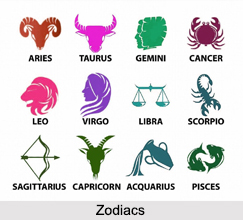
Zodiacs, AstrologyZodiacs are the twelve signs listed in a horoscope which is closely tied to the Earth’s movement through the heavens. The Sun travels around the Earth once each year. Within the space of that year the Sun moves through all twelve signs of the zodiac, spending approximately one month in each sign. The sign that the Sun was travelling through at the time of an individual’s birth is his or her ‘Zodiac’ or ‘Sun Sign’. The position of the Sun in the birth chart governs ones individuality.

The signs are derived from the constellations that mark out the path on which the sun appears to travel over the course of a year. The zodiac belt is the band of stars that surrounds the earth like a ring with the 12 main constellations that forms a great ring around mankind. Amongst the millions of stars in the sky, the 7 planets and two invisible planets (in Vedic Astrology) are in constant motion. Each Zodiac is named after patterns, or configuration of animals and features that can be visualised by looking at them in the starry nights. The figures got linked with the symbolic trait endowed by that zodiac to the earth’s inhabitants. Astrology is guided entirely by zodiac signs.

Twelve Zodiacs in Horoscope
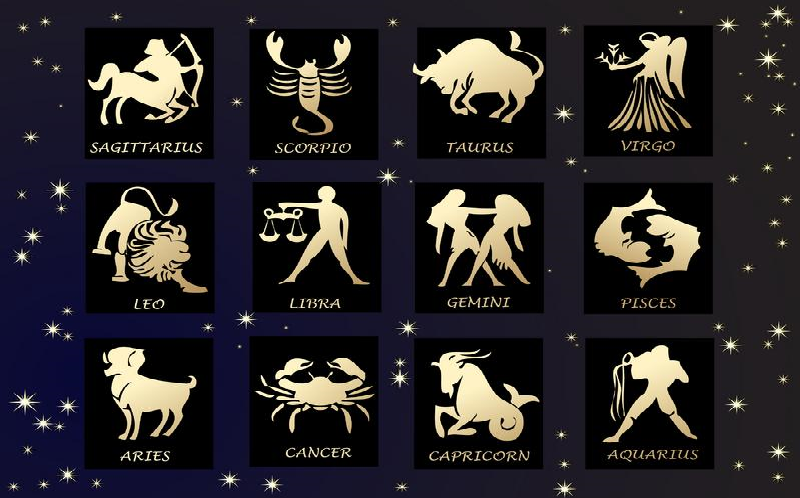
There are twelve zodiac signs in Horoscope, and each sign has its own strengths and weaknesses, its own specific traits, desires and attitude towards life and people. The zodiac sign of a person is identified by analyzing the projection of the position of planets, and the Sun and the Moon on the Ecliptic at the moment of birth.

Elements in Zodiac Signs
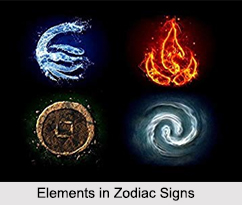
Twelve Zodiacs in Horoscope are categorized by the very element that represents them namely Water, Earth, Fire and Air. They are as follows:

Zodiacs, Astrology
  • Fire Signs: Fire signs are AriesLeo and Sagittarius. People born under these signs posses a fiery drive and liveliness in their behaviour. The constant urge to accomplish things is very evident in those lustrous sign holders. Fire also gives a great deal of pride and warmth to the people.
  • Water Signs: Water signs are CancerScorpio and Pisces. The signs ruled by water are very intuitive. Water can take the shape of the vessel in which it is held. This shows the adaptability of the element and people born in it.
  • Air Signs: Air signs are GeminiLibra and Aquarius. People born in these zodiacs have a fast and at times multidirectional quick thinking. The movement of air is uncontrollable and changeable and so is the basic thought process of these people.
  • Earth Signs: Earth signs are TaurusVirgo and Capricorn. Once formed across the period of time, earth takes the definite shape, and refuses to let it go. The same is true for the characteristics of these signs. People born under it seem grounded and down to earth.
  • Compatibility in Zodiac Signs
    Human relations and compatibility can also be judged on the basis of the relationship of these elements. All the signs are compatible with the other signs born under the same element. There are some elements that are not compatible with the other elements. 

    For more visit the link below:

    Monday, 13 July 2020

    Tantrism


    TantrismTantrism has persisted and thrived throughout Asian history since the middle of the first millennium. It deals with spiritual practices and ritual forms of worship aiming at liberation from ignorance and rebirth. The universe is regarded as the godly play of Shakti and Shiva. Tantrism developed into a tradition by the end of the Gupta reign. However it has influenced major religions like HinduismSikhismBuddhism and Jainism. Tantrism is characterized by the use of rituals thereby identifying macrocosm and microcosm. In Tantrism one uses the heavenly power that flows through the universe to achieve certain goals.

    Origin of Tantrism
    Origin of Tantrism is a debatable issue. There are diverse views - some say that the Pre-Aryan Indians could have been the discoverers; others consider it as the tradition of ancient people. Historically it dates back to the time of the rise of the religion of Buddhism as the later Buddhists adopted some of the Tantric symbols.

    Relation to Vedic Tradition
    The tradition of Tantrism may be considered as intertwined with the Vedic tradition. The sources of written Tantric tradition are the agama which consists of four parts describing jnana, yoga, kriya and charya. Elements of Tantrism exist in Shaiva, Vaishnava, Ganapatya, Shaurya and Shakta forms. The basic ideas of Tantra as a philosophy are found in the Rig Veda. Tantrism is a build-up of various resources to change mundane into super mundane. There are some hymns and use of mystic words during the Rig Vedic period which proves the origin of Tantra.

    Tuesday, 22 October 2019

    Zodiacs, Astrology

    horoscope-circle-with-zodiac-signs-vector-20199302.jpg
    Zodiacs are the astrological signs encyclopaedia, all about the twelve signs those govern human lives.

    Zodiacs are the twelve signs listed in a horoscope which is closely tied to the Earth’s movement through the heavens. The Sun travels around the Earth once each year. The position of the Sun in the birth chart governs ones individuality.

    2017_4image_12_52_350496704horoscoperashi-ll.jpg
    The signs are derived from the constellations that mark out the path on which the sun appears to travel over the course of a year. Amongst the millions of stars in the sky, the 7 planets and two invisible planets (in Vedic Astrology) are in constant motion.


    Twelve Zodiacs in HoroscopeUntitled

    Elements in Zodiac Signs
    Twelve Zodiacs in Horoscope are categorized by the very element that represents them namely Water, Earth, Fire and Air . They are as follows:
    What-Kind-of-Element-Are-You-Fire-Water-Earth-or-Air-1-1.jpg
    Compatibility in Zodiac Signs
    Human relations and compatibility can also be judged on the basis of the relationship of these elements.  These are as follows:

    1. Fire signs and water signs are not so compatiblefire-and-ice-3d-wallpaper_3840x2160.jpg

    2. Water signs gel well with Earth signsUntitled.png

    3. Earth signs do not gel well with air signsUntitled.png

    4. Air and Fire signs are mutually compatibleUntitled.png

    5. Fire is neutral to earth, as both elements have no effect on each otherUntitled.png

    6. Water and air signs are again neutral to each otherD1062_15_685_1200.jpg

    Read More :-Zodiacs, Astrology

    Saturday, 1 June 2019

    Twelve Houses in Horoscope

    free-kundli-500x500
    Twelve Houses in Horoscope describes an individual's life.The twelve houses bear their individual ruling planet, their meaning and their related zodiac sign.The entire life aspects and qualities of the person are recorded in the twelve houses of a horoscope. The houses are also known as 'Sthanas' or 'Bhavas'.

    Twelve houses in Horoscope are:
    Lagnastan
    The zodiac sign of this house is Aries and its planetary ruler is Mars planet.

    Dhanasthan
    The zodiac sign of the second house is Taurus and the planetary ruler is Venus planet.

    Untitled.png
    planets.pngBhatrusthan
    Gemini is the zodiac sign of this house and its planetary ruler is Mercury planet.

    Matrusthan
    The zodiac sign of this house in horoscope is Cancer and the planetary ruler is Moon planet.

    Vidyasthan
    The zodiac sign associated with this house is known asLeo and the Sun planet is the planetary ruler.

    Ripusthan
    The sixth house in horoscope is having Virgo as its zodiac sign and the planetary ruler of this house is Mercury.

    Bharyasthan
    It has Libra and Venus as its zodiac sign and planetary ruler respectively.

    Mrityusthan
    This house is having Scorpio as its zodiac sign and the planetary ruler is Pluto.
    zodac-cardinal_fixed_mutable.jpg

    Bhagyasthan
    The planetary ruler of the ninth house is Jupiter planet and the zodiac sign of this house is Sagittarius.
    kundali-12-sign-1.jpg
    Karmasthan
    The zodiac sign of the tenth house is Capricorn and the planetary ruler of this house is Saturn planet.

    bhavas
    Labhasthan
    The planetary ruler of this house is Uranus planet and the zodiac sign is Aquarius.

    Vyayasthan
    The zodiac sign of the twelfth house is Pisces and the planetary ruler is Neptune.

    Read more here : Twelve Houses in Horoscope

    Monday, 27 May 2019

    Astrology and Health

    Hippocrates, the Father of Medicine said, "A physician without the knowledge of astrology has no right to call himself a physician".
    Astrology-and-Health.jpg
    Hippocrates_rubensHealth is of primary importance to all and Astrology can help understand how each Sun sign dominates different parts of an individual’s anatomy. Some diseases are likely to develop because they are hardwired into ones genetics. By gaining an understanding of this, he/ she can best apply the knowledge of astrology to improve health.

    medical.jpg Astrology and Human Body
    Each sign of the zodiac rules or governs a specific part of the body. These associations date back to the origin of Astrology.
    diet-plan-in-hindi.jpg633x319
    Astrology and Diet
    Each sign of the zodiac has particular diet needs for minerals that are found in certain foods.

    In Astrology, everyone is divided into 4 categories by constitution; waterfire, earth and air.

    Fire Signs: Aries, Leo and Sagittarius.
    111Water Signs: Cancer, Scorpio and Pisces.
    Earth Signs: Taurus, Virgo and Capricorn.
    Air Signs: Gemini, Libra and Aquarius.
    To know more visit here:Astrology and Health