Showing posts with label heritage. Show all posts

Monday, 10 November 2025

The Princely State of Patdi: Echoes of Gujarat’s Regal Heritage


Nestled in the western part of India, the Princely State of Patdi was once a small but significant dominion in the Saurashtra region of Gujarat. Before India’s independence in 1947, Patdi held an important place among the princely states of Kathiawar, contributing to the region’s rich cultural and political tapestry. Although modest in size compared to the larger princely states like Baroda or Bhavnagar, Patdi stood out for its heritage, local governance, and the pivotal role it played in the socio-economic development of its territory. 

Located near the edge of the Little Rann of Kutch, Patdi’s geographical position gave it a unique identity. The arid landscape, interspersed with saline stretches and semi-desert terrain, shaped the lifestyle and economy of the region. The state derived much of its income from agriculture, salt production, and trade, with Patdi town serving as an important local hub. Despite the harsh climate, the people of Patdi developed a resilient character and a self-sustaining way of life. 

The ruling dynasty of Patdi belonged to the Jhala Rajput clan, a lineage known for its valor and chivalry. The Jhalas were among the prominent Rajput rulers in western India, and their influence extended across several states, including Dhrangadhra, Wankaner, and Limbdi. The ruler of Patdi bore the title of “Thakur,” which denoted both nobility and administrative responsibility. Under their rule, the princely state maintained internal order, administered justice, and promoted local welfare while recognizing the suzerainty of the British Crown. 

During the British Raj, Patdi was classified as a salute state—an honor that signified recognition of the ruler’s standing among the princely peers. The state’s administrative system reflected a blend of traditional Rajput governance and colonial oversight. The Thakur maintained authority over local matters such as land revenue, agriculture, and law enforcement, while the British Political Agent ensured alignment with imperial policies. Despite the constraints of indirect rule, Patdi managed to preserve much of its autonomy and cultural identity. 

Socially, the princely state was characterized by a strong sense of community and tradition. Hindu customs dominated, though the region was also home to Jains and Muslims, contributing to a vibrant social mosaic. The rulers of Patdi were patrons of art, architecture, and religious institutions, fostering the construction of temples and public works that still echo the grandeur of the past. Festivals, fairs, and folk performances formed an integral part of the local culture, keeping the spirit of the region alive through generations. 

Following India’s independence in 1947, the Princely State of Patdi acceded to the Indian Union, marking the end of its autonomous rule. The integration of Patdi into the state of Gujarat brought new opportunities for modernization while preserving its historical legacy. Today, the remnants of Patdi’s royal past, its old palaces, temples, and traditions, stand as silent witnesses to a bygone era of princely elegance. 

The story of Patdi is not merely about power or royalty; it is about endurance, adaptation, and identity. Though time has transformed its landscape, the spirit of the erstwhile princely state continues to echo in the sands of Gujarat, reminding us of a chapter in India’s regal heritage that remains quietly dignified and enduring.

Tuesday, 24 January 2023

Madhya Pradesh Temples


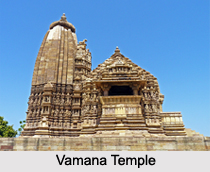
Madhya Pradesh TemplesThe state of Madhya Pradesh is located in central India. This ‘Central Province’ is the second-largest state in India by area (308,245 square kilometers) and the fifth-largest state in the country by population (over 75 million inhabitants). The geographical terrain of this state is characterized by a plateau streaked with the hill ranges of the Vindhyas and the Satpuras, rivers, lakes and dense forests. The natural beauty of Madhya Pradesh, along with world heritage sites, several cities, hill stations, national parks, etc draw tourists to this state. Temples of Madhya Pradesh are no exception in this regard. They also serve as spots that have the potential to catch the attention of tourists visiting this state.

Mahakaleshwar Jyotirlinga
Mahakaleshwar Jyotirlinga is located in the ancient city of Ujjain. This Hindu temple is dedicated to Lord Shiva and is one of the twelve Jyotirlingams (most sacred abodes of Lord Shiva) in India. Mahashivratri is an important festival celebrated in this temple.

Lakshmana Temple
Lakshmana Temple is located in the small village of Khajuraho in the district of Chattarpur. This Hindu temple is dedicated to a form of Vishnu called Vaikuntha Vishnu and houses a tri-headed four-armed sculpture of this deity. This temple is a fine representation of Hindu temple architecture. The temple complex stands on a high platform and has an ardh-mandapa (entrance porch), mandapa, maha-mandapa, antarala and garbhagriha.

Chaturbhuj Temple
Chaturbhuj Temple is located in the town of Orccha. Currently, an image of Radha Krishna is worshiped in this temple. This temple was built in the 16th century by the rulers of the Orccha state called Bundela Rajputs. The Ram Raja Trust is recognized as the managing body of this temple. The State Archaeology Department is responsible for the conservation of the temple structure.

Annapurna Temple
Annapurna Temple is situated in Indore and is one of its famous pilgrimage sites. This Hindu temple is dedicated to goddess Annapurna. Architecturally, this temple is similar to the famous Meenakshi Temple of Madurai. It has three shrines of Shiva, Hanuman and Kalabhairava and the famous Pravachan Hall.

For more, visit the link below:

Thursday, 15 December 2022

Pahari Painting, Indian Paintings


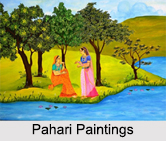
Pahari Painting, Indian PaintingsPahari painting refers to a painting from the mountainous regions and was developed in the independent states of the Himalayan foothills in India. It is one of the types of Indian paintings which are generally done in the miniature style. Pahari painting is the name given to Rajput paintings, made in Himachal Pradesh and Jammu and Kashmir states of India.

Origin of Pahari Painting
Pahari paintings developed and flourished during the period of 17th to 19th century. It was flourished in Basohli, Jammu, Garhwal, Chamba, Kangra, Guler and Mandiin the hilly areas in the northwest has been termed the Pahari School and was influenced to some extent by the Mughal painting of Aurangzeb’s period. Pahari paintings have been extensively influenced by the Rajput paintings, because of the family relations of the Pahari Rajas with the royal court at Rajasthan. There is strong influence of the Gujarat and Deccan paintings. With the appearance of Bhakti movement, new themes for Indian Pahari paintings came into practice. The ‘Shaiva-Shakta’ themes were increased by dialect poetry and folk songs of Lord Krishna and Lord Rama. At the same time, the themes of the paintings revolved around love and dedication also. There was also illustration of great epics, puranas, etc. The depiction of Devi Mahatmya manuscript painted at Kangra, in 1552, has been much acclaimed.

Types of Pahari Paintings
Following are the different types of Pahari Painting:

Basohli Paintings: Basohli town is situated on the bank of the Ravi River in Himachal which has produced splendid Devi series, magnificent series of the manifestations of the Supreme Goddess. Artist Devidasa painted it under the patronage of Raja Kirpal Pal. Gita Govinda of 1730 is also believed to have Basohli origin. Geometrical patterns, bright colours and glossy enamel characterize Basohli paintings.

Bilaspur Paintings: Bilaspur town of Himachal witnessed the growth of the Pahari paintings around the mid-17th century. Apart from the illustrations of the Bhagavata Purana, Ramayana and Ragamala series, artists also made paintings on rumal (coverlets) for rituals and ceremonies.

Chamba Paintings: These are quite related in appearance to Mughalstyle of paintings, which strongly influences the Deccan and Gujarat style too. The late 17th century witnessed Chamba paintings of Himachal being dominated by Basohli style, which ultimately gave way to Guler painting tradition.

For more, visit the link below:

Tuesday, 6 December 2022

Indian Archaeological Museums


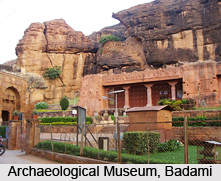
Indian Archaeological MuseumsIndian Archaeological Museums are famous for providing a vivid picture of the Indian subcontinent. They play an integral role in preserving the rich cultural heritage of India, and are present in almost all the major Indian cities. Indian Archaeological Museums exhibit a large variety of excavated materials from ancient and medieval India. Apart from providing information and exhibiting important archaeological elements of ancient times, Indian Archaeological Museums also conduct archaeological excavations. The main objective behind this is to discover archaeological evidences of ancient India and unfolding the history of Indian civilization. Archaeological records like sculptures, portraits, coins and currency, revenue and court fee stamps, wooden and bronze sculptures, armory etc are ideally housed in the Indian Archaeological Museums.

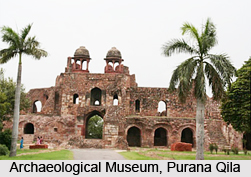
Archaeological Museum, Purana Quila
It is situated inside the fort called Purana Quila in Delhi. The Archaeological Survey of India (ASI) carried out excavations in the year 1955 and later again in the period of 1969 to 1973. The materials discovered through various excavations are displayed in the museum, which narrate the settlements in this region around 1000 BC. Cultural aspects of Mauryan, Mughal, Sunga, Rajput, Gupta, Kushana and Sultanate empires can be figured out from the artifacts of this museum. Antiquities excavated from other parts of Delhi are also exhibited in this museum.

Taj Museum, Taj Mahal
Indian Archaeological MuseumsIt is one of most famous archaeological museums of India in Agra district of Uttar Pradesh. It is situated within the Taj Mahal complex, more specifically, in the Jal Mahal. The three galleries of the museum exhibit artifacts related to the construction of Taj Mahal and the architects involved in building this magnificent structure. Manuscripts, paintings, specimen of calligraphy, government decrees, utensils, arms, marble pillars etc form the exclusive collection of this beautiful museum. The main hall of the museum houses the paintings of the Mughal emperor, Shah Jahan and his wife Mumtaz Mahal on ivory, encased within decorated wooden frames.

Archaeological Museum, Khajuraho
The Archaeological Museum in Khajuraho, Madhya Pradesh, was built in 1967. It displays the loose sculptures from the temples of Khajuraho. The most famous artifacts of this museum include sculptures of Jaina, Brahmanical and Buddhist faiths. The museums comprises of five galleries along with a massive hall.

For more, visit the link below:

Thursday, 17 November 2022

Andhra Pradesh Temple Festivals


Andhra Pradesh Temple Festivals, Indian Temple FestivalsAndhra Pradesh is famous for its varied culture and tradition. Andhra Pradesh is enamoured with thousands of religious centres, where weekly, monthly or annual Andhra Pradesh temple festivals are held. Every village and town in Andhra Pradesh has some kind of temple or place of worship where religious festivals are held, accompanied by fairs. Some of the Andhra Pradesh temple festivals are of local importance, while others have a wider significance.

Some of the popular temple festivals of Andhra Pradesh are as follows:

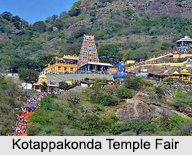
  • Kotappakonda Temple Fair: The famed ‘Kotappakonda Temple Fair’ is held each year on the eve of Maha Shivratri in February. Thousands of devotees swarm the temple with decorated and lighted prabhas (huge lamps) in their hands as a gift to Lord Shiva.


  • Andhra Pradesh Temple Festivals, Indian Temple Festivals
  • Sambhulingeswara Kalyanotsavam: It is another temple festival of Andhra Pradesh, celebrated during Mahashivaratri for five days. On the first day, Prabhas are come out in procession. Cash, silver and gold ornaments, coconuts, fruits and flowers are offered to the Lord, along with cows and calves, tying them to the Dhwajasthambha in fulfilment of their vows. It is believed that childless women, who perform Sambhulingeswara Kalyanotsavam for five days, wearing wet clothes, would surely be blessed with children. Fasting and Jagaranam are also observed. A large five-day fair including cattle fair is held near the temple.


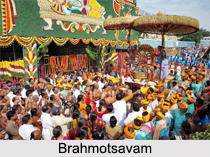
  • Tirupati Festival: There are a number of festivals that are held at Tirpupati in Andhra Pradesh. The most well known festivals are Brahmotsavam, which is the most affected festival of Lord Venkateswara that is held in the month of Asweeja. Every day during the festival, the idol is taken out in bright processions flanked by his companions. The Brahmotsavam continues for 10 days and is one of the most important festivals of the Tirupati temple.


  • Yellamma Jatara: Yellamma Jatara is renowned on the full moon day in the month of chaitra. Yellamma is friend of Kakatamma, the famed goddess of Kaktiya ruler. Goddess Yellamma (Yellaramma) is worshipped all over Andhra. The garaga parade of this place is very celebrated and a fair is also organised.


  • Durgamma Festival: This festival is celebrated for four days in the month of Bhadrapada. On the first day, the water for devotion is brought from a nearby river Majira. On the second day, a buffalo proposed for sacrifice and is taken to the river. After worshipping the water-goddess, the buffalo is washed there. It is then decorated and brought to the temple in a procession to the addition of music.

  • For more, visit the link below:

    Thursday, 23 December 2021

    Nagara Style of Architecture

      The Nagara style is typically characterised by the architectural wonder, which ideally portrayed the craftsmanship of the artists. A study of the temples of northern India reveals two distinct features, in Planning and in Elevation. In plan, the temples were basically quadrangle with graduated projections in the centre. In elevation, it resembles a tower gradually inclining inwards in a convex curve. According to the plan the projections are carried upwards to the top of the Sikhara, and thus there is strong emphasis on vertical lines in elevation. The Nagara style is spread across various parts of India. It therefore, exhibits diverse verities and implications in separate outlines of development and elaboration. Such plans and the curvilinear tower are, however, common to every medieval temple of northern India.


    On account of regional difference, architecture of the temples of Nagara style can be classified according to diverse regions, such as, Orissa, Central India, Rajputana, Gujarat and Kathiwar etc.

    Nagara Style Architecture of Orissa
    The development of the Nagara style took place in Orissa from the 7th to 13th century A.D. It has, therefore, probably more temples than in all the rest of northern India. The activity is mostly centred on Bhubaneshwar, which alone contains hundreds of temples. The three most important temples of Orissa are Muktesvara temple, Rajarani temple and the Lingaraja temple.

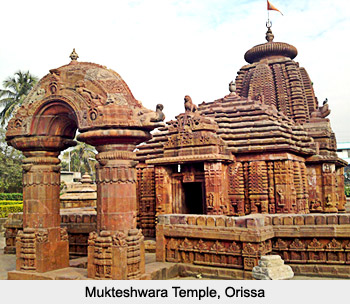
    Mukteshvara Temple, OrissaThe Muktesvara temple is regarded as a gem of Orissan architecture. A low enclosure wall embellished with sculptured niches surrounds it. The temple is entered through an elaborately ornamented Takaratorana that forms a unique and fitting entrance to this small but exquisitely ornate and well-proportioned monument. The Sikhara is of five storeys and shows on the central Ratha beautifully carved Chaitya-dormer surrounded by a Kirtmukha and flanked by two grinning dwarfs. This is the first temple wherein the shoulder partakes of the projections of Sikhara and the Mandapa facade follows the same scheme of ornamentation as the sanctum with the addition of an ornate projection on each side. It is surrounded by a pediment and crowned by a lion figure.

    The Rajarani temple, roughly dates back to the early 11th century, represents a unique experiment in Orissa. Its Sikhara is clustered by turrets including leaning spires and corner-spires, some of them crowned by double Amalakas, like the temples of central India such as those of Khajuraho.

    The Lingaraja temple, dating from the 11th century, is the grandest temple marking the culmination of the architectural activity at Bhubaneshwar. This temple consists of the sanctum, a closed hall, a dancing hall and a hall of offerings. The sanctum is Pancharatha on plan. The lower register of the wall is decorated with Khakhara-Mundis and the upper with Pidhamundis. The Khakhara Mundis contains on the corner Rathas figures of eight Regents and on the flanking Rathas miscellaneous friezes. The Pidhamundis are inset with images of various Brahmanical gods and goddesses.

    The famous temple of Jagannatha at Puri is roughly contemporaneous with the Lingaraja. It shows the same mature plan as the latter, but is even loftier and is nearly 56.70 m high.

    The culmination of the style was reached in the Sun temple at Konark, which marks even in its ruined state. This is the grandest achievement of the artistic and architectural genius of Orissa. The colossal temple originally consisted of a sanctum with a lofty curvilinear Sikhara, a Jagamohana and a detached elaborately carved square platform. This Jagamohana is unparalleled for its grandeur and structural propriety in the country; Majestic in conception and rich imagery, the temple not only marks the final fulfilment of Orissan architecture but is one of the most sublime monuments of India.