Showing posts with label painter. Show all posts

Thursday, 15 December 2022

Pahari Painting, Indian Paintings


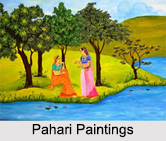
Pahari Painting, Indian PaintingsPahari painting refers to a painting from the mountainous regions and was developed in the independent states of the Himalayan foothills in India. It is one of the types of Indian paintings which are generally done in the miniature style. Pahari painting is the name given to Rajput paintings, made in Himachal Pradesh and Jammu and Kashmir states of India.

Origin of Pahari Painting
Pahari paintings developed and flourished during the period of 17th to 19th century. It was flourished in Basohli, Jammu, Garhwal, Chamba, Kangra, Guler and Mandiin the hilly areas in the northwest has been termed the Pahari School and was influenced to some extent by the Mughal painting of Aurangzeb’s period. Pahari paintings have been extensively influenced by the Rajput paintings, because of the family relations of the Pahari Rajas with the royal court at Rajasthan. There is strong influence of the Gujarat and Deccan paintings. With the appearance of Bhakti movement, new themes for Indian Pahari paintings came into practice. The ‘Shaiva-Shakta’ themes were increased by dialect poetry and folk songs of Lord Krishna and Lord Rama. At the same time, the themes of the paintings revolved around love and dedication also. There was also illustration of great epics, puranas, etc. The depiction of Devi Mahatmya manuscript painted at Kangra, in 1552, has been much acclaimed.

Types of Pahari Paintings
Following are the different types of Pahari Painting:

Basohli Paintings: Basohli town is situated on the bank of the Ravi River in Himachal which has produced splendid Devi series, magnificent series of the manifestations of the Supreme Goddess. Artist Devidasa painted it under the patronage of Raja Kirpal Pal. Gita Govinda of 1730 is also believed to have Basohli origin. Geometrical patterns, bright colours and glossy enamel characterize Basohli paintings.

Bilaspur Paintings: Bilaspur town of Himachal witnessed the growth of the Pahari paintings around the mid-17th century. Apart from the illustrations of the Bhagavata Purana, Ramayana and Ragamala series, artists also made paintings on rumal (coverlets) for rituals and ceremonies.

Chamba Paintings: These are quite related in appearance to Mughalstyle of paintings, which strongly influences the Deccan and Gujarat style too. The late 17th century witnessed Chamba paintings of Himachal being dominated by Basohli style, which ultimately gave way to Guler painting tradition.

For more, visit the link below:

Tuesday, 23 August 2022

Folk Paintings in Rajasthan


Folk Paintings in Rajasthan, Indian PaintingsFolk paintings in Rajasthan are as different as its culture. The folk paintings in Rajasthan are completely handmade. They bring numerous talented painters of Rajasthan. The folk paintings of Rajasthan deal with pictorial depictions of popular Hindu gods, human portraits, common customs and rituals and the elements of nature. Some of the popular folk paintings of Rajasthan include sanjhya painting, phad painting, pichwai painting and miniature painting.

In Rajasthan, the folk paintings are typically done on some particular occasions like marriage, birth ritual and festivals. This tradition of folk paintings is found in villages and rural areas practiced by a variety of tribes. They are very unique, new and done with underdone-hand.

History of the Folk Paintings in Rajasthan
Throughout the early medieval period of the early 5th century, an exceptional art form was taking outline in and around two areas of western India namely, Marudesh and Gurjaratra which are Rajasthan and Gujarat in present day. Throughout this period, the Marudesh and Gurjaratra saw wonderful changes in the political and cultural field and these changes lent a helping hand in the further development of art.

Different types of the Folk Paintings in Rajasthan
Following are the different folk paintings of Rajasthan:

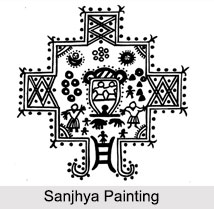
  • Sanjhya Painting: It is a traditional wall painting and is mostly popular in Mewar and Malwa regions. Young girls, especially the newlywed paint the walls for 14 to 15 days during the pitrapaksha. Every day in the evening, they wash the wall with cow dung and ochre. They use various materials to adorn the walls like motifs (made from the lumps of cow dung), flower, leaves, colourful papers of gilt, vermilion, head grains of maize and wheat etc.Folk Paintings in Rajasthan, Indian Paintings On the final day, the images are immersed in a river, pond or any source of water.

  • Thapa: In Rajasthan this art has gained different forms and multilevel representation. Along with the common hand prints, there are iconic depictions of a variety of gods and goddesses which are drawn in festivals and spiritual ceremonies to settle precise deities. Many of these drawings are connected with exact seasons.


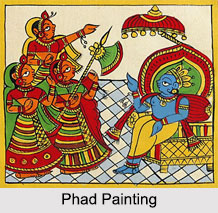
  • Phad Painting - Phad painting or Phad is a style of religious scroll painting. Since the last two centuries, the Joshi families of Bhilwara, Shahpura in Bhilwara district of Rajasthan are widely known as the traditional artists of Phad painting. Phad painting is traditionally done on a long piece of cloth or canvas, known as phad. These sorts of painting feature the narratives of the folk deities of Rajasthan, mostly of Pabuji and Devnarayan. Traditionally vegetable colours are used in these paintings. Some of the noted artists of phad painting are Shree Lal Joshi, Nand Kishor Joshi, Prakash Joshi and Shanti Lal Joshi.

  • For more, visit the link below:

    Thursday, 3 March 2022

    Tanjore Paintings


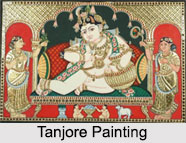
    Tanjore Paintings, Indian PaintingsTanjore Paintings have a very rich heritage. Tanjore Painting is one of the most popular forms of classical South Indian painting. It is the local art form of Thanjavur city of Tamil Nadu. The pattern of art had flourished in Thanjavur, the capital of the Chola dynasty and since got such a name as Tanjore paintings.

    The premise of Tanjore painting is essentially religious and spiritual and the art is renowned for its artistic portray of legendary characters and themes. The Brihadeeswara temple, for instance, houses several illustrations of Thanjavur paintings in the form of Chola murals and Nayak paintings. Even the Maratha palace is an ideal place to explore these paintings.

    History of Tanjore Paintings
    Tanjore Painting of India originated in the 16th century, under the sovereignty of the Cholas. The drop of the Vijayanagar Empire and dismiss of Hampi in the Battle of Talikota in 1565 CE effected the immigration of painters who had been dependent on the aid of the empire. Some of them roamed to Thanjavur and worked under the patronage of the Thanjavur Nayakas. Then, the Maratha rulers defeated the Thanjavur Nayakas and began to raise the Thanjavur atelier. During the Gupta Empire around 18th century, Tanjore had reached the peak of success. The Tanjore painting adorned the interiors of the palaces and soon found their place in every household. The "Saraswathi Mahal Library" in Tanjore displays the famous Tanjore paintings.

    Features of Tanjore Paintings
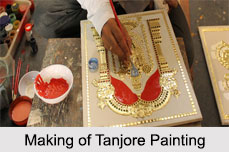
    Tanjore Paintings, Indian PaintingsTanjore paintings are famous for rich colour, exterior prosperity and compressed work of art. Tanjore Paintings are embellished with rich precious stones, glass pieces and gold that add colour to the surrounding. To include 3d effect, the painters use limestone. Subjects of most of the paintings are Hindu gods and goddesses and saints. The paintings are made on wood and cloth made canvass. Tanjore Paintings come in three finishes classic, stamped and exceptional. High quality of 22-carat gold foil is used to make sure that it lasts for generations.

    The characteristic of Tanjore painting is that the figures in the paintings have a round body and egg shaped effulgent eyes and are surrounded by curtains and arch. These paintings illuminate in the dark room. The artists then sketches the meticulous pictures on the canvas while the paste of limestone and fastening substance is used during adorning and engraving ornaments into the paintings. The pillars, dresses, arch and thrones of the Tanjore paintings are gilded with the gold leaves and gems of different colours. After this, colours are painted on the sketch. For outlines dark brown is usually used. Red is preferentially used as the background colour but sometimes green is also used. The yellow colour is used for the Goddesses while for Gods it varies: blue for Lord Vishnu and white for Nataraja. Previously artists used the natural colours made from vegetable dyes. The portfolios of the old Tanjore paintings were restricted to the drawings of the divine figures. But now-a-days the modern artists explore new dimensions. They also start depicting the presiding deities of the famous temples.

    For more, visit the link below:

    Friday, 4 February 2022

    Deccani School of Painting


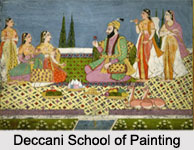
    Deccani School of Painting, Indian PaintingsDeccan school of painting was effective in southern part of India in medieval age and later years. Adil Shahi, Nizam Shahi and Qutub Shahi rulers were the patrons in the development of Deccani School of painting. A lot of artists flourished during the rule of Ibrahim Adil Shah (II) (1580-1627), who was a great lover of painting. It is evident from the availability of numerous portraits of Ibrahim Adil Shah in different museums of the world. Deccani painting can be illustrated as a perceptive and an extremely included mix of original and overseas style of art.

    History of Deccani School of Painting
    The miniature painting method, which increased at first in the Bahmani court of Bahmani Sultanate and later in the courts of Ahmadnagar, Bijapur, Bidar Berrar and Golkonda is generally well-known as the Deccan school of Painting. The Nujum-ul-ulum of 1570 is the first dated manuscript, appears to be a producer of Bijapur, which continued to be one of the major centres of the style. Deccani art also had its consequence on the expansion of miniature painting in the Hindu courts of Rajasthan and central India.

    The art of painting carried with it the influence and essence of the culture it represented. The art of painting widespread in other parts of India were very much influenced. Ibrahim Adil Shah was shown as a musician in few other paintings available in the Naprstck Museum, Prague, and the Goenka Collection, Kolkata. Although the Mughal School of painting and the Deccani School of painting developed the naturalism due to European influence, yet there was a difference between the two. The Mughal school paintings were more dazzling in technique whereas the Bijapur or the Deccani School of painting represented more naturalism due to imaginative composition and poetic content.

    Features of Deccani School of Painting
    Deccani School of Painting’s style is a perceptive, highly integrated merge of indigenous and foreign art forms. The Vijaynagar painting’s similarity is seen in the lengthened figures while the floral backgrounds with a general use of landscape shows Persian influence. Deccani colours are rich and luminous, and much use is made of gold and white. For the most part of the colour of Deccani paintings are Islamic, Turkish and Persian tradition particularly the arabesques, but those are surmount by a pure Deccani part of undergrowth. These paintings have a distinct quality of their own in the very unconventional composition. The rich landscape mysterious atmosphere, gem-like colouring, lavish use of gold, exquisite finish, profusion of large plants, flowering shrubs and typical Dakhni castles in the background and above all, the sweeping decorative rhythm that is of Bijapur origin are quite visible in them.

    For more, visit the link below:

    Thursday, 8 April 2021

    Indian Tribal Paintings


    Indian Tribal PaintingsIndian tribal paintings possess an inimitable sensitivity, as tribal folks possess a passionate awareness, massively varying from the urbanised population. India presents before the world perhaps as sunny a field as any solitary country in the world pregnant with a perfect specimen of all the minute varieties of Oriental life; of Oriental scenery, Oriental nations and Oriental manners, and it is open to the globe to explore these peculiarities to the last degree while enjoying perfectly European security. And tribal paintings cater to such Orientalism, inexhaustible charisma of the "others"; a perfect expression of their life redrawing their passion and mystery.

    Tribal painting is the mirror of the energy of the respective art of various tribal groups. It is a living and changing art form, which changes with time, necessity, environment, memories, global influences and experiences of these people.

    Wall Painting
    Wall painting is the simplest art in any tribal society. The custom of making designs on walls and floors for some festivals or other religious purposes is common in the Indian tribal scenario. Every year when they repair or whitewash their surroundings, they either recreate a fresh design or recreate the previous one with fresh colours.

    Tribal Painting of different regions of India
    The Saura painting of Odisha which is done by the 'Sauras' is one of the important paintings of the eastern zone which consists of sublime portraiture of human beings, horse, elephant and sun with symbolic meanings behind each. Painted to appease the Gods and ancestors, these paintings are noted for their elegance, charm, iconography, aesthetic and ritualistic association. This form of art is mostly found in Rayagada district, Gajapati district and Koraput of Odisha.

    Another Indian tribal art of eastern zone is Santhal Painting which is portrayed by Santhal tribes, located in Bihar, Odisha and West Bengal. It is painted freehand and reflects their perception of life. This painting possesses the simplest themes like harvesting, field, happy family, dance, domestic violence, quarrel, wine party, Gods and Goddess on the canvas. They are done on a handmade paper with poster colors. The Khovar and Sohrai paintings occupy a significant part in the tribal art of India. Khovar is the mural art form practiced by tribal women artists during the marriage season from January to June. The term Khovar is a popular term for the painted rock art caves across India.

    The Khovar is the Bridal Room where the decorated nuptial room is a tribal tradition. The decoration is done in the bride's house by the bride's mother. These two forms of Indian tribal painting redraw Indian illustrious lines in painting and artistic lineage. Kurmi villagers are close to the rock art sites. Tigers and elephants are common motifs in their form of Indian tribal painting along with peafowl and the legendary man-like bird Chibha which runs on legs and stands upright and has hands. This art is colorful, vibrant and evocative, reminiscent of the natural expression of people.

    For more, check the link given below: