Showing posts with label paint. Show all posts

Friday, 4 February 2022

Deccani School of Painting


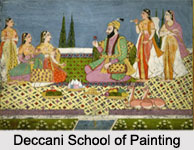
Deccani School of Painting, Indian PaintingsDeccan school of painting was effective in southern part of India in medieval age and later years. Adil Shahi, Nizam Shahi and Qutub Shahi rulers were the patrons in the development of Deccani School of painting. A lot of artists flourished during the rule of Ibrahim Adil Shah (II) (1580-1627), who was a great lover of painting. It is evident from the availability of numerous portraits of Ibrahim Adil Shah in different museums of the world. Deccani painting can be illustrated as a perceptive and an extremely included mix of original and overseas style of art.

History of Deccani School of Painting
The miniature painting method, which increased at first in the Bahmani court of Bahmani Sultanate and later in the courts of Ahmadnagar, Bijapur, Bidar Berrar and Golkonda is generally well-known as the Deccan school of Painting. The Nujum-ul-ulum of 1570 is the first dated manuscript, appears to be a producer of Bijapur, which continued to be one of the major centres of the style. Deccani art also had its consequence on the expansion of miniature painting in the Hindu courts of Rajasthan and central India.

The art of painting carried with it the influence and essence of the culture it represented. The art of painting widespread in other parts of India were very much influenced. Ibrahim Adil Shah was shown as a musician in few other paintings available in the Naprstck Museum, Prague, and the Goenka Collection, Kolkata. Although the Mughal School of painting and the Deccani School of painting developed the naturalism due to European influence, yet there was a difference between the two. The Mughal school paintings were more dazzling in technique whereas the Bijapur or the Deccani School of painting represented more naturalism due to imaginative composition and poetic content.

Features of Deccani School of Painting
Deccani School of Painting’s style is a perceptive, highly integrated merge of indigenous and foreign art forms. The Vijaynagar painting’s similarity is seen in the lengthened figures while the floral backgrounds with a general use of landscape shows Persian influence. Deccani colours are rich and luminous, and much use is made of gold and white. For the most part of the colour of Deccani paintings are Islamic, Turkish and Persian tradition particularly the arabesques, but those are surmount by a pure Deccani part of undergrowth. These paintings have a distinct quality of their own in the very unconventional composition. The rich landscape mysterious atmosphere, gem-like colouring, lavish use of gold, exquisite finish, profusion of large plants, flowering shrubs and typical Dakhni castles in the background and above all, the sweeping decorative rhythm that is of Bijapur origin are quite visible in them.

For more, visit the link below:

Thursday, 8 April 2021

Indian Tribal Paintings


Indian Tribal PaintingsIndian tribal paintings possess an inimitable sensitivity, as tribal folks possess a passionate awareness, massively varying from the urbanised population. India presents before the world perhaps as sunny a field as any solitary country in the world pregnant with a perfect specimen of all the minute varieties of Oriental life; of Oriental scenery, Oriental nations and Oriental manners, and it is open to the globe to explore these peculiarities to the last degree while enjoying perfectly European security. And tribal paintings cater to such Orientalism, inexhaustible charisma of the "others"; a perfect expression of their life redrawing their passion and mystery.

Tribal painting is the mirror of the energy of the respective art of various tribal groups. It is a living and changing art form, which changes with time, necessity, environment, memories, global influences and experiences of these people.

Wall Painting
Wall painting is the simplest art in any tribal society. The custom of making designs on walls and floors for some festivals or other religious purposes is common in the Indian tribal scenario. Every year when they repair or whitewash their surroundings, they either recreate a fresh design or recreate the previous one with fresh colours.

Tribal Painting of different regions of India
The Saura painting of Odisha which is done by the 'Sauras' is one of the important paintings of the eastern zone which consists of sublime portraiture of human beings, horse, elephant and sun with symbolic meanings behind each. Painted to appease the Gods and ancestors, these paintings are noted for their elegance, charm, iconography, aesthetic and ritualistic association. This form of art is mostly found in Rayagada district, Gajapati district and Koraput of Odisha.

Another Indian tribal art of eastern zone is Santhal Painting which is portrayed by Santhal tribes, located in Bihar, Odisha and West Bengal. It is painted freehand and reflects their perception of life. This painting possesses the simplest themes like harvesting, field, happy family, dance, domestic violence, quarrel, wine party, Gods and Goddess on the canvas. They are done on a handmade paper with poster colors. The Khovar and Sohrai paintings occupy a significant part in the tribal art of India. Khovar is the mural art form practiced by tribal women artists during the marriage season from January to June. The term Khovar is a popular term for the painted rock art caves across India.

The Khovar is the Bridal Room where the decorated nuptial room is a tribal tradition. The decoration is done in the bride's house by the bride's mother. These two forms of Indian tribal painting redraw Indian illustrious lines in painting and artistic lineage. Kurmi villagers are close to the rock art sites. Tigers and elephants are common motifs in their form of Indian tribal painting along with peafowl and the legendary man-like bird Chibha which runs on legs and stands upright and has hands. This art is colorful, vibrant and evocative, reminiscent of the natural expression of people.

For more, check the link given below:

Monday, 22 February 2021

Indian Fresco


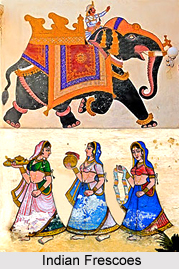
Indian FrescoChola frescoes were discovered underneath the paintings of the Nayak period. These frescoes had an element of Shaivism in them. The frescoes and sculptures in the cave temples of Ellora and Elephanta were probably built later than the ones in Ajanta. These frescoes and sculptures depict Hindu tales and metaphors and in style they evolve from the earlier Ajanta styles. The depiction of the eyes is a unique quality in the frescos of Ajanta. The eyes of the princess, kings and celestial gods are of meditative nature in order to depict the sublime look of grace and compassion. These frescoes were painted between c. 200 BC and 600 and are the oldest known frescoes in India. Jataka stories are depicted here. They have been illustrated one after another.

Other places with valuable preserved ancient and early medieval frescoes include Bagh Caves, Ellora Caves, Sittanavasal, Armamalai Cave, Badami Cave Temples and other locations. Indian frescoes have been made in several techniques including tempera technique.

Chola paintings were discovered in 1931 within the circumambulatory passage of the Brihadeesvara Temple in India. In these frescoes a smooth batter of limestone mixture is applied over the stones, which took two to three days to set. Such large paintings were painted with natural organic pigments. The chola paintings were painted over during the Nayak period. The Chola frescos are synchronised with the completion of the temple by Rajaraja Chola the Great.

The frescoes in Dogra or Pahari paintings exist at Sheesh Mahal of Ramnagar in Jammu and Kashmir. Scenes from epics of Mahabharata and Ramayana along with portraits of local lords have been depicted. Rang Mahal of Chamba in Himachal Pradesh is another site of historic Dogri fresco with wall paintings depicting scenes of Draupadi Cheer Haran, and Radha- Krishna Leela .

The tradition and methods of Indian cliff painting gradually evolved throughout many thousands of years. The Rock Shelters of Bhimbetka is on the edge of the Deccan Plateau. The many caves and grottos found there contain primitive tools and decorative rock paintings reflect the ancient tradition of human interaction with their landscape. The oldest frescoes of historical period have been preserved in Ajanta Caves.

For more visit the link given below:
https://www.indianetzone.com/10/indian_fresco.htm

Wednesday, 4 November 2020

Indian Folk Painting


Indian Folk Painting, Indian PaintingIndian Folk paintings are pictorial expressions of village painters which are marked by the subjects chosen from epics like Ramayana and Mahabharata, Indian Puranasas well as daily village life, birds and animals and natural objects like sun, moon, plants and trees. The colour used expands vast range of vivid vibrant colours to subdued low hues, but mainly derived from the natural material, while papers, clothes, leaves, earthen pots, stone and mud walls are used as canvas. Folk paintings evolved in various region of India depending mainly upon the rural cultures, mythological stories and everyday rituals. The different types of Folk arts are Patas of Bengal and Orissa, Talpatrachitra of Orissa, Madhubani or Mithila style, Rajasthani Painting, Pahari painting, Jain art at Gujarat, Warli paintingsof Maharastra, Thakga, Monpa and different South Indian Folk arts.

Indian Folk Paintings are so variable from region to region because of the availability of material in different area. Whereas in arid Rajasthan the colours in the folk painting are vibrant and lustrous, painters in colourful Bengal seem to search relief in sober subdued tones. Artists in Orissa pick out palm leaves for painting. While north India found the whitewashed walls for colourful paintings, Oriya artists choose red-clayed wall for white and black paintings.

Indian Folk Paintings of Bengal
Bengal seems to be always far away of court life and the convention of temple art in the paintings. Here the most powerful medium of painting is Pata painting which emerged in the Kalighat area of Kolkataby the Patuas, who used simple bold lines and flat colours to describe the Hindu gods and goddesses like Shiva, Durga, Kali, Krishna, Lakshmi, Ganesha as well as daily rural life. They used to sell the pats in the local market to the pilgrims of Kalighat temple for their earnings. In the 19th century when European art became popular and the sell of Patas reduced, the Patuas selected the same medium to mock westernised civilisation.

Indian Folk Painting, Indian PaintingManasa Mangal, based on Goddess Manasa, has always been a very popular subject and the Pats are used during the song of Manasa in the rural areas. The charms of Manasa Mangal Pats are that they are made on piths. Even today many Patuas in the districts of 24 Parganas, Bankura, Birbhum, Midnapur can be found. They use the basic colours like red, yellow, blue, black and sometimes green and brown. They paint usually on cheapest variety of papers and even on old newspapers, called Jarano Pats which are average 12 to 15 feet in length and one to two feet wide.

Indian Folk Paintings of Orissa
In Orissa, two types of folk paintings are popular. The first one is Patas. When the pilgrims of Jagannath Temple wanted to buy some memento, Jagannatha pat was their obvious choice. The painters of this are hereditary Chitrakaras, which literally means artists, also known as Maharajas, live close to the temple premises. The other one is palm leaf etching, locally called Talapatrachitra, one of the most ancient forms of art. The idea came while during writing manuscripts some artists felt to decorate it. The palm leaves are cut into standard size and supported by two wooden planks stringed through a hole in the centre. The artists who practice this art live in Puri and Cuttak.

Indian Folk Paintings of Bihar and UP
Madhubani or Mithila art is persistent in some areas of Bihar and Uttar Pradesh, mainly in the districts of Darbhanga and Muzaffarpur, parts of Mongher, Bhagalpur and Saharsa. It is told that the painting evolved when king of Mithila, Janaka, asked the painters to draw the marital ceremony of his daughter Sita with king of Ayodhya, Rama. The village women paint the pictures of Ramayana, Mahabharata, Krishnalila and other Hindu mythologies as well as birds, animals and other natural objects on the mud walls of their hut. In recent times, it is done on paper and clothes. The Santal paintings are simple and rich in colour.

For more visit the link below:

Tuesday, 23 August 2016

Paintings of Telangana

Paintings of Telangana cover the rural paintings of Nirmal, Deccani Painting, Vijayanagar Paintings and the Mughal Paintings. These paintings of Telangana are the pride of the state. People come and visit this place to see the paintings in different museums of Telangana. To know more read:
http://www.indianetzone.com/73/paintings_telangana.htm