Showing posts with label best place. Show all posts

Monday, 18 September 2023

Laterite Soil in India

 Laterite soil is a unique and significant soil type found in specific regions of India. Its concentration in states like Kerala, Karnataka, Goa, Maharashtra, and Odisha has led to diverse uses ranging from agriculture to construction. However, it comes with its own set of challenges, particularly in terms of fertility and erosion. Sustainable practices and soil conservation efforts are crucial to ensure the continued utility and health of laterite soil in India.

Laterite soil is primarily found in the tropical regions of India, which experience high temperatures and heavy rainfall. Some of the states with significant concentrations of laterite soil include:

Kerala: A major portion of the Western Ghats in Kerala is covered with laterite soil. The hilly terrain and abundant rainfall make this region conducive to the formation of laterite soil. Kerala's laterite-rich areas are known for their lush green landscapes.

Karnataka: The coastal regions of Karnataka, especially in the districts of Dakshina Kannada, Udupi, and parts of Uttara Kannada, are rich in laterite soil. The Western Ghats and the Konkan coast contribute to the prevalence of this soil type.

Goa: Goa, a coastal state, also has a significant presence of laterite soil, especially in its hilly areas. This soil type poses unique challenges for construction activities in the state.

Maharashtra: Certain regions in Maharashtra, such as the Konkan region and parts of the Western Ghats, have laterite-rich soil. The state's diverse topography contributes to the variation in soil types.

Odisha: The Eastern Ghats in Odisha have pockets of laterite soil. This soil type is crucial for the state's agriculture, but it can be challenging for farmers due to its low nutrient content.

Uses of Laterite Soil:

Agriculture: Laterite soil is often used for agriculture, especially in regions where it is the predominant soil type. However, it has limitations, such as low nutrient content and poor water retention. To make it suitable for cultivation, farmers often resort to adding organic matter and nutrients. Indian Soil

Construction: Laterite soil has been used for centuries in construction. Its ability to harden when exposed to air makes it an excellent choice for building materials. It is cut into blocks or bricks and used in the construction of houses, walls, and roads in the regions where it is abundant.

Landscaping: The unique reddish-brown color of laterite soil makes it a popular choice for landscaping in gardens and parks. It adds a distinct aesthetic appeal to outdoor spaces.

Mining: Laterite soil is a source of minerals like iron and aluminum. In some regions, mining of laterite soil is carried out to extract these valuable minerals.

Roads and Pathways: Crushed laterite stones are used as a cost-effective material for road construction, especially in rural areas. These roads are durable and can withstand heavy monsoon rains.


Challenges and Conservation:

While laterite soil has its uses, it also presents several challenges:

Low Fertility: Laterite soil is often poor in nutrients, which can limit its agricultural productivity. Farmers must invest in fertilizers and organic matter to improve soil fertility.

Erosion: The hardening property of laterite soil can make it prone to erosion, especially during heavy rains. Soil conservation measures are essential to prevent land degradation.

Construction Issues: Despite its suitability for construction, laterite soil can expand and contract with changes in moisture content, leading to structural problems if not properly managed.

Sustainability: The mining of laterite soil for its minerals can have adverse environmental impacts, including deforestation and habitat destruction. Sustainable mining practices are necessary to mitigate these effects.



Monday, 6 July 2020

Vastu Shastra

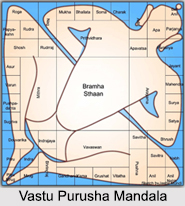
Vastu Shastra is a logical Indian science that deals with the ancient tradition of architecture. It is the science of construction and the traditional Hindu architectural system where the emphasis is laid in the directional alignments. Vastu Shastra, as is practised presently, is based on the 125 verses contained in ‘Brihat Samhita’ of Varahamihira. This very point indicates the vital link between Jyotish and Vastu.

Hindu philosophy considers nature and God synonymous; hence, it becomes all the more significant to build a home according to the principles of Vastu Shastra so that man can exist harmoniously with nature. There are 2 main branches of Vastu Shastra: "Manav Shilpa Shastra" relating to construction of buildings and "Deva Shilpa Shastra" dealing with the principles of constructing temples etc.

Origin of Vastu Shastra
The origin of Vastu Shastra is steeped in legends. It is said that Lord Brahma was the first recipient of this knowledge from Lord Shiva as a part of the Vedas, just like He received the knowledge of ‘Jyotish’. And then the knowledge of Vatu Shastra was gradually spread through the munis, seers and sages of ancient India. However, traditionally the foundation of Vastu is ascribed to the mythical sage Mamuni Mayan.Vastu Shastra, Society

Etymology of Vastu Shastra
The expression Vastu Shastra has its root in the Sanskrit term ‘Vastu’ which means any really existing or abiding substance or essence. In the context of this ancient science of architecture, ‘Vastu’ also mean the site or foundation of a house, site, ground, building or dwelling-place or habitation. The term ‘Shastra’ however means science, doctrine or teaching.

Principles of Vastu Shastra
Vastu Shastra follows the principle that postulates that in the world everything, substance, man and animals, are made from the ‘Panchabhuta’ that is the 5 basic elements: Earth, Water, Fire, Air and Space. These 5 elements have close relationship with man and his environment. Nature has given them their proper place according to merit. Hence it is necessary that man, too, grant a proper place to these elements in the space where he resides.


#history #astrology #architcture #interior 

Thursday, 26 March 2020

Ayodhya, Uttar Pradesh

Ruhi
ayodhya-_AP_880255-ayodhyaAyodhya, a city in Uttar Pradesh is known for its glorious past. The name of Ayodhya is also closely associated with the name of Lord Rama. It is believed to be the birth place of Lord Rama.
index
Ayodhya is an ancient city of India lying on the bank of Ghaghara River. This is situated on the east of Faizabad district of Uttar Pradesh.

c2073e6d6922a811b01ec2f0d2570540unnamedEtymology of Ayodhya
The word ‘Ayodhya’ in Sanskrit means not to be warred against. Ayodhya is regarded as the birthplace of Rama. Many Hindus believe Lord Rama was born at this place and thus it is called Rama Janmabhoomi

History of Ayodhya
Ayodhya is believed to be the birthplace of the 7th incarnation of Lord Vishnu, Lord Rama. In the old books of the Hinduism religion as well as the great epic Ramayana, it is said that Manu founded the city of Ayodhya.
07ayodhya1
Religion of Ayodhya
Ayodhya had primarily been a Hindu city. But religions like Buddhism and Jainism had also flourished in the city with great gutso.
Historical Significance of AyodhyaUntitled
Manu was the first known king of India with Ayodhya as his capital, is corroborated by the Indian Puranas, the Mahabharata and the Arthashastra of Kautilya.

Read More :- Ayodhya, Uttar Pradesh

Monday, 27 January 2020

North Indian Temples

khaju2famous-templesIndia has a rich cultural and historical heritage because of its temples and pilgrimage sites. The North Indian Temples are in plenty and cater to people of all religion.

Dating to the ancient days, there has been a plethora of shrines and temples all over the country. The North Indian Temples not only has Hindu temples, the place also houses Buddhist temples, Gurudwaras and Jain temples as well.

Architecture of North Indian Temples
The North Indian Temples were typically built in the Nagara Style of Architecture.
indiacultural-northtempletour
According to the Nagara style, the temple structure consists of two main buildings. The main place of worship is taller and has an adjoining shorter mandapa. The key difference between these two is the shape of the sikhara.

Temples in Jammu and Kashmir
The northern most state in India, apart from the appealing scenery and nature, Jammu and Kashmir has a number of towering temples.
vaishno-devi-temple-historyamarnath-1 (1)The most popular temples here are the Amarnath Temple at Pahalgam, the Vaishno Devi Temple and the Raghunath Temple, which is known to be one of the largest North Indian Temples.
downloadTemples in Himachal Pradesh
Himachal Pradesh is said to be the land of Gods, often called 'Devabhoomi. From Hindu temples to Jain temples to mosques, the landscape of Himachal Pradesh is dotted with multiple shrines.
Explore-Haryana
Temples in Haryana
The North Indian Temples of Haryana are mostly of the ancient era. These primitive temples are not just places of worship. there is the Mansa Devi Temple, Birla Mandir, Sthaneshwar Mahadev Temple, Shiv Temple, Sheetala Devi Temple which are some of the important temples.

Temples in PunjabUntitled
To witness the rich history, culture and traditions of the state of Punjab, one must visit the numerous temples and shrines, where devotees throng every year. The most famous North Indian Temple of Punjab is the Harmandir Sahib or the Golden Temple.

Read More :- North Indian Temples

Saturday, 25 January 2020

Tourism in Mahabaleshwar

image12
Tourism in Mahabaleshwar expresses the clear tourism destination nixed with nature’s lap and the temples of Hindu Gods and Goddess.

Tourism in Mahabaleshwar deals with the major tourist’s destinations like Venna Lake, Arthur Seat, Needle Hole Point, Elephant Point and many other tourist destinations, which gives a new name as the hill station of West India.

Venna LakelakeVenna Lake is one of the major sightseer attractions of Mahabaleshwar. The lake is surrounded by trees on all sides.

Arthur's Seatlocation_img-3563-1028536363-148Arthur's seat is a point at an elevation of 1340 meters from the sea level. The point was named after British officer Sir Arthur Malet (1806-1888).

Kate's Pointmahabaleshwar_kates_point_-kamalgad_trail_trekBalakwadi dam is viewed from Kate's Point. Kate’s Point offers stunning view of hills and the river. The beauty from Kate’s Point also offers to the national and international level tourists.

Needle Hole Pointkates_pointNeedle hole Point is located near Kate's Point. One can see a natural rock formation with a hole in between, thus giving the name Needle-hole

Wilson Pointwilson-point-sunrise-point-mahabaleshwar-tourism-entry-fee-timings-holidays-reviews-headerWilson Point is named after Sir Leslie Wilson, the Governor of Bombay Presidency during the rule of British Empire in India, from 1923-1926.

3 Monkey Pointmahabaleshwar-td43 Monkey Point is named because of the natural sculpture of the stones which looks like three monkeys sitting beside each other and portraying 3 monkeys of Mohan das Karam Chand Gandhi.

Read More :- Tourism in Mahabaleshwar

Friday, 17 January 2020

Hill Stations of Odisha

odshiaHill stations of Odisha share the forestry and the wildlife sanctuaries with the neighboring states on Eastern Ghats Mountain Range of India.

downloadHill Stations of Odisha covers the small towns and villages, which are gifted with evergreen trees and coffee plantation gardens. These hill stations are ideal for the nine-to-six office goers.
Taptapani

Taptapani, Ganjam district
Taptapani is a place of pilgrimage importance and it is easily accessible from Bhubaneshwar and Beherampur by roadways and railways. There is no airway connectivity except Biju Patnaik Airport.
Mahendragiri, Gajapati District

Mahendragiri-1
Mahendragiri Hill is a hill station with a height of 4,925 ft above sea level. This place is popular for the thick forest vegetation.

Dhenkanal
Dhenkanal, Dhenkanal District
Dhenkanal is a hill station and an educational hub in eastern India.

Olasuni Hill,Olasuni Hill, Cuttack District and Jajpur District
Olasuni Hills share the geographical limit of both Cuttack District and Jajpur District of Odisha.
1575020207_water_fall_koraput

Koraput, Koraput District
Koraput serves as a hill station in Odisha. Koraput has the essence of tribal culture. This place in Koraput District is easily accessible from the cities of Andhra Pradesh also.

Read More :- Hill Stations of Odisha

Wednesday, 15 January 2020

Palaces of India

Palaces-in-India.jpgPalaces of India reflect the grandeur and the rich heritage of India in the past.

Palaces of India are innumerable, scattered throughout the length and breadth of the country and belonging to numerous kings and rulers who ruled India for many centuries.

Bangalore PalaceBangalore Palace.jpg
The Bangalore Palace resembles the Windsor Castle in England and is located in Bangalore and is a well-known venue for international music bands, rock stars.


Falaknuma Palace.jpegFalaknuma Palace
The Falaknuma Palace was built by the Paigah, Nawab Vikar-ul-Umra in the southern part of the old city of Hyderabad.

Kuthira Malika.jpg
Kuthira Malika
Kuthira Malika is located in Thiruvananthapuram, the capital of Kerela and was built by Swathi Tirunal Rama Varma.

Marble Palacemarble-palace-kolkatta1.jpg
The Marble Palace in North Kolkata was constructed by Raja Rajendra Mullick in 1835.

Umaid Bhawan Palacemaxresdefault-1.jpg
The Umaid Bhawan Palace in Jodhpur, Rajasthan, and is last among the magnificent palaces constructed in India. The palace was named after Maharaja Umaid Singh, who was the grandfather of the current owners of the palace.

Read More :- Palaces of India

Tuesday, 24 September 2019

Hill Stations of Jharkhand


Netarhat.jpg

Hill stations of Jharkhand presents a bouquet of hilly regions that mirrors the rich landforms and the serene climatic atmosphere.

Hill stations of Jharkhand projects the hill stations of eastern India like Dalma Hills, Parasnath Hills, Hazaribagh, Ranchi, Netarhat, Ghatshila and many other places.
2018040392-no6iyu1wv01eayohdh69iyxz1l5himclqq4wzjnhcaTagore Hill
Tagore Hill is located at Morabadi. The elder brother of Rabindranath Tagore, Jyotirindranath Tagore purchased the hillok Morabadi and built up an ashram after the suicide of her wife Kadambari Devi.

Parasnath Hillsblog_cover-2
Parasnath Hills are the range of hills located in Giridih district of Jharkhand. The highest peak of Parasnath Hill is 1350 metres. It is one of the most important pilgrimage centres for Jain community.
History of Hazaribagh District Jharkhand.png
Hazaribagh
Hazaribagh is a city and a municipality in Hazaribagh district in Jharkhand. It is the divisional headquarters of North Chotanagpur division.
1507807197_rotates_irctc_3643968622017101217.jpg
Ranchi
Ranchi is the capital of Jharkhand. It is the second-most populous city. Ranchi was the centre of the Jharkhand movement, which called for a separate state for the tribal regions of South Bihar,

GhatshilaUntitled
Netarhat (1)
Netarhat
Netarhat is a town in Latehar district in the erstwhile Palamu district in Jharkhand. Netarhat is referred to as the "Queen of Chotanagpur". It is a popular hill station.


Read More :- Hill Stations of Jharkhand


Wednesday, 11 September 2019

Kerala, Indian state

Kerala is one of the most beautiful states of South India. It is also known as God’s own country.
Kerala is located in the south-west region of India on the Malabar Coast. Its capital is Thiruvananthapuram, which is also its largest city. The commercial capital of the state is Kochi.

History of Kerala
The ancient Keralite legend claims that Kerala originated when Parasurama, Incarnation of Vishnu, threw his battle-axe into the sea.


1477384304_kerala-district-wise-map
Geography of Kerala:
Kerala is situated between 8 degree 18 minutes and 12 degree 48 minutes north latitude and between degrees 52 minutes and 72 degrees 22 minutes east longitude. Kerala is bounded by Arabian Sea on the West, Karnataka on the North, and Tamil Nadu on the East.

Demography of Kerala
The population growth of Kerala is far lower than the national average. The people of Kerala are called Malayali. The official language of the people is Malayalam language.

22kerala.jpg

Culture of Kerala 
Culture of Kerala is diversified. The major dances of Kerala are Kathakali, Thullal and Mohiniattam. The folk art forms include Theyyam, Mudiyettu dance Parichamuttukali, Bhadrakali Pattu, Pulluvanpattu and Thiruvathirakali etc.
kerala art.jpgKalaripayattu is the comprehensive system of the marital arts of Kerala. Several festivals are also celebrated in Kerala. Onam, Vishu Festival, Thrissur Pooram Festival, Payippad Jelotsavam festival, Attukal Pongala festival are some of the major festivals of the state.
a.jpg  

Economy of Kerala
The economy of Kerala is mainly dominated by agriculture. However, Kerala lags behind other Indian states in terms of per capita income and economic productivity.
place

Tourism in Kerala
There are several attractive tourist spots in Kerala. Backwaters, temples, hills and wildlife sanctuaries are some of the main tourist attractions offered by Kerala.

Read More :- Kerala, Indian state