Friday, 16 April 2021

Vijayanagar Empire

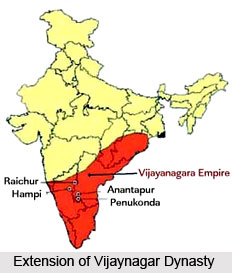
 Vijayanagar Empire, South Indian EmpireVijayanagar Empire was a South Indian empire based in the Deccan. This empire lasted for three centuries and successfully prevented the extension of Muslim sultanates in south. The history of Vijayanagar is perhaps the last magnificent chapter in the history of independent India. Founded by Harihara I and his sibling Bukka Raya in 1336, the empire prolonged until 1646. The authority of the kingdom declined in the 1565 after a key military defeat by the Deccan Sultanates. Vijayanagar Empire is appropriately named after its capital city of Vijayanagar, the remarkable ruins of which surround modern href="https://www.indianetzone.com/3/hampi_karnataka.htm" class="fntlink" title="Hampi">Hampi, a World Heritage site in modern Karnataka, India. The literature in the local dialects accompanied by the inscriptions of medieval European travellers such as Domingo Paes, Fernao Nuniz and Niccol-Da-Conti endow with significant information regarding the region's history.

Legacy of the Vijayanagar Empire
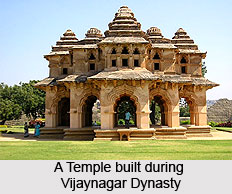
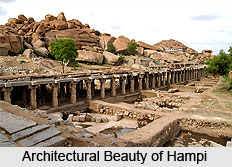
The empire's support facilitated fine arts and literature in order to attain new-fangled pinnacles in KannadaTeluguTamil and Sanskrit languages, while Carnatic Music advanced into its existing structure. The Vijayanagar Empire shaped an era in South Indian history thereby surpassing regionalism with the promotion of Hinduism as a coalescing feature. The empire's legacy includes many monuments, the best known of which is the group of monuments at Hampi. Multiple temple building traditions in South and Central India were synthesised in the Vijayanagara Architecture style. This synthesis inspired the architecture of the Hindu temples’ construction. Efficient functioning of the administration and overseas trade brought new technologies such as water management systems for irrigation.
Vijayanagar Empire, South Indian EmpireHistory of Vijayanagar Empire
Several theories have been projected claiming the basis of the Vijayanagar Empire. A few assert that Harihara I and Bukka Raya I, the originators of the kingdom, were the ones primarily allied to the Kakatiya dynasty who acquired power of the northern regions of the Hoysala Empire through its decline. Further, historians put forth that they were Kannadigas and commanders in the army of the Hoysala Empire posted in the Tungabhadra River region to charge off Muslim incursions commencing from Northern India. Irrespective of their derivation, historians concur that the initiators were backed and enthused by Vidyaranya, a saint at the Sringeri monastery to wrestle the Muslim incursion of South India. Inscriptions by foreign travellers during the late medieval era pooled with topical excavations in the Vijayanagar region have revealed the required details concerning the empire’s history, ramparts, scientific expansions and architectural advancements.

Before the early 14th-century rise of the Vijayanagara Empire, the Hindu states of the Deccan – the Yadava Empire of Devagiri, the Kakatiya dynasty of Warangal, the Pandyan Empire of Madurai were raided and attacked by Muslims from the north. By the year 1336 the upper Deccan region (modern day Telangana and Maharashtra) had been defeated by armies of Alauddin Khilji and Muhammad bin Tughluq of the Delhi Sultanate.
Vijayanagar Empire, South Indian EmpireGovernance of the Vijayanagar Empire

In Vijayanagar, the King was the ultimate authority and he was assisted by a cabinet of pradhanas headed by a Mahapradhana. All high-ranking ministers and officers were required to have proper military training. A secretariat was appointed near the king's palace which employed officers to maintain records. At the lower administrative levels, wealthy feudal landlords (Goudas) looked over the work of the accountants (Karanikas or Karnam) and guards (Kavalu). The palace administration was divided into 72 departments each of them having several female attendants who were trained to handle minor administrative matters. The whole empire was divided into five main rajyas each of which was further divided into regions. The regions were divided into counties with the subdivision of municipalities. The capital city of this empire was totally dependent upon the water supply system. Contemporary inscription of that time brought the fact that huge tanks were constructed by the labours.

For more, visit the link below:

https://www.indianetzone.com/3/the_vijayanagar_empire.htm


Wednesday, 14 April 2021

Telugu Cinema


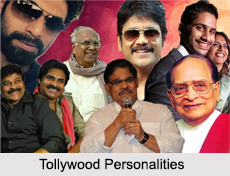
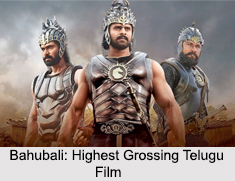
Telugu CinemaTelugu cinema is based in Film Nagar, a neighborhood of Hyderabad, India. The nickname Tollywood is a portmanteau of the words Telugu and Hollywood. Telugu cinema or tollywood is one of the three largest film industries in terms of the number of films produced every year. Telugu industry holds record of having largest film producing facilities in the world. History of Telugu Cinema

History of Telugu films starts in 1912 with silent movie Bhishma Pratigna directed by Raghupati Venkaiah Naidu and R.S. Prakash. This father son duo produced and directed dozens of films in Telugu cinema. In 1931, the first audible movie Bhakta Prahlada was released. H.M. Reddy produced it. Bhakta Prahlada was completed on 15 September 1931, which henceforth became known as "Telugu Film Day" to commemorate its completion. Popularly known as talkies, films with sound quickly grew in number and popularity. In 1934, the industry saw its first major commercial success with Lava Kusha. Directed by C. Pullaiah and starring Parupalli Subbarao and Sriranjani in lead roles, the film attracted unprecedented numbers of viewers to theatres and thrust the young industry into mainstream culture.

In early phase Mythological stories were dominating Telugu industry. By 1936, the mass appeal of film allowed directors to move away from religious and mythological themes. That year, under the direction of Krithiventi Nageswara Rao directed Prema Vijayam, a film focusing on social issues. Its success prompted the production of dozens of other immensely successful 'social films', notably 1939's Vande Mataram, touching on societal problems like the practice of giving dowry. Telugu films increasingly focused on contemporary living: 29 of the 96 films released between 1937 and 1947 had social themes. It influenced other film makers as well to raise the social issues. The issues like untouchablity, dowry, and feudal system were the subjects of Telugu cinema especially after 1939. In 1943 World War II and resource scarcity made British Raj to impose limit on the uses of filmstrip. It was reduced from 20000 to 11000 feet which decreased the number of production of films comparatively.

In 1938, Gudavalli Ramabrahmam, has co-produced and directed the social problem film, Mala Pilla starring, Kanchanamala, the film dealt with the crusade against untouchability, prevailing in pre-independent India. In 1939, he directed Raithu Bidda, starring thespian Bellary Raghava. The film was banned by the British administration in the region, for depicting the uprise of the peasantry among the Zamindars during the British raj. 1940 film, Viswa Mohini became the first Indian film depicting the Indian movie world. The film subsequently moved to sequel films Savithri and Sathyabhama (1941–42) casting thespian Sthanam Narasimha Rao.

Golden Era of Telugu Cinema
Till this era many individual studios were established, actors and actresses were signed on contract basis and Telugu industry was rising rapidly. In 1950 nineteen Telugu films were released in a year. Bilingual films were also in trend for Tamil and Telugu but the expression problems led to the stoppage of this trend. In 1950 NT Rama popularly known as NTR emerged as another great film personality. Akkineni Nageswara Rao and N.T. Rama Rao duo was a hit duo for telugu cinema and they both worked in 15 films including Palletnori pillaGundamma katha, Misamma, Chanakya- Chandragupta etc.

Maya Bazaar, Gumastha, Vinayaka Chavithi, Chandirani and others were made in the 1950 which were quite popular. Malliswari is the first Telugu film which had a public release with thirteen prints along with Chinese subtitles at Beijing on 14, March 1953, and a 16 mm film print was also screened in the United States. The film was directed by Bommireddy Narasimha Reddy, a recipient of the Dada Saheb Phalke Award, and the Doctor of Letters honour.

Relangi, and Ramana Reddy were a comedy double act during this era. Nartanasala won the best art direction award at the Afro Asian film festival in Jakarta. Donga Ramudu directed by K. V. Reddy was archived in the curriculum of the Film and Television Institute of India. Nammina Bantu received critical reception at the San Sebastián International Film Festival. 1967 film Ummadi Kutumbam was selected by Film Federation of India as one of its entries to the Moscow Film Festival. The 1968 cult classic Sudigundalu was screened at the Tashkent and Moscow Film Festivals.

Telugu CinemaDevelopment in Telugu Industry
Moola Narayana Swamy and B. N. Reddy founded Vijaya Vauhini Studios in 1948 in the city of Chennai. Indian film doyen L. V. Prasad, who started his film career with Bhakta Prahlada, founded Prasad Studios in 1956 based in Chennai. However, through the efforts of D. V. S. Raju, the Telugu film industry completely shifted its base from Chennai to Hyderabad in the early 1990s, during N. T. Rama Rao's political reign.

About 245 Telugu films were produced in 2006, the highest in India for that year. Film studios in Hyderabad, developed by D. Ramanaidu and Ramoji Rao, are involved in prolific film production and employment. The Film and Television Institute of Telangana, Film and Television Institute of Andhra Pradesh, Ramanaidu Film School, etc. are some of the largest film schools in India. The Telugu states consist of approximately 2800 theaters, the largest number of cinema halls in any state in India.

Modern Era of Telugu Cinema Bapu's directorial venture Sakshi was showcased at Tashkent International film festival in 1968. In 1976, he directed Sita Kalyanam that critically acclaimed at the BFI London Film Festival and Chicago International Film Festival, and is part of the curriculum at British Film Institute. Pan-Indian film Oka Oori Katha (1977) won special awards at Karlovy Vary International Film Festival and Carthage Film Festival.

To know more about Telugu films, visit the link below:

Tuesday, 13 April 2021

Panchagavya, Ayurveda


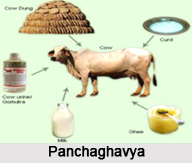
Panchagavya, AyurvedaPanchagavya is famous as a cancer treatment medicine as well as a pesticide. It is very powerful and is very good for health. Panchagavya is among the traditional products that are used in various Hindu rituals from ancient periods in India. The usage of Panchagavya is also known as ‘Cowpathy Treatment’ which is essential component of Ayurvedic medicine and possesses religious importance especially to the Hindus. Panchagavya is a Sanskrit term which is the blend of five products obtained from cow. This concoction involves five different products of cow like cow dung, cow urine, cow milk, cow ghee and curd. Such ingredients are mixed in a perfect ratio and the mixture obtained is permitted to undergo fermentation. The water of tender coconuts, bananas, groundnut cake and yeast are employed to create this unique mixture called Panchagavya, which can be utilized as a powerful organic pesticide.

Ingredients of Panchagavya
Panchagavya must be prepared with the aide of some significant ingredients like jaggery, cow urine, ripe bananas, cow curd, water of tender coconuts and cow ghee.

  • Cow Dung: Cow dung has an antiseptic property. It also has anti-bacterial and fungicidal properties. According to old Hindu Ayurvedic science, the cow dung is mixed with waters and then the filtrate is taken out of the suspension, which is the main ingredient of the skin ointments that is effective in case of serious skin problems like eczemapsoriasis and gangrene.


  • Cow Urine: The cow urine is also sold in the market under the label ‘Gift of the Cow’. It has also medicinal properties. As per Ayurveda, cow’s urine is considered as one of the fundamental ingredients of many Ayurvedic medicines as this has some medicinal properties.


  • Cow Milk: As per Ayurveda, cow milk provides special and unique nutrition, which cannot be derived from any other type of food. Cow milk must be digested properly to nourish all the tissues. It also promotes balanced emotions as well as balances all the ‘Ayurvedic Doshas’. This is also an important food that enhances ‘Ojas’, the force that maintain life.


  • Cow Ghee: According to Ayurveda, the cow ghee is believed to be the best for human consumption. It has much nutritive qualities and is an ideal diet for the heart patients. The regular consumption of cow ghee enhances physical and mental strength, maintains healthy body and increases the potency of the body. Cow ghee has nutritive value also and also helps in taking out the impurities from the body. The cow ghee enhances eyesight; maintain the health of muscles and tendons and keeps the bones stout but flexible.


  • Curd or Dahi: Curd is another by-product of cow milk. In Sanskrit the curd is called ‘Dahi’. The ancient Ayurveda specialists of India like Charaka and Sushruta have described the qualities and usefulness of curd. In many diseases curd is used due to its therapeutic value. The curd has been described as the tonic. It has got the properties that prevent premature aging. Curd cures the patients of diarrhoea and dysentery. In chronic specific and non-specific colitis the curd is also very helpful.

  • To learn more, click the link below:

    Monday, 12 April 2021

    Tourism in Uttarakhand


    Tourism In UttarakhandUttarakhand, a state in north India, is a treasure trove for tourists. The state of Uttarakhand has a wide array of places of interest. Tourism essays an important role in Uttarakhand's economy. Thousands of pilgrims come to Uttarakhand round the year to wander in the abode of Gods and discover Uttarakhand. Uttarakhand tourism is the ideal place for tourists, pilgrims, trekkers and adventurers and has activities in store for any age group. Tourism in Uttarakhand unfolds the heavenly beauty of nature. The glaciers, the snow clad mountains, and valleys of flowers help to boost the popularity of Uttarakhand as a coveted tourist destination.

    Pilgrimage Tourism in Uttarakhand

    Uttarakhand is a pilgrim's paradise and an ideal place to visit for the peace lovers. The amalgamation of Himalayan range, the green dale and the sanctimonious weather make the land the dwelling place of Hindu God and Goddesses. There are numerous mythological stories rooted in the land of Uttarakhand. The sacred rivers like Ganga and Yamuna add to the veneration of this place. The major Hindu pilgrimage centers of Uttarakhand are Badrinath, Kedarnath, Gangotri and Yamunotri. Pilgrims from all over the world has been visiting these places to attain salvation and purification.

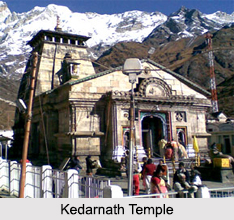
    Kedarnath Temple: The Kedarnath temple is one of the twelve jyotirlingas of Lord Shiva. Set on the backdrop of the majestic Kedarnath range, this temple is flocked by thousands of devotees who come here to seek blessings.

    Badrinath Temple: The Badrinath temple is dedicated to Lord Vishnu and is also a much visited pilgrimage. The temple attracts an ever growing number of spiritual visitors each year.

    Gangotri: Gangotri, a municipality in Uttarakhand, is a holy Hindu pilgrimage town. It is one of the four sites in the Char Dham pilgrimage circuit. This pleasing pilgrimage in the hinterlands of the Himalayas is the most blessed spot where Ganga, the stream of life, touched earth for the first time.

    Yamunotri: The prime attraction of Yamunotri is the temple dedicated to goddess Yamuna. Special Puja is conducted in the temple on the eve of Diwali and Janmashtami.

    Nature Tourism in Uttarakhand
    Wildlife is an integral part of Uttarakhand tourism. Uttarakhand is a biodiversity hotspot and the Government is also promoting Ecotourism in the state as its mission to convert Uttarakhand into an eco tourism spot.

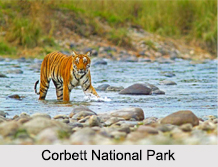
    Jim Corbett National Park: The Jim Corbett National park is a major attraction of the nature tourists in Uttarakhand. It is the oldest park in India and one of the renowned wildlife sanctuaries of the country. There are over 488 species of flora and fauna in this National Park. The wildlife here includes tigernilgai, sambar deer, elephant, flying fox, Indian pangolinwild boar and hedgehog. It is one of the most protected areas of the country and draws numerous Indian and foreign tourists every year.

    Tourism In UttarakhandAskot Sanctuary: The Askot sanctuary is another place of tourist interest in Uttarakhand. The area is affluent for its sal, oak and pine forest and abundant waterfalls. The main attraction of Askot sanctuary are snow leopards, Himalayan Black Bears, Snow cocks, Tahrs, Musk Deers, Chirs, Koklas, Pheasants and Chukors.

    Bansar Sanctuary: The Bansar sanctuary of Uttarakhand is one of the most scenic spots, with plenty of wildlife. The surroundings of the sanctuary abound in alpine ferns, hanging moss, flora and variety of wild flowers.

    Leisure Tourism in Uttarakhand
    Hill stations in Uttarakhand are major places of interest for the leisure tourists. The majority part of the state is covered by the Himalayan Mountains and as a result there are plenty of hill stations which are ideal for the vacationers. Mussoorie, AuliNainitalAlmora, and Ranikhet are the most popular hill stations of the Uttarakhand state.

    Mussoorie: Mussoorie is also known as the 'Queen of the Hills' and is located at the foot hills of the Himalaya. The gun hill and the Kempty Fall of Mussoorie are the most visited destinations.

    Nainital: The beautiful city of Nainital is noteworthy for its scenic hills and this makes it one of the most coveted hill stations of the country.

    Auli: Auli hill station of Uttarakhand is flanked by oak and coniferous forests, which present a panoramic view of Himalayan Mountains.

    To explore more, visit the link below: