Saturday, 12 October 2019

Temples in Jammu and Kashmir

4-4-752x405.jpgTemples in
Jammu and Kashmir serve as spots that have the potential to catch the attention of tourists visiting this state.

220px-The_Ancient_Shankaracharya_Temple_(Srinagar,_Jammu_and_Kashmir).jpgTemples in Jammu and Kashmir are no exception. They serve as spots that have the potential to catch
the attention of tourists visiting this state. The state of Jammu and Kashmir is located in the northern part of India.

2229-sahasrabahu-temple-dedicated-to-lord-vishnu-in-gwaliorShankaracharya Temple: This is one of the most popular temples in Jammu and Kashmir.This
is dedicated to Lord Shiva; a Shiva Linga was placed in the temple during the 19th century.

Untitled.pngShankaragaurishvara Temple: Shankaragaurishvara Temple is
situated in Pattan, near Baramulla. This temple represents Kashmiri style of architecture.


Wangath Temple Complex: Wangath Temple Complex is located in Wangath close to Naranag in the Ganderbal district of Jammu and Kashmir.

c9dbc85a9b0dd325aedcd9edce948784Raghunath Temple: Raghunath Temple is located in the district of Jammu. This temple is regarded as one of the largest temple
Untitled.pngcomplexes of north India.

6e8f15bf415f6c8b585504f64330a8ed.jpgVaishno Devi Mandir: Temples in Jammu and Kashmir also include Vaishno Devi Mandir, which is one of the most famous pilgrimage sites of India. It is situated in Katra on the Trikuta Mountains.

Amarnath Temple: The temple dates back to the 5th century. This temple, dedicated to Lord Shiva, is situated near Lidder Valley in Pahalgam tehsil of Anantnag district at an altitude of 3888 meters.

Sharika Devi Temple
 ps.png
 Ranbireshwar Templeravindranath temple.png
Peer Kho Cave Templepm.png
Read More :- Temples in Jammu and Kashmir

Thursday, 10 October 2019

Jalebi, Indian Sweet


189a5960206ccfdcee9e8c0f8c177545.jpg

Jalebi is the national sweet of India, which is popular around the entire country.

Jalebi, also known as Zulbia or Zalabia, is the national sweet of India. This dessert is mainly served hot with either curd or Rabri.

Jalebis are tremendously popular during various Indian festivals. In general, Jalebi is sold at different sweet shops throughout the year.

mm
The ingredients of Jlebi are:
• 1Cup refined flour

• 1/2 Cup yogurt

• 3 Cups sugar

• 1 Tablespoon milk

• Saffron a few

• Ghee for deep-frying

Read More :- Jalebi, Indian Sweet

Vijayadashami, Indian Festival

5813186760.jpg
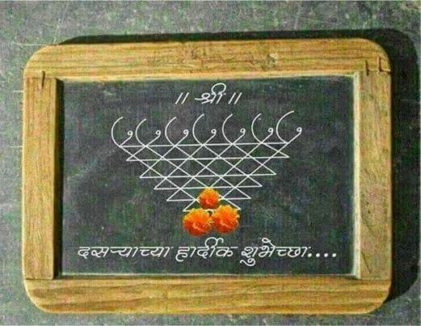
The festival is celebrated on the tenth day of Navaratri, which is held on the tenth day of the month of Ashvin of the Hindu calendar. Also known as Dusshera, the Hindu festival of Vijayadashami usually marks the end of Durga Puja or Ramlila.

e207973d90af5cd886315dbce934bd50Etymology of Vijayadashami
The word Vijayadashami is a combination of 2 words, Vijaya meaning victory
and Dashami meaning tenth.

Legend of Vijayadashami
In various versions, the festival of Vijayadashami has mentions in Hindu epics like the Ramayana and Mahabharata.
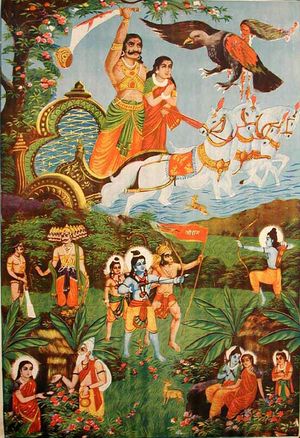
300px-Sitaharan
In Ramayana, celebration of the victory of Lord Rama of him rescuing his wife, Sita and destroying Ravana, in a fierce battle serves to be the back story behind Vijayadashami or Dussehra.

vanaparva.jpgIn Mahabharata, the Pandavas were exiled for 12 years and then one more year in disguises.  It was on the day of Vijayadashami that the Pandavas successfully completed the remaining one year. Arjuna collected the weapons from the Shami tree and defeated the Kauravas who
attempted to steal the cattle of King Virata. Since that day, shami trees and weapons have been worshiped on the ninth day of Navaratri, which symbolises this particular incident in the Mahabharata.

Another legend commemorates the victory of Goddess Durga over Mahishasura, the demon king after a nine-day long battle, and also marks the end of Durga Puja celebrations.

Significance of Vijayadashami
Vijayadashami signifies enlightenment and marks the end of the Maha Navaratri or the 9 days of Durga Puja.  Dusehra-bannerHindus celebrate this festival worldwide by observing social gatherings and offering sweets and gifts to relatives, friends and neighbours.
Untitled25THNSMPTI10222015000228ACelebration of Vijayadashami in different parts of India 
In , the day of Vijayadashami is the one when Goddess Durga is believed
West Bengal to retreat to Kailash. This occasion is celebrated despondently amidst Bengal with ‘Sindur Khela’,  The idol is immersed in the River Ganga on this day and the festivities of greeting each other and distributing sweets begin.
Saraswati-drawing-e1506729966218.jpg
Goddess Saraswati,In the 14th century Vijaynagar Empire, the festival of Vijayadashami played a historical role and was known as Mahanavami. It is dedicated to Goddess Saraswati, the Hindu Goddess of knowledge, learning, music and arts.
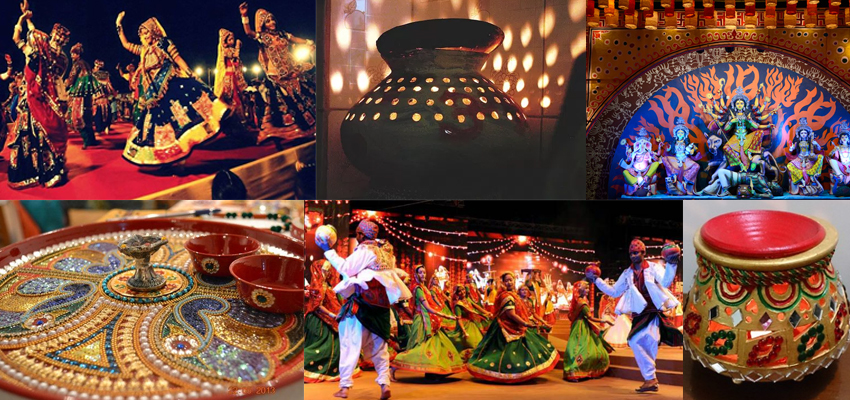
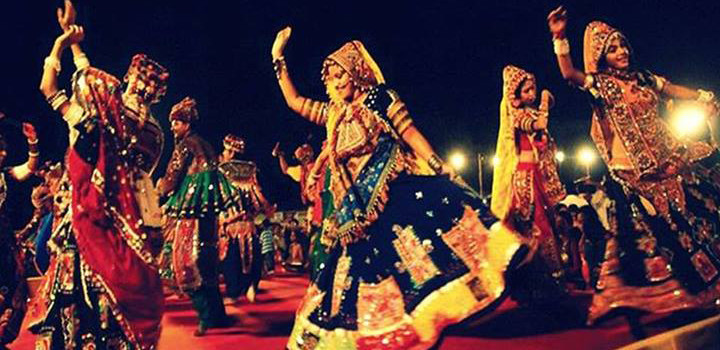
Dandiya-720x350feture.jpgIn Gujarat, both Goddess Durga and Lord Rama are revered for their victory over evil. Fasting and prayers at temples are common. Dandiya Raas and Garba are a part of the festivities through the night.

Read More :-Vijayadashami, Indian Festival

Monday, 7 October 2019

Nava Durga

beautifully-decorated-goddess-durga-psu360001917-small-original-imaej7ujfbeyagec.jpeg467eef064a0fafee8a817b5382a767ee.jpgNava Durga is the nine forms of the Goddess Durga , worshipped during the  Navratri. It is mentioned in the Skandayamala Tantra and Devi Mahatmyam of the Markandeya Purana. ,
durga-pooja
Nava Durga of Skandayamala TantraGoddess Durga is worshipped in the form of nine figures. One of them is placed in the middle and the remaining eight figures correspond to the eight points of the Shailaputri compass.

Nava Durga of Devi Mahatmyam
The Devi Mahatmyam describes the Nava Durgas in a different way from the Skandayamala Tantra. These have been described below:

download.jpg
Shailaputri: Shailaputri is the 1st among Nava Durga. Her worship takes place on the first day of Navratri.  Her emblem is mount Nandi, a bull.

2.jpgBrahmacharini: Brahmacharini is worshipped on the second day of Navratri. She is seated over the red lotus and has a goose as her vehicle.
3.jpg

    Chandraghanta: Chandraghanta is the third form of Goddess Durga.  She has a semi circular moon that looks like a bell.
4.jpgKushmanda: Kushmanda is the fourth Goddess in the series of Nava Durgas. She forms the solar system projecting her power to Lord Surya.
maxresdefault
   Skandamata: Skandamata possesses four hands.  The fourth hand is in Varada Mudra. She is worshipped on the fifth day of Navratri. The lion is her vehicle.
6Katyayani: Katyayani is the sixth form of Goddess Durga.  she has emerged from the hermitage of the Sage Katyayana. She is also known as ‘Vindhyavasini’ as she had resided in the Vindhya mountain range.
7
Kalaratri: Kalaratri is the seventh form of Goddess Durga The Goddess is said to be the destroyer of ghosts, spirits and other demonic powers.
8.jpgMahagauri: Mahagauri is the eighth form of Goddess Durga.  She is the consort of Lord Shiva, popularly known as Parvati. She is regarded as the daughter of Daksha.
9.jpg
Siddhidatri: Siddhidatri is the ninth and the last Goddess of the Nava Durga. The Goddess is seated on a lotus and has four hands.

To know more visit here : Nava Durga


Tuesday, 1 October 2019

Seshendra Sharma, Telugu Poet


ssss.jpg

gunturu-seshendra-sharma-memorial-trust-non-profit--somajiguda-hyderabad-telugu-literature-books-fr48t2Seshendra Sharma was one of the most outstanding Telugu Poet of modern Asia. He was the second person to have been nominated for the Nobel Literature Prize, after Rabindranath Tagore.

Seshendra Sharma, better known as ‘Seshendra’ was a Telugu poet, critic and litterateur. He was a colossus of Modern Indian poetry. His literature is a unique blend of the best of poetry and poetics.

Early Life of Seshendra Sharma
Seshendra Sharma was born on 20 October 1927 to his parents, G. Subrahmanyam Sharma and Ammaayamma. He spent his childhood in his ancestral home in Totapalli Guduru, 
Nellore District of Andhra Pradesh.
Untitled.png

Personal Life of Seshendra Sharma
Seshendra Sharma was married to Janaki. The couple had two girls and two boys; Vasundhara, Revathi, Vanamaali and Saatyaki. in 1970, he entered in a romantic relationship with Indira Devi Dhanrajgir, an Indo-Anglican poet.

Works of Seshendra Sharma
Seshendra Sharma’s first work in print appeared in 1952 which was a translation of Matthew Arnold’s "Sohrab and Rustum". In the beginning, he focused mainly on poetry and occasionally worked on literary criticism.
rr.png

He is well known for his works "Naa Desam, Naa Prajalu" and "Kaala Rekha".

Poems by Seshendra Sharmas.png

Achievements of Seshendra Sharma
The following are the awards and accolades received by Seshendra Sharma for his immense contribution to Telugu Literature: ‘Sahitya Akademi Award’ for his work ‘Kaala Rekha’ in 1994. ‘Sahitya Akademi Award’ for his work ‘Kaala Rekha’ in 1994.Untitled.png

Death of Seshendra Sharma
main-qimg-d41fb0b62cd42f0fd23f861fae19b4a4.jpgmain-qimg-e0e6b02e57091fc11dc5250a9b1c8e35.jpgSeshendra Sharma died on 30 May 2007. He lived with Indira Devi Dhanrajgir at her Gyanbagh Palace till his death.

In 1970, he entered in a romantic relationship with Indira Devi Dhanrajgir, an Indo-Anglican poet.

Read More :- Seshendra Sharma, Telugu Poet

Navaratri, Indian Festival


happy-navratri-new-card-3-e1569832305544.jpg

Navaratri is a colourful Indian festival of the worship of Devi Durga during the nine festive nights.

Navaratri is a Hindu festival celebrated every year in the month of October, according to the Hindu calendar.
ardhanarishvara-hd-wallpapers-2191269
Concept of Ardhanarishvara
This is the core Concept of Ardhanarishvara, in the religious parlance. The manner in which the origin of things operates in this world and our religious interpretation of this cosmic activity is in the form of the worship of Shiva or the worship of Shakti.
Durga-Puja.pngdsc_6163-2-780x405Dedication to Goddess Durga
Navaratri is dedicated to the goddess of Power, Durga. In ancient mythology, it is alleged that gods contributed Devi Durga with ten deadly weapons to save the world from evil in her battle with Asura.

Celebration of Navaratri
Navaratri comes twice a year, the Sukhla paksha(waxing moon) of the lunar month of Ashwin , being the first, in September or October in the
mm
 Autumn, and the second occurs during the first nine days of the bright two weeks of the Sukla Paksha of the lunar month of Chaitra, in mid March to mid April, the Spring time.
Gods worshipped in Navaratridurga maa.png
Read More:- Navaratri, Indian Festival

Lata Mangeshkar, Indian Playback Singer


Lata-Mangeshkar

Lata Mangeshkar is India’s most known and respected female play back singer and music composer from India . She with her mesmerizing voices captivated millions of hearts.

Lata-mangeshkar-2
Lata Mangeshkar is the second Indian vocalist to have been awarded the Bharat Ratna, the nation's highest civilian honour.

dbb9e97cb4a3c4b661277e98f25a3a27Lata Mangeshkar has also been honoured with the prestigious Yash Chopra Memorial award by Manish
Tewari, the current Information and Broadcasting Minister on 19th October, 2013.

27people-who-influenced-lata-mangeshkar2.jpgEarly Life of Lata Mangeshkar
Lata was born in Indore, in the Indian state of Madhya Pradesh on 28th September, 1929 into a middle-class Maharashtrian family. She was the first born child.

images (2)Early Career of Lata Mangeshkar
Lata Mangeshkar's first music lessons were imbibed from Dinanath Mangeshkar, her father. She worked as an actress in certain musical plays directed
by her father, at the tender age o f five. The plays were known as 'Sangeet Natak' in Marathi language.

Achievements of Lata Mangeshkar
The songs sung by Lata Mangeshkar have been applauded across the globe, particularly for the brilliant quality of her voice and her perfection displayed.
Singing Career of Lata Mangeshkar during 1950's UntitledSinging Career of Lata Mangeshkar during 1960'spr.png
images
Singing Career of Lata Mangeshkar during 1980's and 1990's 
During this time period, Lata Mangeshkar's career consisted of songs which made her work with music directors like Shiv-Hari, Ram-Laxman in films like 'Ye Kesa Farz' (1985), 'Maine Pyar Kiya' (1989), etc.

mpLata Mangeshkar has won several awards and honours Padma Bhushan (1969),Padma Vibhushan (1999), Dada Saheb Phalke Awards (1989),(1997), Bharat Ratna (2001),

Read More :- Lata Mangeshkar, Indian Playback Singer