Saturday, 19 January 2019

Classical dances of India

Rooted in Hindu musical theatre, the classical dances of India or Shastriya Nritya seem to have evolved since the ancient times and have acquired a new dimension.
Classical dances of India are one of the most comprehensive and oldest dance forms in the world. India offers a number of classical dance forms
indian-classical-and-folk-dances.jpg
each of which can be traced to different parts of the country. Each of these dance form represents the culture of a particular region or group of people. India is a land of multiple languagesculture and traditions.  Natya Shastra, which is regarded as the fifth Veda.
The classical dances of India mainly focus on the Navarasas
nava rasa.png
 or emotions - Hasya RasaRaudra RasaBibhatsa RasaBhayanaka RasaVira RasaSringara RasaKaruna Rasa, Adbhuta Rasa and Shanta Rasa. There are 8 classical dances of India that has got recognition from the Sangeet Natak Academy of India.

Types of Classical Dances of India
Traditionally performed as an expressive dance-drama form of religious performance art, the classical dances of India relates to VaishnavismShaivismShaktism along with pan-Hindu epics. It also relates to Vedic literature, or a folksy entertainment that includes story-telling from Sanskrit or regional language plays. Discussed elaborately below are the 8 classical dances of India.
bhratnatyam.jpg

Bharatnatyam: Considered to be a ‘fire dance’, the classical dance form of Bharatnatyam includes the element of airwaterearth and sky. The movements of a Bharatnatyam dancer reflect the mysterious display of the abstract element of fire. It is originated in the southern state of Tamil Nadu. It is unique to the Dravidian culture of South India. In the ancient days, devdasis or temple dancers  Rukmini Devi Arundale was influential in bringing it to the attention of the West. There are several religious mythologies associated with the origin of this dance form. It got its name from sage Bharata who was entrusted with the work of writing Natya Shastra following the instructions of Lord Brahma.
Kathak dance

Kathak: A dance of northern India, Kathak is often a dance of love. From 16th century onwards it absorbed certain features of Persian dance and Central Asian dance which were imported by the Mughal era. There are 3 major gharanas of Kathak from which performers today draw their lineage: the gharanas of JaipurLucknow and Varanasi The movements include intricate footwork accented by bells worn around the ankles. Like other Indian dances it began as a temple dance.
kathakali-dance.jpg


KathakaliOriginated from south-western India, from the state of Kerala, The name of this dance form has its origin in Malayalam, where the word Katha means story and Kali means play. This dance form draws inspiration from the Ramayana and stories from Shaiva traditions. Kathakali is traditionally performed by boys and men,which have different implication and are used to portray evil or good with colour variations. Women and saints are portrayed with lustrous yellowish faces.
kuchipudi-dance-.jpg


Kuchipudi: Performed to both Carnatic and Hindustani music, Kuchipudi is a form of dance-drama which adapts Natya, Nritta and Nritya. It originated in Andhra Pradesh and presents scenes from mythological tales and Hindu epics.  It has been accompanied with instruments like mridangamandala and a pair of cymbals.
Manipuri-1.jpg


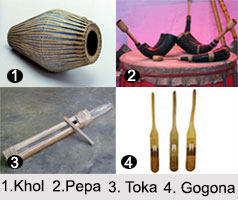
ManipuriUsed to be a temple dance form and has a close association with the religious and social framework of Manipur. It is religious in nature and depicts Hindu deities Radha and Lord KrishnaMusical instruments like Pena, bansuri and small cymbals are used. The dress worn by the female dancers are called patloi, and the lehenga is called Kumin with mirror work woven into gorgeous designs and layered with a transparent silk.
-mohiniyattam-.jpg 


Mohiniattam: Another classical dance of India that evolved in the state of Kerala. The name comes from a mythical character Mohini, an enchantress, who is an incarnation of Lord Vishnu.
Odissi-.jpg

Odissi : The dance form of Odissi is indigenous to the eastern state of Odishaand is predominantly a dance performed by women. Nritya and Abhinaya are the 2 most interesting highlights of Odissi.  The different elements of Odissi dance style are MangalacharnaBatu NrityaPallavi Nritya and Abhinaya.
Sattriya..jpg

Sattriya: It originated in the state of Assam and has a history dating back to almost 500 years old theatre tradition nourished in the Vaishnava Monasteries of Assam. The dance form has been extracted from a massive organisation of theatrical activities which constitutes the Ankiya Bhaona form. To know more visit here : Classical Dances of India

Indian Street Food


hhh.jpg

Indian Street Food is a unique combination of tasty appetizer, which at the same time is easy on the pocket.
Indian Street Food varies from region to region. The street vendors offer hot fresh, lip smacking snacks which are very filling. These foods are popular mainly because they are available at half the price of any restaurant food. Take-out food, junk food, snacks, and fast food are synonymous with street food and all of these can be purchased on the foot path without entering any building.
Below are some indian street food.

North Indian Street Food
Easy_Aloo_Paratha_Recipe_.jpgsamosa.jpg
East Indian Street Food
aluchop.jpgkulfi.jpg
West Indian Street Food
bhel puri.jpg
South Indian Street Food
medu vda.jpg
These popular street foods have a local flavour and even foreigners love to gorge on them making the road side eateries a class in it. Their cheap cost and instant availability has made them world famous.
To know in detail & its recipes, visit here : Indian Street Food


Friday, 18 January 2019

Wedding in India


Wedding in India is a social event that holds special significance and involves elaborate traditions and rituals.
soulWedding in India and its various traditions are vast. The
customscustoms and rituals play a significant role in Indian marriages, be it a Hindu marriage ceremony or a Muslim marriage ceremony. The
customs and rituals followed during an Indian wedding reflect the rich culture and heritage of this diverse country.
download.jpg
History of Wedding in India &
 Classifications of Wedding in Indiaclassification.jpg 
There are six major classifications of Indian weddings. These are Arranged MarriagesArranged -Love MarriagesLove MarriagesLove - Arranged MarriagesInter Caste Marriages and Court Marriages. Arranged marriages are the most prevalent category.
hindu.jpgTraditions of Wedding in India
sikh.jpg
muslim.jpg
are all different from one another.  It is the groom who is supposed to look after the bride for the entire life.

 Wedding Feasts 
feast.jpg
Marriages in Different Regions of India

wedding-of-year.jpgIn India, weddings are considered as the bonding of not only two souls but also of two different families and their caste culturesIndian religious weddings in different parts of the country follow their own norms and rituals.
2_Marriage_Laws_in_India_2.jpg
Marriage Laws in India 
In India, marriage rules and regulations are different for different clans and religions. The different marriage acts meant for the Indian citizens are Hindu Marriage Acts, Christian Marriage Acts, Muslim Marriage ActsSpecial Marriage Acts and Parsi Marriage Acts. Registration of weddings in India is mandatory.
To know more visit here :  Wedding in India

Religious Temples Of India


01_Indian_Temples

Indian Temples are popular worldwide and people travel from across borders to visit these temples. India is a land of many temples.
Indian Temples display the rich cultural and historical tradition of India. From the magnificent Himalayan Mountain Ranges in the North, to Kanyakumari in the South, India is graced with thousands of temples, religious shrines and monuments dating back to hundreds of years. Along with that exist uncountable myths and legends to explain the existence of these temples in every corners of India. The assemblage and adornment in these ancient Indian temples exhibits one of the world's foremost artistic heritages. Since the 6th century B.C, Indian temples have fortunately been endowed with generous donations from kings, nobles and affluent merchants.
Khajuraho_Temples_Madhya_Pradesh_1

Concept of Indian Temples
It is believed that in every Hindu temple in India, exist the Lord who overlooks his or her domain and assists devotees. Devotees approach the sanctum sanctorum in order to obtain a vision (darshana) of God and perform devotional worship. It is believed that the sanctum is filled with His power and blessings.
DSC01616-Cave-26.JPG
History of Indian Temples
History of Indian temples can perhaps never be stated to have begun in an exact precise age or date, when some specific saint or king had ordered for a temple to be erected. The earliest instances of temples are the rock cut and cave temples. The temples and religious monuments built then symbolised the ruler and his richness and devotion.

Structure of Indian Temples
slide7
Architecture of Indian Temples 

13_Architecture_of_Khajuraho_TempleRamanathaswamy-Temple-1Indian_Cave_Temple_Sculpture2

Indian Regional Temple 

03_South_Indian_Templesfamous-temples noth
by religions

Indian Temples by Religion 
An Indian temple being the exponents of religion almost counts up to the congregated faiths of  HinduismBuddhismJainism, SikhismIslamic and Christianity.
This was the short summary , To know detail information about indian temples their,
Styles of Worship in Indian Temples , Indian Temple Managements and many more visit our site : Indian Temples

Bihu Dance - Folk Dance Of Assam


Bihu Dance is a popular folk dance related with the state of Assam in India and it is performed commonly in the Bihu festival. There are three types of Bihu festivals that are popular in Assam namely Rongali Bihu, Kongali Bihu and Bhogali Bihu and the Bihu dance is performed in the Rongali Bihu.
This happy dance is performed by both young men and women, and is characterized by fast dance steps, swift hand movement.
Lord_Shiva_16105

Origin of Bihu Dance
The features regarding the origin of Bihu dance is not known but has been very significant in the cultures of many Assamese ethnic groups like the DeorisSonowal Kacharis, Chutias, Moran and Borahis. Basically, the word Bihu is the Assamese term for marking the onset of the harvest season or the Assamese New Year. It is an eagerly awaited festival and is one of the biggest festivals in Assamese culture involving a lot of indigenous display of song dance and merry making.
Bihu Dance, Assam, Indian Folk Dance

Costumes of Bihu Dance
The lively dance steps of Bihu and the quick hand movements describe the Bihu dance of Assam. This folk dance of Assam is performed generally by the young males and females to demonstrate their joy and happiness on the arrival of spring season.
The male performers of Bihu dance are dressed in dhotis and gamocha.
For more, here is a great site that you should checkout
Bihu dance is folk dance of Assam 

Thursday, 17 January 2019

Crafts of Indian States


Crafts of Indian states are innumerable and which have attained commercial proportions not only in India but also abroad. Craft making is an ancient tradition in India, which has withstood the test of time, and this tradition has passed on from generation to generation.
handicrafts_of_jammu_and_kashmir
1_phulkari_crafts_of_punjab

Crafts of North Indian States 
The Northern Indian states like Jammu and KashmirHimachalPradeshPunjabHaryanaUttaranchal and Uttar Pradesh are renowned for their exquisite crafts which involve embroiderycarpets -weaving, metal crafts, and wood carvingPunjab's durry-weaving
crafts, shawls of ChambaHimachal Pradesh, wood crafts of SaharanpurUttar Pradesh are some of the different crafts of these portions of India. The crafts of Haryana have never been widely acclaimed and more than artistic showpieces they are utilitarian in nature.
Wooden_Crafts_of_Arunachal_Pradesh (1).jpg
Indian_Silk_Sare.jpg

Crafts of North-Eastern Indian States 
Assam, MizoramTripuraArunachal PradeshNagaland and Meghalaya are the Indian states which specialise in creating numerous beautiful crafts. One will come across bell metal crafts, sholapitha crafts, brass metalware, 'sitalpith' crafts, wood crafts, fibre crafts and pottery work in Assam. Assam's weaving industry is famous, particularly for weaving mulberry
Manipur is well-known for its production of jewelleriesbamboo and cane crafts, metal bowls and dolls of clay. Pineapple fibre artefacts, especially purses, bags and nets made in Meghalaya are quite popular. Tripura's silver ornaments, 'sitalpati', tablemats, etc are important crafts of this region. The various crafts of Nagaland are woodcarvings, bamboo work, and pottery, which have a commercial demand in the local and international market.

lacquer_crafts_of_andhra_pradeshCrafts_of_Karnataka_1.jpg
kerosene_lamps_7734.jpgCrafts of South Indian States 
The  bear testimony to the dexterity, and decorative abilities of the craftsperson. The crafts of the state include woodcarving,ivory carving, 'kasuti embroidery', durries, Pottery and 'Cheennapatna' toys. Papier machestone craft, durries and metal ware are the various . The craftsmen of Andhra Pradesh are engaged in making bidri crafts, embroidery crafts known as 'banjara needle craft', 'Budhithi brassware', lacquer crafts and others. Kerala produces reputable products of metal crafts, wood crafts, bamboo crafts and ivory crafts.
East_Indian_Crafts_1.jpgWest BengalOrissaBihar and Jharkhand are the states of Eastern India which manufacture unique crafts. Terracotta crafts, clay craftsjute craftsleather craftsconch shell crafts and 'kantha-stitch' crafts are amongst the reputable crafts of West Bengal. Bihar produces marvellous glassworks, carpet weaving crafts, lacquer crafts and stone crafts. Applique work, 'Patachitra', wood carvings and metal crafts of Orissa are in high demand.
Mirror_Embroidery_of_Gujarat.jpg
silverring_9254.jpgBandhani.jpgCrafts of Western Indian States 
The embroidery work of Gujarat and Rajasthan are immensely popular, particularly the crochet lace crafts of Jamnagar region of Gujarat, 'gota' stitch and 'pichwai' embroidery of Nathdwara are some of the exclusive embroidery crafts of the state of RajasthanKutch and Saurashtra
Pottery crafts, wood carvings and weaving of 'kosa' silk in Maharashtra are the the other significant crafts of these parts of the country. The crafts of Goa are a commercial success and reflect the perennial glory of Goa. The chief craft forms in the state are woodwork, brass and metal work, crochet embroidery, bamboo craft,  and metal embossing.
mp_leathercraft

Crafts of Central Indian States:The  have attained commercial proportions and are sold in emporiums and shops around the country

To know more  visit here : Crafts of Indian states