Showing posts with label regional food. Show all posts

Wednesday, 15 July 2026

Nawab Mehboob Alam Khan: Preserving the Legacy of Hyderabadi Culinary Heritage

Hyderabad is celebrated for its rich culinary traditions, blending influences from the Deccan, Mughal, Persian, and Turkish kitchens. Among the foremost figures dedicated to preserving this remarkable food heritage is Nawab Mehboob Alam Khan, an Indian food connoisseur and culinary expert renowned for his extensive work in Hyderabadi cuisine. Through years of meticulous research, documentation, and practical application, he has played a significant role in restoring several forgotten recipes, ensuring that the authentic flavours of Hyderabad continue to be appreciated by future generations.


Early Life and Family Background

Mehboob Alam Khan was born into a distinguished noble family in Hyderabad. He completed his schooling at St. George's Grammar School, one of the city's well-known educational institutions. His family has long been associated with Hyderabad's social and business landscape. 

His father, Shah Alam Khan, was an eminent educationist and an influential personality in Hyderabad. He was also the son-in-law of the founder of the Hyderabad Deccan Cigarette Factory, a business that has remained closely linked with the family over the years. 

Today, Mehboob Alam Khan's family continues to own the Hyderabad Deccan Cigarette Factory in Hyderabad. In addition to his business interests, he serves as the director of the Anwar-uloom Educational Society, reflecting his continued involvement in educational and community development initiatives. 

A Lifelong Passion for Hyderabadi Cuisine

Mehboob Alam Khan's greatest contribution lies in his unwavering commitment to researching and preserving the traditional cuisine of Hyderabad. Over several years, he has undertaken detailed studies of historical recipes, culinary practices, and traditional cooking techniques that were once an integral part of the royal kitchens but gradually disappeared with changing lifestyles. 

His efforts have resulted in the revival of numerous lost recipes that showcase the richness and diversity of authentic Hyderabadi cuisine. By carefully documenting these dishes and encouraging their preparation using traditional methods, he has helped safeguard an important aspect of India's culinary heritage. 

Professional Contributions to the Hospitality Industry

Recognised for his deep knowledge of Hyderabadi food, Mehboob Alam Khan has worked as a culinary consultant for the Taj Group of Hotels. In this capacity, he has contributed to presenting authentic regional cuisine in prestigious hospitality settings while maintaining its historical integrity and traditional flavours. 

He has also worked with the government in planning and preparing menus for official state dinners, where regional culinary traditions are showcased before distinguished guests. His expertise has helped ensure that authentic Hyderabadi cuisine is represented with accuracy and elegance on such formal occasions. 

In addition, Mehboob Alam Khan is a stakeholder in Taj Holdings, reflecting his broader engagement with the hospitality sector. 

Promoting Authentic Hyderabadi Food

Beyond research and consultancy, Mehboob Alam Khan has promoted traditional cuisine through his chain of restaurants, which specialises in serving authentic Hyderabadi dishes. These establishments provide diners with an opportunity to experience recipes rooted in the city's rich culinary history. 

The family's association with Hyderabadi cuisine extends to the next generation as well. His nephew, Qutub Alam Khan, owns Chicha's, a well-known Hyderabadi restaurant located at Lakdi ka Pul, further contributing to the preservation and promotion of the region's distinctive food culture. 

A Lasting Culinary Legacy

Nawab Mehboob Alam Khan has established himself as one of India's foremost custodians of Hyderabadi cuisine. By reviving forgotten recipes, collaborating with leading hospitality institutions, and promoting authentic culinary traditions through restaurants and official events, he has made a lasting contribution to preserving one of India's most celebrated regional cuisines. His work continues to inspire chefs, food historians, and enthusiasts who value the importance of safeguarding India's diverse culinary heritage.

Wednesday, 5 November 2025

Chef Chinu: Celebrating Flavor, Style, and Culinary Joy


Shilarna Vaze, often fondly called Chef Chinu, stands as one of India’s most vibrant culinary personalities. Known for her colorful aesthetic, infectious energy, and creative approach to food, she has built a distinctive presence that bridges the gap between professional cooking and accessible home-style recipes. Shilarna’s journey reflects a blend of global training and deeply rooted Indian sensibilities, making her a key voice in contemporary Indian cuisine and food culture. 

Originally from Goa, Shilarna’s love for food emerged early, shaped by the region’s diverse gastronomic heritage and the lively culinary traditions of her family. Her passion eventually led her to train professionally, studying at the prestigious Le Cordon Bleu in London. This classical foundation provided her with techniques and discipline, but it was her innate creativity and curiosity that truly set her apart. From there, Shilarna went on to explore kitchens around the world, absorbing influences and styles that now feature subtly in her cooking. 

Her professional life took shape in multiple dimensions. Along with her husband, Nachiket Barve, a celebrated fashion designer, Shilarna co-founded a stylish catering company called The Back Kitchen, which has become known for its fresh, playful menus and beautifully presented dishes. Whether it’s a private dinner or an event for well-known personalities, Shilarna brings an artistic touch that transforms food into an experience. Her approach emphasizes local ingredients, reinterpretation of traditional flavors, and plating that feels both modern and inviting. 

Yet Shilarna’s influence stretches beyond the kitchen. She has made her mark as a media personality, food stylist, content creator, and cookbook author. Her television appearances, especially as the charming, relatable host of cooking shows, introduced her to audiences who appreciate her fun and approachable style. In a landscape where many chefs portray culinary arts as complex or rigid, Shilarna encourages experimentation and joy. Her online content, often sprinkled with humor and authenticity, showcases recipes, lifestyle tips, and glimpses into her life as a chef, mother, and entrepreneur. 

Fashion and design have also played a subtle but meaningful role in her identity. Growing up in a creative environment and sharing life with a fashion designer has influenced her signature visual flair. From colorful hair and bohemian outfits to elegant table settings and bold plating, Shilarna embodies a lifestyle where food, art, and self-expression naturally intertwine. It’s this blend that differentiates her as not just a chef, but a cultural personality. 

At the heart of her work lies a commitment to balance, between professional and personal life, between traditional and modern flavors, and between joy and mindfulness. Shilarna Vaze has championed the idea that cooking is not merely a task, but a form of storytelling and connection. Her journey reflects a constantly evolving creative spirit, one that continues to inspire home cooks, aspiring chefs, and anyone who believes in living life with flavor and flair.

Monday, 15 September 2025

Food in Vedic Period

The Vedic period, spanning roughly from 1500 BCE to 500 BCE, represents a formative stage in India’s cultural and social evolution. Food during Vedic period was deeply intertwined with religion, lifestyle, and the natural environment. The dietary practices reflected not only sustenance but also ritual significance, with offerings of food playing a central role in Vedic sacrifices and daily worship.


Agricultural Foundation

Agriculture was the backbone of Vedic society, and food habits were primarily shaped by what was grown and available locally. Grains such as barley (yava) and wheat were the main staples, with rice (vrihi) gaining prominence in the later Vedic period. These cereals were consumed in various forms—boiled, roasted, or ground into flour for breads and porridge. Pulses like lentils and beans supplemented the diet, providing protein, while fruits, roots, and vegetables formed an essential part of daily meals. 

Dairy and Milk Products

Milk and milk-derived products held a special place in Vedic food culture. Cow’s milk was considered sacred and vital, leading to the reverence of cows in Vedic tradition. Products such as curd, butter, and ghee (clarified butter) were not only consumed as food but also used extensively in religious rituals. Ghee, in particular, was a crucial offering in yajnas (sacrificial rituals) and symbolized purity and prosperity. 

Meat and Animal-Based Foods

Contrary to later practices that emphasized vegetarianism, Vedic society was not entirely vegetarian. Early texts like the Rigveda mention the consumption of meat, particularly during rituals and feasts. Cattle, goats, sheep, and sometimes even horses were sacrificed in yajnas, and the meat was distributed among participants. Hunting and fishing were also practiced, suggesting that animal-based foods were part of the diet, though their role diminished in the later Vedic period as vegetarian ideals gained ground. 

Beverages and Drinks

Soma, a ritual drink mentioned extensively in the Rigveda, occupied a central role in Vedic rituals. Prepared from a mysterious plant, its exact identity remains debated, but it was believed to possess energizing and divine qualities. Apart from Soma, alcoholic drinks like sura were also consumed, though often looked down upon in religious contexts. Water, milk, and herbal drinks remained the more common beverages in everyday life. 

Food and Rituals

Food during the Vedic period was not merely a means of nourishment but a bridge between humans and the divine. Ritual offerings of grains, milk, ghee, fruits, and meat to the fire god Agni symbolized a reciprocal relationship with the gods. The sanctity of food was emphasized, and sharing meals during sacrifices reinforced social and communal bonds. 

Transition to Vegetarianism

As the Vedic age progressed into the later period, philosophical and spiritual ideas from the Upanishads and emerging ascetic traditions began to reshape dietary habits. A stronger emphasis on non-violence (ahimsa) led to a gradual decline in ritual meat consumption and a greater focus on plant-based diets, laying the foundation for India’s enduring vegetarian traditions. 

Food in the Vedic period was a reflection of the society’s agricultural practices, religious beliefs, and evolving philosophies. From grains and dairy to ritual offerings of meat and Soma, the diet mirrored both material sustenance and spiritual symbolism. Over time, shifts in thought and culture transformed these habits, leaving a legacy that continues to shape India’s culinary and spiritual traditions today.

Wednesday, 22 March 2023

West Indian Cuisine

 The communities that belong to the western part of the country principally practise Jainism and the religion teaches them non violence. Indian regional cuisine is majorly influenced by religion and external invasions. The major states of the region comprise of Gujarat, Maharashtra, Goa and Rajasthan. West Indian Cuisine varies from region to region.

Features of West Indian Cuisine
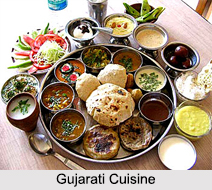
Essentially, the cookery in the western region of the country is simple with dishes like Aloo Bhaji (spicy potatoes), Kadhi (chickpea dumplings in yoghurt sauce) and preparations polished off with rice and pooris (puffed whole wheat fried breads).This region has diverse food culture that is spicy and largely vegetarian with some popular meat dishes. Gujarati cuisine has a special place for desserts and snacks. Gujarati prefer the thaali style meals where multiple dishes from starters, maincourse to side dishes and desserts are served in a large plate.

Maharashtrian cuisine among the West Indian Cuisine has mainly 2 sections defined by the geographical demarcations. A large portion of Maharashtra falls in the coastal regions and depends on rice, coconut and fish. Maharashtra also resides in the hilly regions of the Western Ghats and Deccan plateau regions and use groundnut. Their main cookery follows with jowar (sorghum) and bajra (millet) as staples.


Goan Cuisine
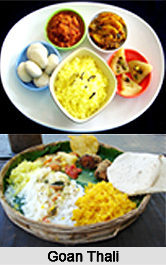
Goan cuisine, on the other hand is influenced by the Portuguese cookery as well. Goa with its lush green coastline makes fresh fish and seafood available in ample quantity. Goan cuisine is a typical blend of regional foods such as seafood, coconut milk, rice and paste. As the area is located in a tropical climate, Goan delicacies popularise the use of spices and intense flavours. The accepted dishes of the region are Vindaloo and Xacuti. Saraswat cuisine is found in the coastal areas of Goa and contributes to the Konkani food.


Gujarati Cuisine
Gujarati cuisine depends on the influence of Hinduism and Jainism. However, Gujarati cuisine is predominantly vegetarian. And the dishes are prepared with hint of sweetness adding sugar or brown sugar. A typical Gujarati Thali consists of Roti, daal or kadhi, rice and sabzi or shaak. Most of the Gujarati dishes are specifically sweet, salty, and spicy at the simultaneously.

For more, visit the link below:

https://www.indianetzone.com/2/western_indian_cuisine.htm

Monday, 19 December 2022

Indian Snacks


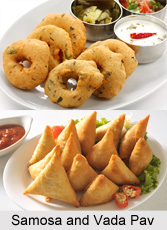
Indian SnacksThe Indian snacks are usually delicious and mouth watering preparations. Savouries like "Samosa", "Aloo Tikki" and "Vada Pav" are easily prepared and are commonly served Indian snacks. The popularity of Indian snacks grew because of its easy process of preparation and that they can be prepared at any time. The crispness and tempting tastes of Indian snacks is liked by young and old alike. Snacks are generally eaten between meals. It is thought to be ideal to serve the appetizing Indian snacks while having coffee or tea.

A snack is a portion of food, often smaller than a regular meal, generally eaten between meals. Traditionally, snacks are prepared from ingredients commonly available in the home. Snack foods are typically designed to be portable, quick and satisfying. A snack eaten shortly before going to bed or during the night may be called a midnight snack.

Varieties of India Snacks
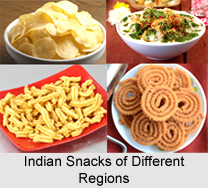
"Bhajias" or "Pakoras" can be prepared in both vegetarian and non-vegetarian forms. Sometimes only fried forms of besan with onions can make lovely "Bhajias", at times chicken or vegetable puree is added to make it fulfilling. "Chaat" is a popular type of Indian snacks and vendors literally crowd the streets selling all kinds of delicious variations of chaats. "Bhelpuri" is a type of low fat, nutritious and delicious snacks found in India. It is just a mixture of puffed rice, sauces, dried chats and other spices. "Chiwda" is a Marathi snacks and is popular for its properties to be crispy and crunchy that can be easily stored for a long time in airtight container. Similarly "Vada Pav" can be said to be a principle dish of Maharashtra that is presently a popular Indian snacks across the nation. Breadcrumbs along with some delicious mixture of curry make the sumptuous "Vada Pav".
Indian Snacks


For more, visit the link below:

Monday, 5 December 2022

Thalipith, Indian Snack, Maharashtra


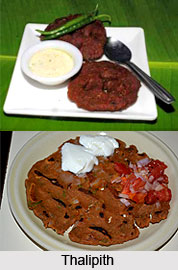
Thalipith, Indian Snack, MaharashtraThalipith is a wonderful snack recipe from Maharashtra cuisine. It is a multi-grain mildly spiced pancake ideal for breakfast as well as lunch. It is made in various ways and one can choose different types of flours according to choice. Thalipith is easy to make and can be prepared at home.

Ingredients of Thalipith
  • 1 cup whole wheat flour (atta)
  • 1 cup bajra flour
  • half cup rice flour
  • half cup besan
  • half tsp chilly powder
  • half tsp turmeric powder
  • 1 tsp cumin powder
  • 1 tsp dhania powder
  • Oil as required
  • Salt to taste


  • Method of Preparing Thalipith
  • Mix the flours and roast lightly in a pan or a griddle.
  • Add chilly powder, salt, turmeric powder, dhania powder and jeera powder.
  • Knead with water to make firm dough.
  • Roll into thin rotis and cook over a tawa (griddle), smearing oil on both sides, till crisp.
  • Serve hot.


  • Another method of preparing Thalipith is as follows:

    Ingredients of Thalipith
  • 1 cup whole wheat flour
  • 1/2 cup rice flour
  • 1/2 cup jawar flour
  • 1/2 cup gram flour
  • 2 tsp red chilli powder
  • 1/2 tsp turmeric powder
  • 2 tsp coriander powder
  • 1 tsp cumin seeds
  • 1/2 tsp carom seeds
  • 2 tbsp sesame seeds
  • 3/4 cup thick poha
  • 1" piece of ginger
  • 4 green chillies
  • 1 tsp garam masala
  • 1 cup finely chopped coriander leaves
  • 1/4 cup finely chopped onion

  • For more, visit the link below:

    Monday, 7 November 2022

    Marwari Cuisine


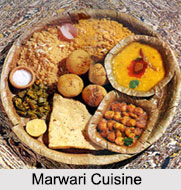
    Marwari Cuisine, Indian Regional CuisineMarwari Cuisine is the cuisine of the people from the erstwhile princely state of Marwar in Rajasthan. It is primarily vegetarian and offers a fabulous variety of dishes. The cooking style used is mainly based on the natural climatic conditions of the desert land from where the Marwari people have originated. Food that lasted for several days and that could be eaten without heating was preferred, more out of necessity than choice.

    Features of Marwari Cuisine
    Marwari cooking has its own unique flavour where the simplest and the most basic of ingredients go into the preparation of most of the dishes. There are some specific reasons for the use of some specific ingredients. Most Marwari food is based on dried ingredients that is readied and kept. The harsh climate along with the insufficiency of a lot of ingredients has formed the traditional cuisine of this region of Rajasthan. Most Marwari cuisine adds ghee to the dishes in the raw form, oil is hardly used. The dish is prepared and ghee is added on top, which is the best way to consume fat.

    The Marwari vegetarian food comes in two varieties; one is consumed by the local people who use various types of spices and herbs and the other one is the food consumed by the Marwari Jains. The Marwari Jain people prepare food without using onions, garlic or any ingredient grown under the soil, except ginger and groundnuts.

    For more, visit the link below:

    Thursday, 22 September 2022

    Curry, Indian Cuisine


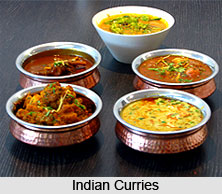
    Curry, Indian CuisineCurry is an incorporation of complex combinations of spices or herbs, usually including fresh or dried hot chillies. The decisive identity of India with the world starts with the flavours of the ubiquitous curry. It has successfully arrested the fascination of the globe all through. It is one delicacy that is prepared with different variations by different chefs.

    The origin of the word 'Curry' comes from the Tamil word 'Kari', which is a blend of spices and sauces, chiefly coconut. Curry may contain meat, poultry, fish, or shellfish, either alone or in combination with vegetables. Many are instead entirely vegetarian, especially among those who hold ethical or religious values against eating meat or seafood. However, it has spread all over the country with varieties sprouting up in every Indian province.

    In original traditional cuisines, the precise selection of spices for each dish is a matter of regional cultural tradition and religious practice. Such dishes are called by specific names that refer to their ingredients, spicing, and cooking methods.

    Traditionally, spices are used both whole and ground; cooked or raw; and they may be added at different times during the cooking process to produce different results. The main spices found in most curry powders are turmeric, coriander, and cumin; a wide range of additional spices may be included depending on the geographic region. Curries may be either ‘wet’ or ‘dry’. Wet curries contain significant amounts of sauce or gravy based on yoghurt, coconut milk, dal or stock. Dry curries are cooked with very little liquid which is allowed to evaporate, leaving the other ingredients coated with the spice mixture.

    Curry, Indian CuisineThe evolvement of curry in India has now led to a fantastic amalgamation of international cuisines, with the term being just not restricted to Indianised versions. It is usual to distinguish broadly between regional styles of Indian cuisine, recognizing that within those categories are innumerable sub-styles and variations. The distinction is commonly made with reference to the staple starch: wheat in the form of unleavened breads in the north; rice in the east; rice and millet in the south.

    For more, visit the link below:

    Wednesday, 7 September 2022

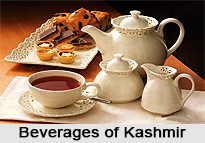
    Beverages of Kashmir


    Beverages of Kashmir, Kashmiri CuisineKashmiris are heavy tea drinkers. Kashmiri Cuisine cannot be complete without having beverages. "Kahwah" and "Sheer Chai" are the favourite beverages of the Kashmiri Cuisine. Tourists come to Kashmir not only for its natural beauty but also to have the refreshing beverages of the state. Being a cold region much of the beverages served here are served warm.

    Over the past 100 years, the cuisine of Jammu and Kashmir has evolved to a great extent and this has been mainly due to the influence of Kashmiri Pandits that hail from the Hindu Community and the Kashmiri Buddhists from the valley. The cuisines of North India Plains, Persia and Central Asia have also marked their strong influence on the cuisine of this state. A few refreshing and notable beverages of Jammu and Kashmir have gained prominence amongst the tourists.

    Kahwah
    Kahwah is one popular drink that is served at religious places, and during special festivals and marriage fests. This is a warm kind of tea that is usually served after meals to wash the food down. Though every one of us is familiar with ginger tea that is prepared in our homes, yet the special Kashmiri tea which is a fragrant one blended with cardamom is must have. It is one of the delightful thirst quenching drink which the tourists ask for. Infact, the natives that prefer drinking Kahwah to settle their stomach upset. It is also believed to be good for digestion.

    This drink hails its origin from an Arab coffee which was popular in 14th century. This drink has astonishing 20 varieties which are prepared in diverse households. Also called "Maugal Chai" by the Kashmiri Pandits, some people at times also add milk to alter its taste.

    Ingredients:
  • Green tea leaves - 1 tsp
  • Green cardamoms - 2
  • Cloves - 2
  • Cinnamon - 2 inch stick
  • Almonds - 4 to 5
  • Sugar - 3 tsp
  • Saffron - 2 to 3 strands
  • Beverages of Kashmir, Kashmiri Cuisine

    Method:
  • Grind the cardamoms, cloves and cinnamon to powder.
  • Crush almonds and keep aside.
  • In a pan pour 3 cups of water, crushed green tea leaves, sugar, cardamom-cloves-cinnamon powder and saffron.
  • Leave to infuse over a very low flame for 10 minutes till the tea turns light golden. Strain into tea cups.
  • Sprinkle the finely ground almonds on top of each cup and serve hot.


  • Sheer Chai or Noon Chai
    Sheer Chai or Noon Chai is a common breakfast tea in Kashmiri households and is taken with breads like ‘Bakarkhani’. This tea is best served in large samovars. The word "noon" in Kashmiri language means Salt.

    This popular drink is a pinkish coloured salted tea which is made with green tea, milk, salt and sodium bicarbonate. The particular colour of the tea is a result of its unique method of preparation and the addition of soda. The Kashmiri Pandits more commonly refer to this Chai as "Sheer Chai".

    For more, visit the link below:

    Friday, 17 June 2022

    Cuisine of Kerala


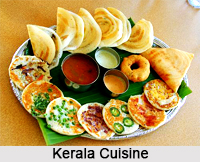
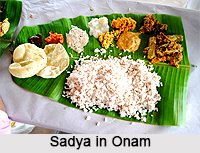
    Cuisine of Kerala, Indian Regional CuisineThe delicious Kerala cuisine is one of Kerala's popular attractions. The food of Kerala is traditionally served on a banana leaf and almost every dish has coconut and spices added for flavour, giving its cuisine a sharp pungency that is heightened with the use of tamarind. The cuisine of Kerala is characterized by the use of coconut, either chopped or grated and used as garnishing, coconut milk or paste is used to thicken gravies and coconut oil is used for cooking. Though one cannot imagine Kerala food without chillies, curry leaf, mustard seed, tamarind and asafoetida.

    Kerala is known as the "Land of Spices" because it traded spices with Europe as well as with many ancient civilizations with the oldest historical records of the Sumerians from 3000 BC. Various locally available vegetables such as tapioca, cassava and yam form part of the cuisine of Kerala. Bananas and coconuts are available year round and is a staple diet in Kerala. The refreshing juice of the tender coconut is a delightful drink, which can be enjoyed on Kerala tours with Kerala Backwater.

    Breakfast Items of Kerala Cuisine
    The breakfast dishes include "Puttu" and "Kadala", "Idli", "Sambar", "Dosa" and "Chutney", "Idiyappam", "Paal-Appam". Idiyappam and Paal-Appam are had with vegetable stew or curry. Other items include "Upma", "Chapati" and so on.

    Cuisine of Kerala, Indian Regional CuisineLunch and Dinner Items of Kerala Cuisine
    "Rice" is had during the lunch. Parboiled rice is preferred by the Keralites. "Kanji", a kind of rice porridge is also well-liked. Rice is accompanied with one or more curries. It includes sautéed vegetables or "Uperi", "Rasam", buttermilk or simply curd, "Kalan" or "Parippu Curry". Vegetarian dishes include "Sambar", "Avial", "Thoran", "Puliserry", "Olan", "Eriserry", "Pulinji", "Payaru", "Pacchadi" and so on.

    Chapathi and Puri is also eaten by the Keralites as their dinner menus. In North Kerala "Podi Patthiri", a flat thin rice chapati made from a boiled mash of rice baked on a tava and dipped in coconut milk is very common. The "Ari Patthiri" is a thicker version made from parboiled rice and flattened out on a cloth or banana leaf to prevent it from sticking.

    For more, visit the link below: