Showing posts with label traditional sports. Show all posts

Thursday, 4 June 2026

Saba Anjum Karim: Trailblazer of Indian Women’s Hockey

 Saba Anjum Karim, born on 12 June 1985, is a former member of the Indian national women’s hockey team who emerged as one of the most promising talents in Indian hockey during the early 2000s. She hails from Kelabadi in Durg town, Chhattisgarh, a region that would later take pride in her international achievements. From an early age, her sporting abilities set her apart, paving the way for her entry into structured competitive hockey at the national level.


Entry into Junior National Hockey

Karim’s rise in Indian hockey gained momentum in 2000 when she was selected for junior national camps. That same year, at just 15, she made her professional debut at the Under-18 Asian Hockey Federation (AHF) Cup held in Hong Kong. Playing as a right-wing forward, she quickly demonstrated her attacking prowess and contributed significantly to India securing the gold medal. 

Her early success continued as she represented India at the 2001 FIH Junior Women’s World Cup in Buenos Aires, Argentina. During this phase, she participated in several youth-level international tournaments, consistently showcasing her skill, agility, and goal-scoring ability on the global stage. 

Breakthrough at the Commonwealth Games

A defining moment in Saba Anjum Karim’s early career came in 2002 when, at just 16 years of age, she became the youngest participant in the women’s hockey competition at the Manchester Commonwealth Games. Her inclusion itself was a testament to her extraordinary talent. 

More importantly, she played a role in India’s historic campaign, which culminated in a gold medal victory against host nation England in the final. Around the same period, she also participated in key tournaments such as the Asian Games (October 2002), Asia Cup (February 2004 in Delhi), and other international tours including Australia and New Zealand. 

Senior Career and Consistency

Karim’s consistent performances in her formative years laid a strong foundation for her senior career. Over time, she represented India in multiple international competitions, including the Commonwealth Games in 2002 and 2006, as well as various test series and multinational tournaments. 

She was known for her role as a right-wing forward and developed into a reliable attacking player. Over the course of her career, she achieved an impressive milestone of 92 goals in 200 international appearances, underlining her importance to the national team. 

She trained under coach Mr. Salim and was also part of the senior national coaching camps conducted by the Indian Women’s Hockey Federation (IWHF), where she was included among the top 31 players selected for advanced training. 

Leadership and Captaincy

A significant milestone came in 2011 when Saba Anjum Karim was appointed captain of the Indian women’s national field hockey team at the age of 26. Her first assignment as captain was a four-test series in Australia, followed by a three-nation Super Series Championship featuring nine-a-side matches. 

Her leadership marked a new phase in her career, where she combined experience with tactical understanding to guide a young Indian side on the international stage. 

Awards and Legacy

In recognition of her outstanding contribution to Indian hockey, Saba Anjum Karim was conferred the Arjuna Award in 2013, one of India’s highest sporting honors. The award was presented by then President Pranab Mukherjee at Rashtrapati Bhavan in New Delhi during the National Sports Awards ceremony. 

Her journey from a young girl in Durg to an international hockey captain remains an inspiring example of dedication, discipline, and sporting excellence in Indian women’s hockey. 

Tuesday, 29 August 2023

Wrestling in India: A Rich Tapestry of History and Achievements


Wrestling, a sport deeply ingrained in India's cultural and historical fabric, has a lineage that dates back centuries. With its origins rooted in ancient texts and mythologies, Indian wrestling, or 'kushti' as it is locally known, has evolved into a fiercely competitive and celebrated sport. This article delves into the history of wrestling in India, shedding light on its evolution and the remarkable achievements of some of the nation's most renowned wrestlers.


Historical Roots

The roots of wrestling in India are entwined with the country's rich mythological and historical narratives. References to wrestling can be found in ancient texts like the Mahabharata and Ramayana, where valorous warriors engaged in the sport as part of their training. The sport's ancient form, known as 'Malla Yuddha,' was a combination of physical prowess and strategic acumen, making it an integral part of warrior culture.


Evolution of Kushti

Over the centuries, kushti underwent transformations, merging indigenous techniques with influences from Persian and Mongolian wrestling styles. Traditional akhadas (wrestling training centers) became the nurturing ground for wrestlers, not only in terms of physical training but also in terms of values like discipline, dedication, and respect. Wrestlers, or 'pehlwans,' adhered to a strict regimen, often living austere lives to maintain peak physical condition. Traditional Sports


Pioneering Achievements

India boasts a long line of wrestlers who have not only excelled on the domestic front but have also made their mark on the international stage. One such trailblazer was Gama Pehlwan, hailed as one of the greatest wrestlers of all time. Gama's feats are legendary, from remaining undefeated in his career that spanned several decades, to even accepting challenges from international wrestlers and strongmen. His legacy continues to inspire wrestlers in India and beyond.


Modern-Day Icons

In recent decades, Indian wrestling has seen a resurgence, with athletes achieving remarkable feats in various international competitions, including the Olympics. Sushil Kumar, a two-time Olympic medalist, brought wrestling to the forefront of Indian sports consciousness with his bronze and silver medal wins in 2008 and 2012, respectively. His achievements sparked a renewed interest in the sport, inspiring a new generation of aspiring wrestlers.

Another name that shines brightly is Bajrang Punia. With numerous international titles under his belt, including World Championships and Commonwealth Games gold medals, Bajrang is a symbol of the relentless determination that defines Indian wrestlers. His agility and technique have earned him a reputation as one of the best in the world.

Vinesh Phogat's journey is equally inspiring. Hailing from a family deeply rooted in wrestling, Vinesh overcame adversity and injury to become the first Indian woman wrestler to win a gold medal at the Asian Games. Her success has been pivotal in changing societal perceptions of women in sports and has encouraged a growing number of young girls to pursue wrestling.


A Global Force

Indian wrestling's achievements extend beyond the mat. The annual 'Dangal' competitions draw massive crowds and provide a platform for emerging talent to showcase their skills. The rise of the Pro Wrestling League has further amplified the sport's popularity, allowing wrestlers from various countries to compete in an exciting team format.


Wrestling in India is a testament to the country's enduring traditions and its ability to adapt and excel in the modern world. From its mythological origins to the achievements of contemporary wrestlers, the sport has etched its place in India's cultural mosaic. As Indian wrestlers continue to make their presence felt on the global stage, the legacy of kushti grows stronger, inspiring generations to embrace the values of discipline, dedication, and determination.


Wednesday, 7 December 2022

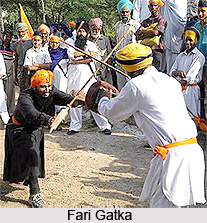
Fari Gatka, Indian Martial Art


Fari Gatka, Indian Martial ArtFari Gatka is an ancient Indian fencing-combat form that incorporates the use of swords and shields. India is home to a variety of fighting and combat techniques. India deeply influenced the development of various modern martial arts, particularly within the countries that have been influenced by Indian culture and religion and one such game is Fari Gatka. It is a bladeless armed combat technique developed by the Sikhs of Punjab, in North-Western India. It is practiced like sword-fighting, but with wooden sticks and leather shields. This martial art was conceived as an offensive, as well as defensive combat form, which focuses on developing the physical state along with strengthening the mental and spiritual aspects as well.

History of Fari Gatka
History says that this martial art dates back to the Mughal era. It is said that initially it was practiced by the Sikh inhabitants of Punjab to protect themselves from Mughal invasion. It is also believed that a form of this art involving the use of sword and shield was practiced by Akbar.

Practice of Fari Gatka
It is practiced with a cane stick which is used as a Gatka or sword along with a small leather shield called Fari. The word Gatka is derived from the Sanskrit word "Gada", meaning Mace. The sword is usually around 3 foot, where as the shield is 9 inches in diameter. The Fari is made with sturdy leather and weighs around 1lbs. Fari Gatka is practiced in a 20 foot quadrangle arena. The sport involves the use of weapons by both hands, for it is believed that proper co-ordination of the two sides of the body is necessary for balanced development. The fighters could score points only when their swords would come in contact with vital pressure points on the opponent's body. The match ends when one of the participants has received 5 strikes in the body.

For more, visit the link below:

Saturday, 16 July 2022

Chess Championships in India


Chess Championships in IndiaChess Championships in India is mainly conducted by the All India Chess Federation. These tournaments have the national and international prestige. In India, the chess scenario is actually flourishing with some very talented youngsters who are willing to make it large in the international stage. In fact, India is sometimes considered as a chess powerhouse. With such a tremendous increase in the number of youngsters aspiring to take the game of chess, the domestic chess championships or tournaments have witnessed a strong competition as well as considerable improvement in overall standards.

Role of All India Chess Federation
All India Chess Federation organizes chess events not only at national level, but also at several regional levels. The regional level chess championships of India are basically conducted by State Chess Associations. All India Chess Federation has produced some of the finest chess players, the country has ever witnessed. The list includes names like Viswanathan AnandManuel Aaron,Dibyendu BaruaHumpy Koneru and Parimarjan Negi and Tania Sachdeva to name a few, who have left a mark in the world chess arena and have made the country proud. Throughout the year, a number of chess events are organized and where a large number of young enthusiasts participate.

Women Chess Championship in India
The All India Chess Federation is in charge of managing Men’s Chess in India and is also responsible for managing Women’s Chess in India. In the year 1974, the first Women’s Senior National Chess Championship was organized in the country. The first 10 editions were dominated by the Khadilkar sisters Vasanti, Jayshree and Rohini. The several renowned chess championships in India 

Monday, 20 June 2022

Types of Wrestling in India


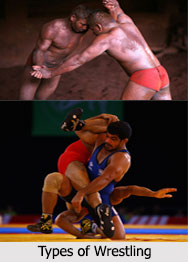
Types of Wrestling in IndiaTypes of Wrestling in India depend upon many factors like techniques, winning, regional and many more. Today, techniques of wrestling have been integrated with other hand-to-hand combat systems, including military combat and martial arts.

Modern Types of Wrestling in India
In the folk-style, Wrestling in India can be divided into two main categories like ‘Malla Krida’ and ‘Malla-Yuddha’. Malla Krida is the sports form of the game, while Malla-Yuddha is the battle version of wrestling. The free-style varieties are more common than the other forms, since Vedic times. The free-style varieties of wrestling in India are known as ‘Pushti’ or ‘Kushti’.

Malakhra: Malakhra is a unique type of wrestling, which has been derived from South Asia. This game is played in many portions of India and also in Pakistan. The participants tie a cloth around the waist of the opponent and each of them makes an attempt to throw him down, to the ground.

Vajra Mushti: Vajra-Mushti, also referred to as 'diamond-fist' or 'thunder-fist' is a technique of martial arts of ancient India which is performed by wrestlers known by the name Jyesthimalla. The weapon employed in this game is called 'Indra-mukti' which implies the fist of Lord Indra.

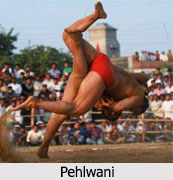
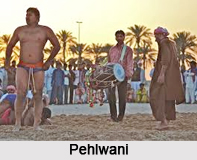
Types of Wrestling in IndiaPehlwani: Also known as 'Kusti', Pehlwani is a procedure of wrestling which originated from South Asia. It is said to be a fusion of the local form of wrestling, known as ‘malla-yuddha’ and 'varzesh-e bastani', a Persian form of wrestling.

Ancient Types of Wrestling in India
Wrestling was a traditional pastime in India during the ancient time. Wrestling in Ancient India was divided into four types like ‘Bhimaseni’, ‘Hanumanthi’, ‘Jambuvanthi’ and ‘Jarasandhi’, based on the technique and methodology.

• Bhimaseni Wrestling: The other type, Bhimaseni is for those wrestlers, who have huge build and strength. This form of wrestling gives pressure on acquiring the strength and then using it.

For more, visit the link below:

Friday, 20 May 2022

Indian Regional Football Tournaments


Indian Regional Football TournamentsIndian Regional Football Tournaments include Durand Cup, IFA Shield, Subroto Cup, Santosh Trophy, Indian Super Cup and Federation Cup.

In India, cricket is the most popular game, but football still holds a special place among the sport loving people. India's richness of football heritage is evident from the fact that it hosts one of the oldest football tournaments in the world.

These football tourneys are played all through the seasons where aspiring footballers, from across the country take part to exhibit their class and skills in front of thousands of appreciative and football crazy people.

There are many football tournaments arranged at the regional levels that help to search for the budding talents of football. Sometimes the tournaments are arranged in the school level so that the possible footballer can be trained from the young age. These local tournaments often play a crucial role in a person career. Most of the leading Indian footballers today have come through from the local leagues.

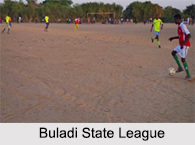
Buladi State League
This tournament includes the best district teams. A total of 19 districts participate in this tournament. In the first phase they were arranged in six groups. The second stage is knock-out phase, which ultimately leads to the final. Supporters for all the teams come from various districts to support their teams and the play ground turns into a festival mode during the course of the tourney.

Buladi Tribal Football Championship
This is the tournament that includes eight districts, four from North Bengal and four from South Bengal. The players are mostly tribal boys. The drive for arranging this tournament is to spot out talented footballers from the tribal belt of the state and bringing them to mainstream football. Apart from this, the endeavour behind arranging this tournament is to create a supply chain of footballers to the higher level.

For more, visit the link below:

Tuesday, 22 February 2022

Rowing Clubs in India


Rowing Clubs in IndiaRowing clubs in India are affiliated to various rowing association of India, which in turn is affiliated to the Rowing Federation of India. Some of these clubs have long history attached to it as they were set up during the times of British Colonial rule in India.

Bengal Rowing Club
Bengal Rowing Club (BRC) is located in Kolkata in West Bengal. This rowing club is one of the most famous rowing clubs in India. GD Birla, on the site of a former lakeside bank of Rabindra Sarobar, founded the club on 25th August 1929. BRC Students Rowing Championship is the biggest sporting event of Bengal Rowing Club (BRC). It is organized annually in mid May. The championship is organized in several categories, which include 'Junior Girls, Fours’, 'Senior Girls, Fours', 'Junior Boys, Fours' and 'Senior Boys, Fours'.

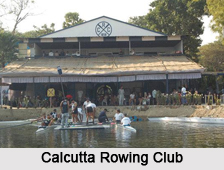
Calcutta Rowing Club
Rowing Clubs in IndiaCalcutta Rowing Club is situated in the city of Kolkata in the Indian state of West Bengal and founded in the year 1858 and is also one of the oldest rowing clubs of its kinds outside UK. History of Calcutta Rowing Club has not been known. The exact history has been wiped out of Kolkata, after the city experienced the great cyclone in the year 1864. The boat and boat house, along with minute books and all the records have been disappeared. Out of the catastrophe, the only thing that could be preserved were the Accounts of 1858-59 signed by Mr.John Cowle, as the Honorary Secretary and Treasurer, and he goes down in history as the first officer on record. Currently the club is located at the 15 Rabindra Sarobar, Kolkata-700029, after the construction of the Dhakuria Lake in 1928. Ever since 1979, the CRC has been able to maintain its position and status in the rowing scene.

For more, visit the link below:

Wednesday, 9 February 2022

History of Chess in India


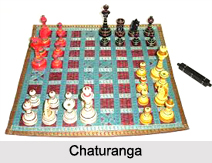
History of Chess in IndiaHistory of Chess in India began before 6th Century BC. The early name of Chess was Chaturanga. From early era, Chess has a huge evolution. Earlier, it was concentrated among the kings and royal people of different dynasties.

Early History of Chess in India
Chess, which was named as Chaturanga became popular in Gupta era. There, its early form in the 6th century was four divisions of the military: infantry, cavalry, elephants, and chariot. These forms are represented by the pieces that would evolve into the modern pawn, knight, bishop, and rook, respectively. Chess was not only popular in early India. But it was also popular in early Persia, Afghanistan and Central Asia.

Medieval History of Chess in India
Chess was introduced to Persia from India and became a part of the princely or courtly education of Persian nobility. The game was taken up by the Muslim world after the Islamic conquest of Persia, with the pieces largely keeping their Persian names. In Sassanid Persia around 600 the name became chatrang, which subsequently evolved to shatranj, due to Arab Muslims' lack of "ch" and "ng" native sounds, and the rules were developed further. The model chess was redefined during Rajputana era. Later during the rule of Delhi Sultanate and the Mughals, it was named as "Satranj".

For more, visit the link below:

Thursday, 27 January 2022

Traditional Games


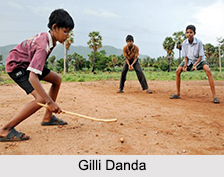
Traditional GamesTraditional games have always been part of the Indian culture since centuries. If looked at these very closely, one would surely find many striking similarities in most of the famous games played all around the world. For eg: Cricket or Baseball can be called as an improvised version of the traditional 'Gilli Danda'. Then, we also have the famous games like Polo, Rugby, Boat Racing which are again the improvised versions of many other traditional games played in many remotest parts of India. These are:

Kalari Payattu: Kerala's martial art form, Kalari Payattu, is very similar to Karate.

Chaupar: A very similar but more skilful, complex and may be a little older than Pachisi, a game called Chausar, Chaupar or Chaupad is also popular among Indians.

Pallanguli: Pallanguli is a game played mostly played by Tamil women, both in Southern India and Sri Lanka and it is known as the number game. Men also sometimes play it for gambling purposes. The board has 14 cups, each player controlling seven.

Gilli Danda: Cricket or Baseball played with sticks instead of bats or balls, is exactly the structure of Gilli Danda. Gilli Danda is played with two wooden sticks - a gilli and a danda.

Asol Aap: Asol Aap or Canoe Race is an indigenous game of Andaman and Nicobar islands. In this game, a canoe having a length of almost 100' is used.

Vallamkali: Celebrated in Kerala, the festival of Onam is well known for the famous snake boat race that is organized on the occasion.

Gella - Chutt: Gella - Chutt is a famous indigenous game of Tripura. Interestingly, the number of participating in a game of Gella - Chutt differs in the various places the game is played.

Hiyang Tannaba: Hiyang Tannaba is a very famous boat race, which takes place in Manipur, and is an essential ingredient of one of their prominent festivals - Lai Haraoba.

Inbuan: Inbuan is an age-old game played in Mizoram. The game bears a striking resemblance to combat wrestling.Traditional Games

Insuknawr: Insuknawr or rod - pushing is an indigenous game of Mizoram. Played only by the male population of Mizoram.

Kang Shanaba: Kang Shanaba is an indigenous Manipuri game played on the day between Manipur's New Year's Day and the Ratha Jatra festival.

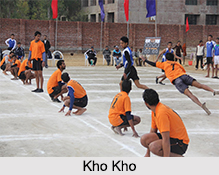
Kho-Kho: Kho-Kho is one of India's very famous traditional games and is also known as a 'Standing Game'. This is the sport where players chase and try to touch a person.

Kirip: Kirip (Nicobarese wrestling) Kirip is an indigenous wrestling form of the Nicobarese tribe. The game begins with the wrestlers clasping each other from behind using their hands- the grip should not be relaxed till the match is over. In this game, the wrestlers must try and push the opposition to the ground using their legs. As soon as a player's back comes in contact with the ground, he loses the match. The game is played in 5 rounds.

For more, visit the link below:

Thursday, 13 January 2022

Forms of Kabaddi


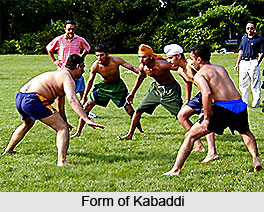
Forms of KabaddiKabaddi in India is recognised as a traditional and one of the most popular sports. Kabaddi is played quite extensively all over the country. The game has passed a long way since its inception in India, during the pre-historic period. The Indian people love to play the game very much, as it does not need many kinds of equipments to play. Another reason is that, the game helps one to be physically fit and also teaches about how to defend and attack at the same time.

Different Forms of Kabaddi in India
There are various forms of Kabaddi in India. These forms atre played in different regions in India.

Amar
This form of Kabaddi is played based on points scored by both sides. Here, the play field has no specific measurements and 9 to 11 players constitute each of the teams. In this form of Kabaddi, there is no out and revival system or Lona (a bonus of two points awarded to the team that gets all opponents out). However, it is a time bound game. According to the rules of this form of Kabaddi, all the players are bound to remain within the court throughout the match. By this, the players can give their best, without the fear of having to miss out a great deal of action.

Gemini / Gaminee
In this form of Kabaddi, each of the sides comprises nine players and this form brings with it an inherent fear. The fear is of being called "out", as it literally means that the player has to go out of the court and wait there until all his opponents face the same fate or inflict the same consequence on his team-mates. The team that becomes successful in getting all the opponents out is awarded a point. This system is being used in the modern version of Kabaddi also; however, there is a slight variation. In the modern version, a team successful in getting all the opponents out is awarded a bonus of two points called the Lona. In the Gemini or Gaminee form of Kabaddi, a team is revived once all its members are dismissed, and the game continues till five or seven such points are gained by either of the teams. This game is not time bound, and sometimes it can be quite frustrating for a player who is out early, to wait until a Lona is achieved.

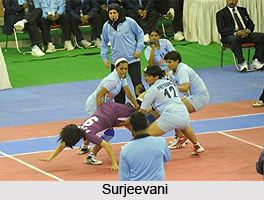
Forms of KabaddiSurjeevani
This is one of the forms of Kabaddi that has a lot of resemblance with the modern version of the game. In this form, the players who are out are instantly revived and the game lasts for 40 minutes with a 5-minute break in between. Each of the team comprises nine players in this form, and a Lona is usually awarded to the team that succeeds in getting all the opponent team members out. The team that earns the maximum points, after the limited duration of the game, is declared the winner. The Surjeevani form of Kabaddi is played on a bigger field in comparison to the other two forms of the game. The rules of this form of Kabaddi regarding out and revival system of a player, have great resemblance with that of Modern Kabaddi.

Modern Kabaddi
This is the latest of all the forms of Kabaddi and it is actually a synthesis of all the other three forms, with notable changes with regards to rules and regulations. Here, each team consists of 12 players, out of which seven are on court at a time, and five in reserve. The two teams collect points by either touching or capturing an opponent member. Both the teams aim for higher points within the time limit of 40 minutes, by alternating in defence and offence. There are two halves, each of 20 minutes in this form of Kabaddi, with a break of five minutes. In modern form of Kabaddi, the playground is required to be level and soft and is also required to be made of earth, manure or saw dust. The measurement of the playing area is 12.50 mteres x 10mters, divided by a line into two halves. Each half of the ground measures 10 meters x 6.25 meters and there shall be strip of one meter wide on each side of the play field that is called lobby. The side that wins the toss first sends a 'raider', who enters the opponents' court chanting, 'kabaddi-kabaddi'. The repeated clear sound of Kabaddi within the course of one’s respiration is called cant.

For more, visit the link below:

Wednesday, 29 December 2021

Pehlwani, Indian Martial Art


Pehlwani, Indian Martial ArtPehlwani or Kushti is a popular style of Indian wrestling that was developed during the Mughal period. Pehlwani is a fusion and combination of Varzesh-e Bastani of Persian origin and malla-yuddha of Indian origin.

Origin of Pehlwani
Pehlwani is an evolved and enhanced variation of the ancient Indian wrestling form known as Malla Yuddha, which was practiced during the 5th century BC. It can be described as the oldest and the traditional forms of Wrestling in India. Malla Yuddha is even described in the Malla Purana, a treatise formed in the 13th century. During the Mughal invasion in Indian in the 16th century, Malla Yuddha underwent a complete transformation as the Central Asian Mughals promoted Persian customs and culture. Malla Yuddha was hugely influenced by Mongolian and Persian (Varzesh-e Bastani) form of wrestling and thus Pehlwani was created. The various instructors and practitioners gradually developed it.

History of Pehlwani in India
There were several great and renowned wrestlers in India, like Ghulam Muhammad, popularly known as Gama Pehlwan, and Jatindra Charan Guha, famous as Gobar Goho, who brought the country international recognition in wrestling. In the IV Asian Games or Jakarta Games, India reached the summit of glory as all the 7 Pehlwans received medals, including 12 medals in freestyle wrestling and Greco-Roman wrestling. Again at the Commonwealth Games, conducted at Kingston, Jamaica, all of the 8 Indian wrestlers received medals for their outstanding performances. By 1960s, the country was ranked amongst the top 8 wrestling nations in the world. Due to their glorious history in wrestling, India hosted the World Wrestling Championships in New Delhi in 1967.

Development of Pehlwani in India
The practitioners of Pehlwani nowadays incorporate various Asian martial art styles in their training routine like including the grappling aspects of Jujutsu and Judo. The conditioning and sparring techniques of Pehlwani have been introduced into various aspects of Shoot Wrestling and Catch Wrestling, including the derivative systems. These also incorporate numerous throws, takedowns and submissions of Pehlwani.

For more, visit the link below:
https://www.indianetzone.com/57/pehlwani.htm

Tuesday, 14 December 2021

Indian Chess Tournaments


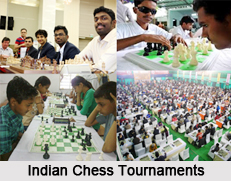
Indian Chess TournamentsIndian Chess Tournament is one of the popular tournament in India creates a great excitement among the chess lovers of India. The first ever official National Chess Championship in India was organized by the All India Chess Federation (AIFF) at Eluru in Andhra Pradesh.

Initially, the Indian Chess tournaments used to be held at every alternate year, but are being held annually, since 1971. Almost all the Chess associations in India and the Chess clubs organise at least one tournament every year and the tournaments play a vital role in upbringing the young Indian chess players.

Organizing the Chess Tournaments in India
The Indian chess tournaments are mainly organised with a view to bring up new talents in the field of Chess and provide India with ample talented Chess players to shine in the international arena. The Indian Chess associations like the district associations, state associations or even the Chess clubs are in charge of organising these tournaments.

Contribution of All India Chess Federation (AICF)
Indian Chess TournamentsHowever, as the national governing body for Chess in India, the All India Chess Federation (AICF) organises most of the national level Indian Chess tournaments. In India, people of every age play chess like the children, the adults and even the senior citizens. Indian Chess tournaments are organised for each of those Chess players. There are tournaments at the under-7, under-9, under-11, under-15, under-19, junior, senior levels and there are separate tournaments for men's and women's, as well.

Organising International Chess Tournaments
Apart from organising regional and national level tournaments, the Indian Chess associations also organise various International Chess tournaments. All these International tournaments are organised by the AICF and it gets sufficient help from the state Chess associations. Many Indian Chess tournaments have earned recognition and reputation in the international level and a large number of internationally acclaimed Chess players also come and play in these tournaments.

For more, visit the link below: