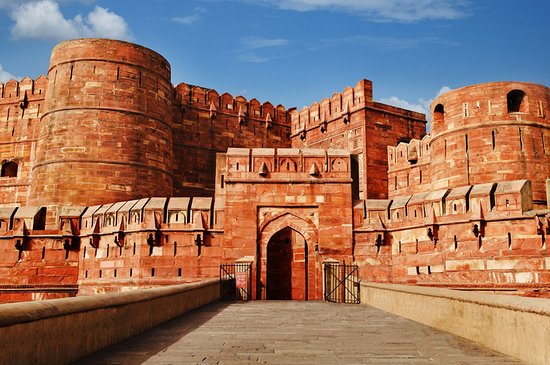
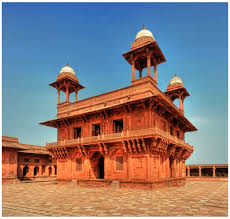
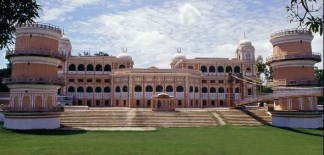
Agra Fort, a UNESCO World Heritage Site, stands as a remarkable example of Mughal architecture and historical significance. Located in Agra, Uttar Pradesh, this formidable structure played a crucial role in India’s history as the main residence of the Mughal emperors until the capital shifted to Delhi. Built with red sandstone and incorporating influences from Persian, Timurid, and Indian architectural styles, the Agra fort remains a symbol of Mughal power and artistic excellence.

Historical Background
Agra Fort’s origin dates back to the 11th century when it
was a brick fort under the control of the Rajput rulers. However, its
transformation into the grand structure seen today began in 1565 under Emperor
Akbar. Recognizing the strategic importance of Agra, he initiated the fort's
reconstruction using red sandstone. Successive rulers, including Jahangir and
Shah Jahan, made significant additions to the fort, incorporating elements of
marble and intricate embellishments.
During Shah Jahan’s reign, Agra Fort also became a place of confinement. After being deposed by his son Aurangzeb, Shah Jahan spent his last years in the fort’s Musamman Burj, from where he could view the Taj Mahal, the mausoleum he had built for his wife Mumtaz Mahal. The fort also played a pivotal role in battles involving the Marathas and the British, marking its influence in India’s colonial history.
Architectural Features
Agra Fort showcases a blend of military and artistic elements, reflecting the architectural evolution of the Mughal era. The fort spreads over 94 acres and has a semicircular shape, with walls rising to a height of 70 feet. It is surrounded by a deep moat for added security.
Among its notable structures is the Delhi Gate, the grand entrance originally used for ceremonial purposes. The Amar Singh Gate serves as the main entry point today. Inside, the Diwan-i-Aam (Hall of Public Audience) and Diwan-i-Khas (Hall of Private Audience) highlight the Mughal emperors’ governance and diplomatic functions. The Jahangiri Mahal, built by Akbar, features a blend of Hindu and Islamic architectural styles, while the Khas Mahal and Sheesh Mahal constructed by Shah Jahan exhibit intricate marble work and mirror inlays.
The Musamman Burj, a white marble tower, remains one of the most historically significant parts of the fort. It was in this tower that Shah Jahan spent his final days under house arrest. The Moti Masjid, or Pearl Mosque, further exemplifies Mughal craftsmanship, with its pristine white marble and serene ambiance.
Cultural and Historical Significance
Agra Fort represents the zenith of Mughal architectural prowess and political dominance. This fort served as the heart of the empire, witnessing key historical events, including diplomatic visits and royal successions. Its strategic location near the Yamuna River provided both defensive advantages and aesthetic appeal.
Today, Agra Fort stands as a major tourist attraction, drawing visitors who seek to explore its rich history and architectural splendor. Recognized as a UNESCO World Heritage Site in 1983, it continues to be a significant cultural landmark that reflects India’s historical grandeur and architectural excellence.