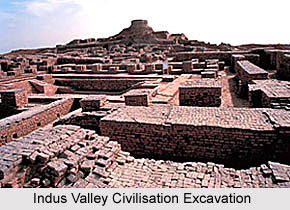
 Indus Valley Civilisation, also known as 'Harappan Civilisation', was discovered as a consequence of the excavations conducted in 1920. The culture of Indus Valley Civilization manifested the growth of an ancient society which evolved and thrived during the Bronze Age in the North-West region of India and its subcontinent. The civilization was named after the Indus River, along the banks of which the civilization developed. Geographically, the Indus Valley Civilization covered the territory of Pakistan, the states of Rajasthanand Punjab, the valleys of Narmada and Tapti in Gujarat, with intrusions into the upper Ganga-Yamuna Doab. Collectively they constitute an area of about 8, 40,000 sq miles, which is much bigger than that of any contemporary civilization in other places. The origin, culture and decline of the Indus Valley Civilization are shrouded in mystery and have fascinated the historians and common populace as well. It is estimated by experts that the society existed between 3300 BC and 1700 BC.
Origin of Indus Valley Civilisation
The origin of Indus Valley civilisation is devoid of any kind of battles or conflicts. The people of Indus Valley rather made deals instead of war and created a stable peaceful and prosperous culture. The Harappa Civilization has its significance for not only historians and archaeologists but for the people in general. It was best known for its spectacular city planning, its drainage system and had surpassed all other contemporary civilizations.
As far as the origin of the word Indus is concerned, scholars are of the opinion that the name Indus is the origin of the word Hindu. Though the original Indian name of the river is Sindhu, the Greeks referred to the river as the 'Indos' while the later Arabs referred to it as 'Al-Hind.' Eventually the name came to be applied to the people of the subcontinent, namely, the 'Hindi,' the 'Hindus' and the 'Indians.' It is believed that the Indus Valley Civilization belonged to the copper age as the presence of iron tools and implements has not yet been established at any part of this civilization.
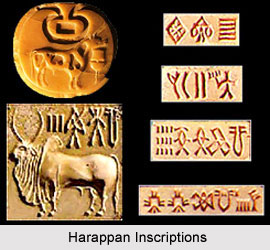 The oldest mention of the Indus Valley Civilisation is found in the works of Charles Masson in 1842. In 1856 while laying a railway track, British engineers came across an ancient city. They used the bricks from the ruined city to build the railway bed. Finally it was Alexander Cunningham, the director of the Archaeological Survey of British India, who presented to the world a seal from this ancient civilisation. In the year 1920, Indian archaeologists Dayaram Sahani and R.D Bannerjee undertook excavations on one of these mounds in Harappa. The archaeologists expected to find something, but never imagined that a city lay beneath the earth. Further excavation at different places in India and Pakistan, led to discovery of another large city 'Mohenjodaro' with the recovery of at least 80 villages and towns related to this newly discovered civilization. They named it Harappan after the first city they discovered.
For more visit the page:


