Showing posts with label tribe. Show all posts

Tuesday, 28 April 2026

Chadar Community in India: History, Social Identity, and Contemporary Realities

 The Chadar caste in India represents a lesser-discussed yet culturally significant community within the country’s complex social structure. Like many caste groups, the Chadar community has evolved over time, shaped by regional traditions, occupational roles, and broader socio-economic changes. Understanding their history and present condition offers insight into the diversity embedded within India’s caste system.


Historical Background

The origins of the Chadar caste are not extensively documented in mainstream historical texts, but they are generally believed to have roots in specific regional communities, particularly in parts of northern and eastern India. Traditionally, caste identities in India were closely linked to hereditary occupations, and the Chadar community was no exception. Their name is sometimes associated with occupational or regional identifiers, reflecting the localized nature of caste development. 

In earlier periods, caste hierarchies were rigid, with each group occupying a defined social position. The Chadar caste was often categorized among communities engaged in manual or service-oriented work. These roles, while essential to the functioning of society, were frequently undervalued within the traditional hierarchy. 

Traditional Occupation and Social Role

Historically, members of the Chadar caste were associated with occupations that required physical labor or specialized skills. These could include agricultural work, artisanal tasks, or services within rural economies. Their contribution was integral to sustaining village life, particularly in agrarian settings where interdependence among caste groups was a defining feature. 

Despite their importance, communities like the Chadar often faced social marginalization. Access to education, land ownership, and economic mobility was limited, reinforcing their position within the lower strata of the caste hierarchy. 

Regional Distribution

The Chadar caste is not uniformly spread across India but is found in specific regions, with variations in identity and status depending on local contexts. In some areas, they may be recognized under different sub-caste names or grouped within broader caste categories. This regional diversity reflects the fluid and complex nature of caste identities in India. 

Their cultural practices, language, and traditions often align closely with the dominant regional culture, while still maintaining distinct community-specific customs. 

Contemporary Status

In modern India, the socio-economic condition of the Chadar community has undergone gradual transformation. Constitutional provisions, affirmative action policies, and increased access to education have contributed to improving opportunities for historically marginalized groups. Depending on regional classification, members of the Chadar caste may be included in Scheduled Castes (SC), Other Backward Classes (OBC), or similar categories, enabling them to benefit from government initiatives. 

However, challenges persist. Economic disparities, limited access to quality education, and social discrimination continue to affect sections of the community. Urbanization and migration have opened new avenues for employment, yet the transition from traditional occupations to modern professions remains uneven. 

Cultural Identity and Social Change

The Chadar community, like many others, is navigating a balance between preserving cultural identity and adapting to contemporary realities. Social reforms, increased awareness, and community-led initiatives have played a role in challenging traditional barriers. Younger generations, in particular, are seeking education and professional opportunities beyond conventional roles. 

At the same time, cultural traditions—such as local festivals, marriage customs, and community networks—remain important in maintaining a sense of identity and continuity. 

The Chadar caste in India exemplifies the layered and evolving nature of the country’s social fabric. While historical constraints have shaped their trajectory, ongoing social and economic changes are gradually redefining their position. A nuanced understanding of such communities is essential for appreciating India’s diversity and addressing the inequalities that persist within its caste system.

Monday, 23 September 2024

Kuvi Language

Kuvi is a Dravidian language primarily spoken by the Kondh tribes in the eastern part of India, particularly in the states of Odisha and Andhra Pradesh. As a significant part of the South-Central Dravidian subgroup, Kuvi holds a prominent place among the tribal languages of India. Despite the growing influence of dominant regional languages, Kuvi remains an integral part of the Kondh community’s cultural identity and heritage.


Historical Background of Kuvi

The roots of Kuvi language can be traced back to the ancient Dravidian family of languages, which predates the Indo-Aryan linguistic influence in India. Historically, Kuvi developed alongside other tribal languages in the region, such as Kui, another language spoken by the Kondh tribe. The two languages, though related, have evolved distinctly over time, with Kuvi maintaining its unique grammatical structure and vocabulary. 

Kuvi has been passed down orally through generations. Due to the tribal nature of the Kuvi-speaking communities, written records of the language are limited. However, efforts by linguists and cultural organizations in recent decades have led to the documentation and preservation of Kuvi, particularly through educational programs aimed at promoting its use among younger generations. 

Geographic Distribution

Kuvi is predominantly spoken in the districts of Rayagada, Koraput, and Kandhamal in Odisha, as well as parts of northern Andhra Pradesh. The speakers of Kuvi are primarily members of the Kondh tribe, which is recognized as a Scheduled Tribe by the Indian government. Although there are several thousand speakers of Kuvi, the language is categorized as vulnerable by UNESCO due to the influence of dominant regional languages like Odia and Telugu. 

Cultural Significance of Kuvi

The Kuvi language is deeply intertwined with the social and cultural fabric of the Kondh community. It serves as a medium through which traditional knowledge, customs, and values are transmitted across generations. Folktales, songs, and rituals in Kuvi reflect the tribe’s connection to nature and their ancestral traditions. 

Festivals and ceremonies, particularly those related to agriculture and the Kondh community's indigenous belief systems, are conducted in Kuvi, highlighting its role in preserving cultural continuity. The language is also used in oral storytelling traditions, which serve as a repository of the tribe’s collective memory and experiences. 

Challenges and Preservation Efforts

The Kuvi language faces several challenges, most notably the growing dominance of regional languages and the increasing trend of migration to urban areas, where children are exposed to other languages. This shift has resulted in the younger generation gradually losing fluency in Kuvi, posing a threat to the language's survival. 

However, there have been efforts to revitalize the language, especially through educational initiatives in tribal areas. Schools have started incorporating Kuvi in their curricula, and local organizations are promoting literacy in the language. Additionally, the creation of Kuvi dictionaries and the translation of important documents into the language are contributing to its preservation.

 Kuvi stands as a testament to the linguistic diversity of India and the resilience of indigenous languages. Its historical roots, cultural significance, and the ongoing efforts to preserve it highlight the importance of safeguarding such languages for future generations. Although it faces challenges, Kuvi continues to be a symbol of the Kondh community’s heritage and identity.

Wednesday, 28 August 2024

Bishnoi Tribe


The Bishnoi tribe, one of the most ecologically conscious communities in India, traces its origins back to the 15th century in Rajasthan. Founded by Guru Jambheshwar, also known as Jambhoji, the tribe was established on the principles of environmental conservation and peaceful coexistence with nature. Guru Jambheshwar, who was born in 1451 in a small village called Pipasar in present-day Rajasthan, laid down 29 tenets for his followers, which serve as the foundation of Bishnoi society. The name "Bishnoi" is derived from the Hindi words "Bis" (twenty) and "Nau" (nine), representing the 29 principles that guide their way of life.


Society and Social Structure

The Bishnoi society is primarily agrarian, with agriculture serving as the main source of livelihood for its members. The tribe is known for its strong sense of community and adherence to the teachings of Guru Jambheshwar. Their social structure is simple and egalitarian, with a deep respect for all forms of life. The Bishnois are committed to protecting the environment, and their social practices reflect this commitment. 

Women in Bishnoi society play a significant role, not only in managing households but also in agricultural activities and social rituals. They are respected for their contribution to maintaining the ecological balance, and their participation in social and environmental responsibilities is highly valued. The tribe is also known for its strict adherence to non-violence, both towards humans and animals, which is a cornerstone of their social fabric. 

Cultural Practices and Beliefs

The culture of the Bishnoi tribe is deeply intertwined with their religious beliefs and environmental ethos. They follow the 29 principles laid down by Guru Jambheshwar, which include prohibitions against the felling of trees and the killing of animals. These principles are not just religious doctrines but are also practical guidelines for sustainable living. 

One of the most well-known cultural practices of the Bishnoi tribe is their unwavering commitment to wildlife conservation. The tribe is particularly known for its protection of the blackbuck, an endangered species of antelope. Bishnois have been known to sacrifice their lives to protect trees and wildlife, a notable example being the 1730 Khejarli Massacre, where 363 Bishnois were killed while trying to protect Khejri trees from being cut down by the Maharaja of Jodhpur's men. 

In addition to their environmental practices, the Bishnois observe a number of religious rituals and festivals that are integral to their cultural identity. They celebrate the birth anniversaries of Guru Jambheshwar with great fervor, and these occasions are marked by community gatherings, prayers, and the sharing of food. The tribe also practices strict vegetarianism and abstains from alcohol, following the teachings of their guru. 

The Bishnoi tribe is a remarkable example of a community that has successfully integrated environmental conservation into its social and cultural practices. Their origin, rooted in the teachings of Guru Jambheshwar, has shaped a society that prioritizes ecological balance and peaceful coexistence with nature. The tribe's commitment to protecting the environment and its unique cultural practices make it a distinctive and respected community in India.

Thursday, 8 February 2024

Santhali Language

 The Santhali language, originating from the Santhal tribal community of India, bears a rich history and a significant evolution in its script and usage over the years. During the British colonial era in India, the Santhali language was transcribed using the Roman script. However, in contemporary times, the Devanagari script has become the predominant script for writing Santhali.


The linguistic affinity between Santhali and Bengali is notable, leading to a preference among educated Santhali writers to utilize Bengali for their literary works. This preference is largely due to the phonetic similarities shared between the two languages. Despite this inclination towards Bengali, it is important to recognize that Santhali is believed to be older than the Indo-Aryan languages, underscoring its historical significance within the linguistic landscape of India. 

The absence of a standardized script specific to the Santhali language prompted the emergence of the 'Ol Chiki' script, pioneered by the esteemed thinker Pandit Raghunath Murmu in 1925. Revered as Guru Gomke among the Santhal people, Pandit Raghunath Murmu played a pivotal role in advocating for the development of a distinct script for the Santhali language. His efforts were propelled by the recognition that existing scripts failed to adequately capture the nuances of Santhali communication. 

Pandit Raghunath Murmu's legacy extends beyond script development, as he made substantial contributions to Santhali literature and cultural enrichment. With over 150 books to his credit, covering a diverse array of subjects, Pandit Raghunath Murmu's literary prowess left an indelible mark on the Santhal tribal community. 

In contemporary times, despite a relative decline in the usage of the Santhali language, it remains a vital component of the cultural heritage of the Santhal people and also counted among the prominent tribal languages in India. While its prevalence may have diminished, there persists a cadre of educated individuals within the Santhal community who continue to champion the language through literary endeavors and scholarly pursuits. These individuals play a crucial role in preserving the linguistic heritage and ensuring the continued vitality of the Santhali language. 

In conclusion, the history and evolution of the Santhali language reflect a journey marked by resilience, adaptation, and cultural significance. From its humble beginnings transcribed in the Roman script to the development of the 'Ol Chiki' script under the guidance of Pandit Raghunath Murmu, the trajectory of the Santhali language is emblematic of the enduring spirit of the Santhal people. While challenges persist in maintaining its prominence, the intrinsic value of the Santhali language as a repository of cultural identity and heritage remains steadfast.

Tuesday, 8 November 2022

Indian Tribal Culture


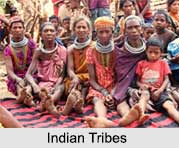
Indian Tribal Culture, Indian TribalsIndian Tribal Culture speaks about the diversity of the country. ‘Unity in diversity’ is one of the most spectacular features amongst the population of India. Tribal culture of India, their traditions and practices interpenetrate almost all the aspects of Indian culture and civilisation. India has traditionally been the home of different cultures and people. India’s tribal population is as different as the country itself. The different tribes in India if ever counted can move up to a mind boggling number, with all their ethnicities and impressions.

Customs and Traditions of Indian Tribal People
In India, culture and diversification amongst the tribal can also be admired from any land direction. Each of the tribes is a distinctive community, either migrated from a different place or the original denizens of the land. The speciality of the Indian tribes lies in their customscultures, beliefs and the harmony in which they survive in unanimity with nature. Tribal living perfectly portrays a well-balanced background.

Sentinelese tribe of Andaman is one of the most secret tribes existing in the world. They are fond of buckets, specifically red buckets. Jarawa Tribe of Andaman are still rooted in their tribal customs and traditions. They enjoy fish, pigs and other animals but wouldn't touch a deer as they consider deer sacred and they also change the names of their children post puberty. There is a detailed ritual held to celebrate, in which a boy has to search for a wild pig and present it to everyone in the village and a girl is rubbed in clay and pig oil. Chenchus in Andhra Pradesh speak a dialect of Telugu language known as ‘Chenchu’. Chenchu youths are free to marry whoever they want to and they agree to the divorce, and widows as well are approved to remarry.

For more, visit the link below:

Monday, 21 February 2022

Indian Scheduled Tribes


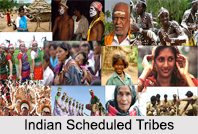
Indian Scheduled TribesIndian Scheduled Tribes are the group of tribal communities and was given the name ‘Scheduled Tribes’ during the post-Independence period, under the rule of Indian Constitution. Since the Independence of India, the Scheduled Tribes were given Reservation status. India can proudly be called the largest tribal population in the world. The scheduled tribes in India constituted 8.2 percent of India’s population, according to 2011 census. In all, 698 scheduled tribes exist at present in India.

The primary criteria adopted for delimiting Indian backward communities as Scheduled Tribes includes, traditional occupation of a definitive geographical area, characteristic culture that includes a whole range of tribal modes of life, i.e., language, customs, traditions, religious beliefs, arts and crafts, etc., archaic traits portraying occupational pattern, economy, etc., and lack of educational and economic development. The people in scheduled castes are essentially the lowest part of Hindu society.

Origin of Indian Scheduled Tribes
Scheduled Tribes in India, also referred to as Adivasis (original inhabitants), are spread all-over India. These various tribes resided in India long before the Aryans had arrived roughly during 1500 B.C.

Society of Indian Scheduled Tribes
More than 650 tribes that make up the Scheduled Tribes speak a multitude of languages. They are also religiously diverse, with some following animism, while others have adopted HinduismIslam or Christianity. The social traditions of most tribals make them stand out from the country’s mainstream Hindu population.

Revolutions of Indian Scheduled Tribes
The Indian scheduled tribes collectively owned property in keeping with their tradition. The colonial authorities had introduced a land administration where others infringed into traditional tribal lands on the grounds that such lands were ‘Terra Nullius’ meaning ‘no man’s land’. This led to a series of tribal revolts against British colonial rule. And these tribal revolts have been legendary in Indian history, referring to the Malpahariya uprising in 1772, the turbulence in Kutch in 1815 and 1832, the Bhil revolt of 1818, the uprising of the Mers in Rajputana in 1820, the rebellion of the Hos in Chota Nagpur in 1831, the uprising of the Khonds in Odisha in 1846 and the Santhal rebellion in Bihar in 1855. Heroes like Birsa Munda, Kanhu Santhal and Tantya Bhil stand out valiantly in the chronicles of Indian nationalism.

For more, visit the link below:

Thursday, 28 October 2021

Indian Tribal Languages


Indian Tribal LanguagesIndian subcontinent consists of an umpteen number of separate linguistic communities, at times sharing a common language and culture and again, at times standing in huge difference in dialects. It is already acknowledged that cosmopolitan and metropolitan populace possesses their indigenous sophisticated version of language and mode of communication. However, the point of interest in this context is the mode of utilisation of the language of tribes and tribal population in the country.

Tribal people make up 8.2 percent of the nation's total population, which adds to over 84 million people, according to the 2001 Indian census. Tribal people are essentially an aboriginal community residing in India, possessing their own customs and languages. With their own mellifluous and rational style of living, Indian tribesmen are almost secluded in their universe, cut off from the rest of 'civilised' society. As such, it has since long remained a point of much curiosity and research about the kind of daily life they lead, or the style of language they employ. Indeed, Indian tribal languages are perhaps the second most enamouring topic of daily discussion, with the first being accredited to tribal dance and jewellery.

Different Types of Indian Tribal Language
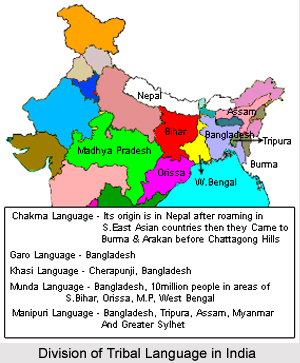
Indian tribal language can be defined as essentially 'folk' languages, possessing no literary specifications of their own and spoken by people of ethnic groups who prefer to live in relatively isolated groups. Indian tribal languages can simply be defined as the traditional languages utilised by the tribal folk. The languages used by tribal communities in India are indeed quite complex, but still priceless relics of India's past and nearly overshadowed glory. This is the precise reason why they are preserved orally in the form of songs, legends and other tales. Some of the leading tribal language-speaking groups comprise: Garo tribesChakma tribesNaga tribesGond tribesMizo tribesMunda tribes, Santhali tribes, Khasia tribesOraon tribes and the tribe of Manipur.

Some of the tribal languages prevalent in India are Abujmaria, Garo, Aariya, and Tsangla, Saurashtri etc.The Garo language is spoken by the tribal communities residing in and around Garo hillsMeghalyaTripura, Western Assam, and Nagaland. Several dialects of this language include Megam, Chisak, Atong etc. Another tribal language is Abujmaria which is spoken by the people of Abujmar hills in Bastar District. The Hill Maria tribal community uses this language as their medium to converse with their folks. This language is of Dravidian language family. Saurashtri is another tribal language which is also termed as Patnuli. Tribal communities residing in different parts of Andhra Pradesh, parts of Karnataka, North Arcot and Chennai speak in this language. Apart from these tribal languages, there are some other tribal languages namely Gadaba spoken by the people of Koraput district of Orissa. Aariya is another tribal language spoken by the tribal communities of Madhya Pradesh and Tsangla spoken in some villages of Arunachal Pradesh.

For more, visit the link below:

Monday, 12 July 2021

Indian Tribal Festivals


Indian Tribal FestivalsIndian tribal festivals have been a part of the framework of tribal India for hundreds of years. Even today this tradition continues. In all, the 573 tribal groups prevailing in the country possess their individual kind of festival. Indian tribal festivals possess a distinctive quality of their own, standing out from the other regular city festivals happening each other day. The tribal mode of celebrating, their costumes, jewellery, dancing, singing, language or the quaint ceremonious atmosphere in some far-off jungle or mountain, makes it all the more interesting. Beginning from Jammu and Kashmir in the north, to Kerala in the south, to Gujarat in the west and Manipur in the east, tribal festivals exist in each corner of states and even in union territories of Andaman and Nicobar IslandsDaman and Diu and Lakshadweep Islands. It can also be noticed that tribal festivals in India are mostly meant to appease the presiding God, depending upon their religious importance.

Tribal Festivals of Central India
Tribal festivals in Madhya Pradesh consist of varied mood and modes, making the whole affair a happy and enchanting one. Some of the legendary tribal festivals in Madhya Pradesh include Madai festival, Bhagoriya festival, the tribal Dussehra of Bastar, the religious festival of Karma, festival of Nagaji. Musical and dancing festivals of this central Indian state include heavy and intoxicated episodes, with the sounding of drumsflutes, tables, ghungroos. The Gonds, the Bhils and several other tribes occupy centre-stage. The interesting factor that can be observed here is that, the above-mentioned tribal festivals from Madhya Pradesh are also enjoyably celebrated in Chhattisgarh as well.

Tribal Festivals of Northern India
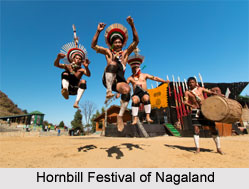
The states of Nagaland and Mizoram with its long list of tribes varying in lifestyle, celebrate festive occasions on several days and dates. Some of them include, the Mim kut festival by Kuki tribe, the Sekrenyi festival by Angami tribe, the Tsukhenyi festival by Chakasang tribe, the Aoling festival by Konayak tribe, the Monyu festival by Phom tribe, the Moatsu festival by Ao Naga tribe, the Miu festival by Khaimggan tribe, the Tulini festival by Sema Naga tribe, the Nyanyulum festival by Chang tribe, the Nazu festival by Pochury tribe, the Metemneo festival by Yimchunger tribe, the Amongmong festival by Sangtam tribe, the Tokhuemong festival by Lotha tribe, the Ngada festival by Rengma tribe, the renowned Hornbill festival by every Naga tribe and the Nga-Ngai festival by Zeliang tribe.Indian Tribal Festivals

Tribal Festivals of Eastern India
The annual Mansa festival in Jharkhand is a big affair for the tribal people in Panchparanga, wherein the tribals are seen to appease Goddess Manasa by piercing their body. Tribal festivals in Orissa are a lavish and magnanimous affair, with perhaps a significant mass of Indian population joining in the festivities. Some of the much talked-about tribal festivals include Bali Jatra by Koraput tribe, Karama festival observed by the Ho, Kisan, KolBhumijOraon, Bhuiyan and Binjhal tribes, the Sume-Gelirak festival by Bonda tribe of Koraput, Bija Pandu festival, also known as Chaitra Parva, observed by Koya tribe of Orissa, the Kedu festival of the Kondhs of Phulbani, Chaita Parva festival observed by tribes of Koraput and Bhuiyans and the Mage Parab festival of the Ho, Oraon, Kisan and Kol tribes.The Bohaggiyo Bishu tribal festival from Assam, observed by the Deori tribe, one of the four divisions of the Chutiyas is legendary within the tribal festivals included both in the state and India, with sublime implications. Sarhul is a festival of flowers and the most popular of all the tribal festivals in the country. The festival is observed by Mundas, Oraon and Santhal tribal communities, inhabiting in regions of Orissa, Jharkhand and Bihar.